
Cars BMW Cars Volkswagen Cars Chevrolet Cars Land Rover Cars Lada Cars Honda Cars Peugeot
English Русский
Български
Беларускі
Український
Српски
Hrvatski
Română
Polski
Slovenský
Magyar
Bookmark News and articles Sitemap Feedback Site search
MercedesMan.ru


A-Class C-Class E-Class G-Class M-Class S-Class Others
W116 (1972-1980, petrol) W126 (1979-1991, petrol) W140 (1991-1998) W220 (1998-2005)
  • Main
  • S-Class
  • W126 (1979-1991)
  • Chassis
  • Front suspension
  • Checking the shock absorber

Checking the shock absorber (Mercedes-Benz S-Class W126)

0
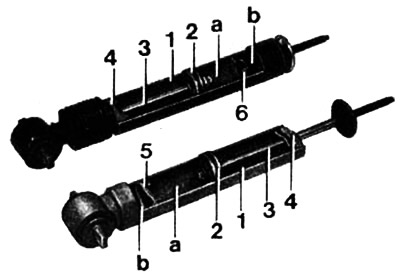
1. Cylinder. 2. Working piston. 3. Piston rod. 4. Sealing part with washer. 5. Separating piston.…

1. Cylinder. 2. Working piston. 3. Piston rod. 4. Sealing part with washer. 5. Separating piston. 6. Shock absorber disc. a. Oil chamber, b. Gas chamber


Note: The models in question can use gas shock absorbers with or without separator pistons. In gas shock absorbers with separator pistons between the gas and oil chambers, the piston rod is located at the top of the shock absorber, while in shock absorbers without separator pistons, it is located at the bottom of the shock absorber.


A knocking noise coming from the rear shock absorbers may be caused by the following reasons:

The upper shock absorber mount cushion is not installed correctly.

The rubber cushion of the lower shock absorber mount has come loose.

If there is significant oil loss, the separator piston may begin to hit the piston rod.

The working piston has become disconnected. Press the rod, release it and then press it again. If a knocking sound is heard when switching from the compression cycle to the rebound cycle, the shock absorber must be replaced.

Hissing sound from rear shock absorbers:

If the balance piston is not well sealed, gas can penetrate into the oil chamber, forming foam there, the presence of which is indicated by hissing sounds when driving. This defect requires replacement of the shock absorber, even if it still functions normally.


Checking shock absorbers removed from the car (front and back):

Remove the shock absorbers.

Carefully inspect the rods for surface damage.

Check the rods for bending. To do this, lay out the shock absorbers on a wooden surface in the order in which they were installed.

Insert the rods one by one. A bent rod will inevitably get stuck in the guide bushing.

Note: The thin film of oil on the piston rod is a factory issue.


Holding the shock absorber in its working position, slightly stretch it and then compress it. A serviceable shock absorber in both cycles gives a smooth, even ride without jamming.

If there are signs of oil leakage, the shock absorber must be replaced.

Checking the oil reserve:

To check the oil reserve, measure the piston rod clearance (a). When oil is lost, this clearance increases for shock absorbers with separating pistons, and decreases for shock absorbers without separating pistons.
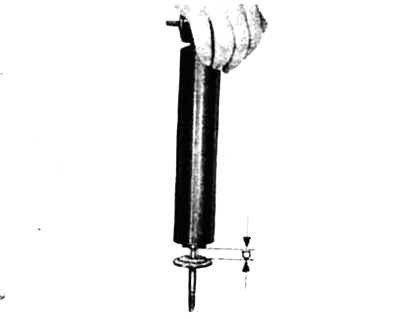
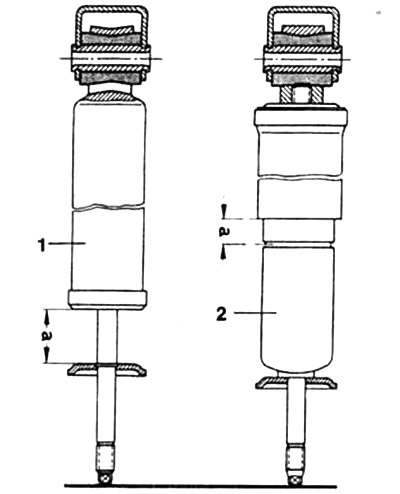
To check the oil reserve, measure the piston rod clearance (a). When oil is lost, this clearance…


To check the oil reserve, measure the piston rod clearance (a). When oil is lost, this clearance…


During this check the shock absorber temperature should be approximately 20°C.


Note: A thin film of oil on the piston rod is a factory occurrence and is not a sign of an oil leak.


Remove the rod and place it upside down on a flat surface.

Shock absorber with equalizing piston: press the rod so that the stop on the working piston reaches the separating piston. Measure the gap (a) and compare it with the specified value.

Shock absorber without separating piston: compress the shock absorber until a clearly defined resistance is felt, indicating that the piston has entered the cavity with oil. Holding the shock absorber in this position, measure the gap (a) and compare it with the specified value.

The picture shows two rear shock absorbers, the first of which (1) is made by Fichtel&Sachs, has markings of one or two transverse white lines. Shock absorber (2) (produced by Boge) marked with an oblique white line.
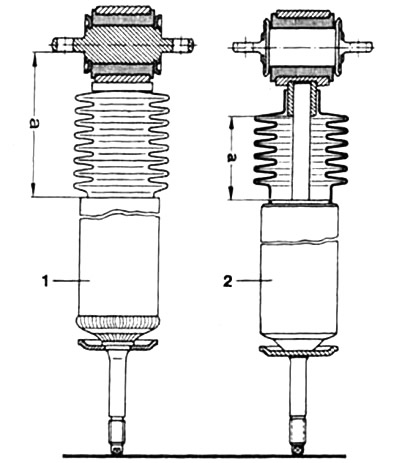
The picture shows two rear shock absorbers, the first of which (1) is made by Fichtel&Sachs, has…


Caution: The hissing sound that may be heard when the shock absorber is compressed is not a sign of any malfunction.


Shock absorberClearance "a" of piston rod, mm
newpermissible max value
With separating piston front and rear0±232
Without separator piston front and rear20±20
Fichtel&Sachs105±282
Water147±2137


Note: A shock absorber with a separating piston must be replaced if the maximum permissible value of the "a" value is exceeded, and a shock absorber without a separating piston - if the gap "a" value does not reach the maximum permissible value.


Further testing of shock absorbers requires special equipment and can only be performed at a service station.
This article is available at: russian, bulgarian, belarusian, ukrainian, serbian, croatian, romanian, polish, slovak, hungarian
The article has been verified: Burova Vera Semenovna
Share with friends:
◀ Previous
S-Class W126 / Front suspension
Next ▶

Front shock absorber — removal and installation
Description of the front suspension design
Front Coil Springs — Removal and Installation
Removal, installation and checking front wheel bearings
Adjusting the axial clearance of wheel bearings
Front and rear suspension specifications
Tightening torques for threaded connections
More similar articles for repairing other models

☛ Shock absorber strut — removal and installation Mercedes W168 (1997-2004)
☛ Why do you need a shock absorber? Mercedes W202 (1993-2000)
☛ Checking, removing and installing shock absorbers Mercedes W123 (1976-1985)
☛ Removal, checking and installation front shock absorbers Mercedes W463 (1999-2019)
☛ Removal, checking and installation front shock absorbers Mercedes W163 (1997-2005)
☛ Checking the condition of the rear shock absorber Mercedes Vito 2 (2003-2014, diesel)
Link in different formats to this article
Comments and feedback from visitors
No comments yet


How much will 26 + 36 ?


W220 (1998-2005) 
  • General information
  • Introduction to guide
  • User manual
  • Maintenance
  • Power unit
  • Engine repair
  • Cooling and heating systems
  • Power and exhaust systems
  • Ignition and control system
  • Charge and launch systems
  • Transmission
  • Automatic gearbox
  • Drive shafts
  • Chassis
  • Brake system
  • Front suspension
  • Rear suspension
  • Steering
  • Body
  • Body elements
  • Electrical equipment
  • Equipment and devices
  • Electrical circuits
W140 (1991-1998) 
  • User manual
  • Controls and instruments
  • Driving and operation
  • Maintenance
  • Power unit
  • Petrol engine V6
  • Petrol engine V8
  • Petrol engine V12
  • Diesel engine OM603
  • Diesel engine OM606
  • Cooling system
  • Power supply and injection system
  • Control system HFM-SFI
  • Control system LH-SFI
  • Control systems ME-SFI
  • Diesel control system
  • Ignition system
  • Charge and launch system
  • Transmission
  • Mechanical gearbox 717.438
  • Mechanical gearbox 717.454
  • Automatic gearbox 722.5
  • Automatic gearbox 722.6
  • Clutch and drive shafts
  • Differential
  • Chassis
  • Brake system
  • Steering
  • Front suspension
  • Rear suspension
  • Body
  • Exterior (external elements)
  • Interior (internal elements)
  • Electrical equipment
  • Equipment and devices
  • Electrical circuits
W126 (1979-1991, petrol) 
  • Power unit
  • Engine repair
  • Ignition system
  • Lubrication system
  • Cooling system
  • Fuel system
  • Fuel injection system
  • Transmission
  • Clutch and cardan
  • Mechanical gearbox
  • Automatic gearbox
  • Chassis
  • Front suspension
  • Rear suspension
  • Steering
  • Brake system
  • Electrical equipment
  • Power devices
  • Electrical circuits
W116 (1972-1980, petrol) 
  • General information
  • Introduction to guide
  • Power unit
  • 8-cylinder V8 engine
  • 6-cylinder I6 engine
  • Cooling and lubrication system
  • Power system (carburetor)
  • Fuel injection system
  • Ignition system
  • Transmission
  • Clutch and cardan
  • Car gearbox
  • Chassis
  • Front suspension
  • Rear suspension
  • Steering
  • Brake system
  • Electrical equipment
  • Power devices
  • Electrical circuits
 
MercedesMan.ru © 2017–2026 · Mobile version · Read about Mercedes · Sitemap: EN BG BY UA RS HR RO PL SK HU · Feedback · Site search · Bookmark A-Class (W168) · C-Class (W201) · C-Class (W202) · C-Class (W203) · E-Class (W123) · E-Class (W124) · E-Class (W210) · G-Class (W463) · M-Class (W163) · S-Class (W116, petrol) · S-Class (W126, petrol) · S-Class (W140) · S-Class (W220) · Sprinter · Vito 1 · Vito 2 · Vario 814D ·
 
We only use cookies without which some of the site's features may not be available.