



Support the car with stands and remove the wheel. Using a screwdriver, carefully press the brake pads away from the disc.
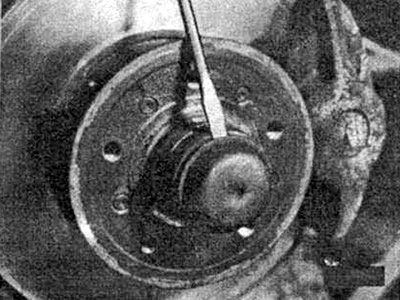
Pry up the hub cap with a wide screwdriver and remove it.
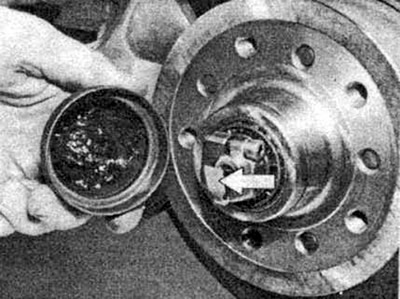
Remove the contact spring of the radio interference suppressor (see arrow).
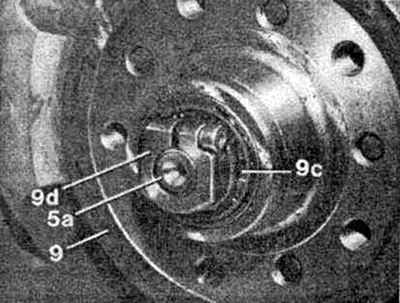
Loosen the clamp nut bolt (9d).
Tighten the hub (9) and nut simultaneously until the hub no longer moves. Then turn the nut back about 60' and release the tension by hitting the steering knuckle (5a) with a wooden hammer. The outer hub bearing (9c) is also shown in the figure.
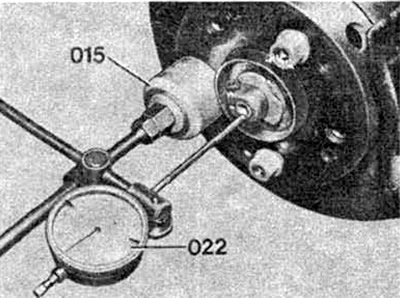
The axial clearance of the bearing is measured using a dial gauge and a suitable support. The nominal clearance value is 0.01-0.02 mm.
Set the dial gauge to a 2mm load. This will show a 2mm gap before testing even begins.
Measure the gap by pulling the brake disc hard and then pressing it. Before each measurement, rotate the hub several times.
Note: It may happen that the hub does not turn during the measurements. In the absence of special tools, the gap should be adjusted so that it is not felt at all. The gap will need to be checked in the workshop afterwards.
Tighten the clamp nut bolt and check the bearing axial clearance again.
Install the contact spring in place.
Apply approximately 15 g of high-temperature roller bearing grease to the hub cap. On vehicles manufactured before November 1982, remove the old grease from the cap and fill it with new grease.
Install the hub cap in place by tapping it lightly with a wooden hammer.
Replace the front wheel, lower the vehicle and tighten the wheel bolts in a diagonal pattern.