
Cars BMW Cars Volkswagen Cars Chevrolet Cars Land Rover Cars Lada Cars Honda Cars Peugeot
English Русский
Български
Беларускі
Український
Српски
Hrvatski
Română
Polski
Slovenský
Magyar
Bookmark News and articles Sitemap Feedback Site search
MercedesMan.ru


A-Class C-Class E-Class G-Class M-Class S-Class Others
W116 (1972-1980, petrol) W126 (1979-1991, petrol) W140 (1991-1998) W220 (1998-2005)
  • Main
  • S-Class
  • W140 (1991-1998)
  • Power unit
  • Cooling system
  • Cooling and Heating Systems — General Information

Cooling and Heating Systems — General Information (Mercedes-Benz S-Class W140)

0
Contents: Engine cooling system ↡ Heating and ventilation system ↡ Independent heater ↡

Engine cooling system


All models of the vehicles considered in this Manual are equipped with a positive pressure engine cooling system with thermostatic control of the working fluid circulation. The water pump is fixed to the engine block and pumps the coolant through the cooling tract of the latter. The flow of liquid washes the areas of each cylinder in the block, after which it is directed to the rear of the engine. Cooling channels laid in the block and cylinder head castings provide intensive cooling of the intake and exhaust ports, spark plug installation areas and exhaust valve guides.
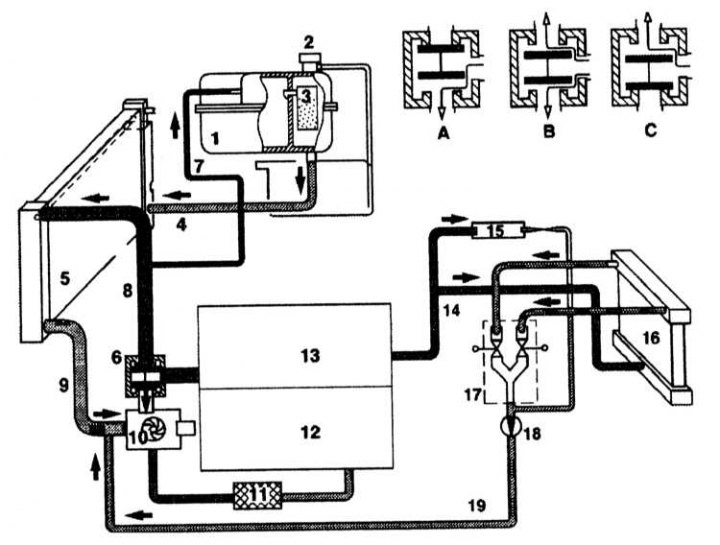
General diagram of the cooling system operation

General diagram of the cooling system operation
1 - Expansion tank; 2 - Lid; 3 - Built-in silica gel tank; 4 - Intake pipe; 5 - Radiator; 6 - Thermostat; 7 - Ventilation tube; 8 - Flow from engine to radiator; 9 - Flow from radiator to engine; 10 - Cooling system pump; 11 - Oil radiator; 12 - Cylinder block; 13 - Cylinder head; 14 - Heater delivery pipe; 15 - Windscreen washer heater; 16 - Heater radiator; 17 - Double pulsation valve; 18 - Circulation pump; 19 - Heater return pipe


From the moment the engine is started, the cooling system goes through three operating modes: at the first stage, until the coolant temperature rises above a certain value, it circulates in a small circle from the working circuit of which the radiator is excluded. As the liquid heats up further, the plate valve of the wax-filled thermostat entering the system tract opens and the radiator is connected to the circulation circuit. Then, when the coolant temperature reaches the next control value, a temperature-sensitive switch is triggered, activating the cooling system fan, the additional air flow pumped by it significantly increases the efficiency of the radiator heat exchanger.

The cooling system has a sealed design and is tightly closed with a radiator cap capable of withstanding a certain excess pressure, which increases the boiling point of the coolant and, accordingly, the efficiency of heat removal through the radiator. When the internal pressure in the system exceeds a certain value, excess coolant flows through the connecting (overflow) tube into the expansion tank. As the system cools, the liquid automatically returns from the tank to the radiator.

Adding coolant to the system is done through the neck of the expansion tank (see Chapter Routine maintenance) which simultaneously also acts as a receiver, accumulating the excess liquid displaced from the radiator.

Due to the listed design features, such a cooling system is called closed, since it excludes any functional losses of the working fluid.


Heating and ventilation system


The heating system consists of fans and heat exchangers located in the front and rear passenger compartment units. Hot coolant passes through the heat exchangers. When you move the heater control knob located on the control panel (for more details, see. Comfort Chapters User manual) the valves open and hot air begins to flow into the car's interior. If you turn on the heater fan, air will be forced into the interior.

Outside air passes through a filter before entering the passenger compartment (refer to Chapter Routine maintenance). The bulk of dust particles will settle in the filter. It is necessary to observe the frequency of filter replacement. A filter blocked by dust will limit the air supply to the cabin, which will lead to stagnation of air inside the cabin.

Distribution of air flows of the ventilation system is carried out using dampers. An air circulation mode is provided. The dampers are controlled using servo drives.

Independent heater


The standard equipment of some models may include an independent heater, which provides the ability to autonomously warm up the engine and the car interior using a timer signal or a remote control. The operating principle of the independent heater is discussed in Section Independent heater Chapters User manual.
This article is available at: russian, bulgarian, belarusian, ukrainian, serbian, croatian, romanian, polish, slovak, hungarian
The article has been verified: Polyakov Zakhar Grigorievich
Share with friends:
◀ Previous
S-Class W140 / Cooling system
Next ▶

 
Cooling and Heating System Specifications
Antifreeze is a means of protection against freezing
Coolant Replacement — General Notes
Removal and replacing cooling system hoses
Checking the proper functioning of the thermostat
More similar articles for repairing other models

☛ Checking the tightness of the cooling system Mercedes W168 (1997-2004)
☛ Cooling and Heating System Specifications Mercedes W203 (2000-2007)
☛ Design and specification of the cooling system Mercedes W123 (1976-1985)
☛ Cooling, Heating and Ventilation System Specifications Mercedes W463 (1999-2019)
☛ Removal and installation the control panel of the heating /… Mercedes W163 (1997-2005)
☛ Checking the level of liquid in the cooling system Mercedes Sprinter (1995-2000, diesel)
Link in different formats to this article
Comments and feedback from visitors
No comments yet


How much will 49 + 41 ?


W220 (1998-2005) 
  • General information
  • Introduction to guide
  • User manual
  • Maintenance
  • Power unit
  • Engine repair
  • Cooling and heating systems
  • Power and exhaust systems
  • Ignition and control system
  • Charge and launch systems
  • Transmission
  • Automatic gearbox
  • Drive shafts
  • Chassis
  • Brake system
  • Front suspension
  • Rear suspension
  • Steering
  • Body
  • Body elements
  • Electrical equipment
  • Equipment and devices
  • Electrical circuits
W140 (1991-1998) 
  • User manual
  • Controls and instruments
  • Driving and operation
  • Maintenance
  • Power unit
  • Petrol engine V6
  • Petrol engine V8
  • Petrol engine V12
  • Diesel engine OM603
  • Diesel engine OM606
  • Cooling system
  • Power supply and injection system
  • Control system HFM-SFI
  • Control system LH-SFI
  • Control systems ME-SFI
  • Diesel control system
  • Ignition system
  • Charge and launch system
  • Transmission
  • Mechanical gearbox 717.438
  • Mechanical gearbox 717.454
  • Automatic gearbox 722.5
  • Automatic gearbox 722.6
  • Clutch and drive shafts
  • Differential
  • Chassis
  • Brake system
  • Steering
  • Front suspension
  • Rear suspension
  • Body
  • Exterior (external elements)
  • Interior (internal elements)
  • Electrical equipment
  • Equipment and devices
  • Electrical circuits
W126 (1979-1991, petrol) 
  • Power unit
  • Engine repair
  • Ignition system
  • Lubrication system
  • Cooling system
  • Fuel system
  • Fuel injection system
  • Transmission
  • Clutch and cardan
  • Mechanical gearbox
  • Automatic gearbox
  • Chassis
  • Front suspension
  • Rear suspension
  • Steering
  • Brake system
  • Electrical equipment
  • Power devices
  • Electrical circuits
W116 (1972-1980, petrol) 
  • General information
  • Introduction to guide
  • Power unit
  • 8-cylinder V8 engine
  • 6-cylinder I6 engine
  • Cooling and lubrication system
  • Power system (carburetor)
  • Fuel injection system
  • Ignition system
  • Transmission
  • Clutch and cardan
  • Car gearbox
  • Chassis
  • Front suspension
  • Rear suspension
  • Steering
  • Brake system
  • Electrical equipment
  • Power devices
  • Electrical circuits
 
MercedesMan.ru © 2017–2026 · Mobile version · Read about Mercedes · Sitemap: EN BG BY UA RS HR RO PL SK HU · Feedback · Site search · Bookmark A-Class (W168) · C-Class (W201) · C-Class (W202) · C-Class (W203) · E-Class (W123) · E-Class (W124) · E-Class (W210) · G-Class (W463) · M-Class (W163) · S-Class (W116, petrol) · S-Class (W126, petrol) · S-Class (W140) · S-Class (W220) · Sprinter · Vito 1 · Vito 2 · Vario 814D ·
 
We only use cookies without which some of the site's features may not be available.