



Note: See also Section Checking the functioning of the cooling system and frost resistance of the coolant, replacing the liquid in the Chapter Routine maintenance
Caution! Avoid contact of antifreeze with exposed areas of the body and painted surfaces of the vehicle.
Any accidental splashes should be washed off immediately with plenty of water.
Remember that antifreeze is a highly toxic liquid and its ingestion into the body, even in small quantities, can have the most serious consequences, including death.
Never leave antifreeze stored in a loosely closed container; immediately collect any coolant spilled on the floor.
Remember that the sweet smell of antifreeze can attract the attention of children and animals.
Consult with your local authorities about methods of disposal of used coolant - in many regions of the world there are special collection points for various types of waste.
Never pour old coolant down the drain or onto the ground!
Warning! Drained coolant must not be reused. Coolant is toxic and must not be disposed of with household waste.
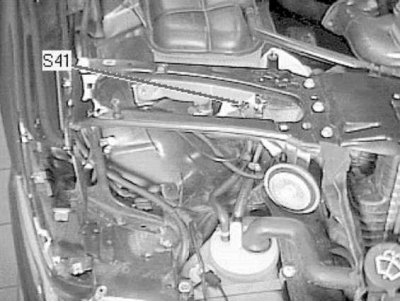
The coolant level switch is located at the bottom of the expansion tank on the right side of the engine compartment
The coolant must be replaced when the cooling system is repaired, in which the liquid is drained. In the event that the cylinder head, cylinder block, cylinder head gasket, radiator, heat exchanger or engine are replaced during repair, the coolant must be replaced with new one. During the circulation process, anti-corrosion additives are deposited on new light metal parts and thus form a durable anti-corrosion layer. The anti-corrosion additive in the used coolant is usually not sufficient to form a sufficient protective layer on new parts.
Descriptions of fluid replacement procedures are provided in Chapter Routine maintenance.