



Caution! Avoid contact of antifreeze with exposed areas of the body and painted surfaces of the vehicle.
Any accidental splashes should be washed off immediately with plenty of water.
Remember that antifreeze is a highly toxic liquid and its ingestion into the body, even in small quantities, can have the most serious consequences, including death.
Never leave antifreeze stored in a loosely closed container; immediately collect any coolant spilled on the floor.
Remember that the sweet smell of antifreeze can attract the attention of children and animals.
Consult your local authorities about methods of disposal of used coolant - in many regions of the world there are special collection points for various types of waste. Never pour old coolant into the sewer or onto the ground!
Note: Non-toxic grades of antifreeze have been developed in recent years, but they must still be disposed of in an orderly manner.
Coolant
The cooling system is filled with a mixture of water, antifreeze and anticorrosive agent all year round. This prevents rust and corrosion, salt deposits and, in addition, increases the boiling point of the coolant. In the cooling system, due to the expansion of the liquid when heated, excess pressure is created, which also leads to an increase in the boiling point of the coolant.
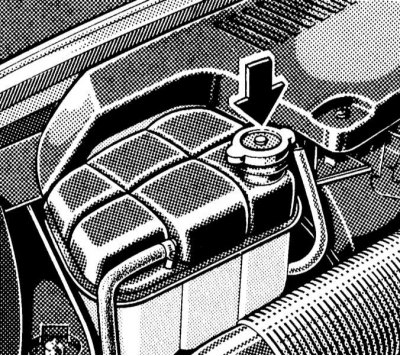
The pressure is limited by a valve located in the expansion tank cap, which opens at a pressure of 1.4-1.6 bar.
For the engine cooling system to function properly, a high boiling point of the coolant is required. At a low boiling point, a vapor lock may form, resulting in reduced fluid circulation and deterioration of engine cooling. Therefore, the cooling system must be filled with a mixture of water and the listed additives all year round.