
Cars BMW Cars Volkswagen Cars Chevrolet Cars Land Rover Cars Lada Cars Honda Cars Peugeot
English Русский
Български
Беларускі
Український
Српски
Hrvatski
Română
Polski
Slovenský
Magyar
Bookmark News and articles Sitemap Feedback Site search
MercedesMan.ru


A-Class C-Class E-Class G-Class M-Class S-Class Others
W463 (1999-2019)
  • Main
  • G-Class
  • W463 (1999-2019)
  • Power unit
  • Cooling system
  • Antifreeze is a means of protection against freezing

Antifreeze is a means of protection against freezing (Mercedes-Benz G-Class W463)

0

Antifreeze - a means of protection against freezing


Warning! Do not allow antifreeze to come into contact with exposed areas of the body or painted surfaces of the vehicle. Wash away accidental splashes immediately with plenty of water. Remember that antifreeze is a highly toxic liquid and its ingestion, even in small quantities, can have the most serious consequences, including death. Never leave antifreeze stored in a loosely closed container; immediately collect any coolant spilled on the floor. Remember that the sweet smell of antifreeze can attract the attention of children and animals. Consult with local authorities about methods of disposal of used coolant - in many regions of the world, special collection points for various types of waste have been set up. Never pour old coolant into the sewer or onto the ground!


Note: Non-toxic grades of antifreeze have been developed in recent years, but they must still be disposed of in an orderly manner.


Coolant


Note: To prevent blockage of the radiator by corrosion products of aluminum components, it is recommended to fill the radiator with a mixture of special antifreeze/corrosion inhibitor (KFM) and distilled water. Mercedes-Benz has approved KFM "TYPE 30" for use.
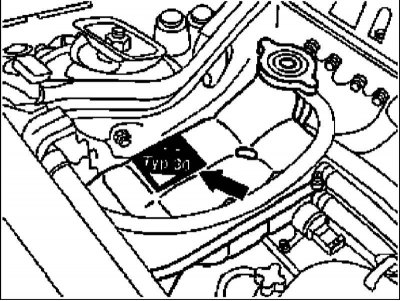

Mercedes-Benz has approved the use of antifreeze/corrosion inhibitor (KFM) «TYPE 30»

Mercedes-Benz has approved the use of antifreeze/corrosion inhibitor (KFM) "TYPE 30"


The cooling system is filled with a mixture of water, antifreeze and anticorrosive agent all year round. This prevents rust and corrosion, salt deposits and, in addition, increases the boiling point of the coolant. In the cooling system, due to the expansion of the liquid when heated, excess pressure is created, which also leads to an increase in the boiling point of the coolant. The pressure is limited by a valve located in the expansion tank cap, which opens under pressure 1.4÷1.6 atm. Additional efficiency of the cooling system is ensured by increasing the boiling point of the coolant. Exceeding the boiling point leads to the formation of vapor locks, which disrupt the normal circulation of liquid in the cooling tract.

[Original can be found on the website: MercedesMAN.ru]

Taking this into account, only the required mixture should be used to fill the cooling system at any time of the year (see Specifications).
This article is available at: russian, bulgarian, belarusian, ukrainian, serbian, croatian, romanian, polish, slovak, hungarian
The article has been verified: Polyakov Zakhar Grigorievich
Share with friends:
◀ Previous
G-Class W463 / Cooling system
Next ▶

Cooling, Heating and Ventilation System Specifications
Coolant Replacement — General Notes
Checking the cooling system cap, replacing the hoses
Checking the Thermostat
Removal and installation the thermostat
Removal and installation the cooling system radiator
More similar articles for repairing other models

☛ Mudguard (protection) of the bottom — removal and installation Mercedes W168 (1997-2004)
☛ Antifreeze is a means of protection against freezing Mercedes W203 (2000-2007)
☛ Engine overload protection system Mercedes W124 (1984-1995)
☛ Antifreeze is a means of protection against freezing Mercedes W163 (1997-2005)
☛ Antifreeze is a means of protection against freezing Mercedes W140 (1991-1998)
☛ Antifreeze — General Information Mercedes Sprinter (1995-2000, diesel)
Link in different formats to this article
Comments and feedback from visitors
No comments yet


How much will 33 + 29 ?


W463 (1999-2019) 
  • General information
  • Introduction to the guide
  • Controls and instruments
  • Driving and operation
  • Maintenance
  • Power unit
  • Engine repair
  • Cooling system
  • Heating and ventilation
  • Power system (gasoline)
  • Fuel system (diesel)
  • Exhaust system
  • Ignition and control system
  • Charging and starting system
  • Transmission
  • Automatic gearbox
  • Transfer case
  • Axles front and rear
  • Chassis
  • Brake system
  • Front suspension
  • Rear suspension
  • Steering
  • Body
  • Exterior (external elements)
  • Interior (internal elements)
  • Doors, locks and windows
  • Electrical equipment
  • Equipment and devices
  • Switches in salon
  • Headlights and lighting
  • Audio system and navigation
  • Electrical circuits
 
MercedesMan.ru © 2017–2026 · Mobile version · Read about Mercedes · Sitemap: EN BG BY UA RS HR RO PL SK HU · Feedback · Site search · Bookmark A-Class (W168) · C-Class (W201) · C-Class (W202) · C-Class (W203) · E-Class (W123) · E-Class (W124) · E-Class (W210) · G-Class (W463) · M-Class (W163) · S-Class (W116, petrol) · S-Class (W126, petrol) · S-Class (W140) · S-Class (W220) · Sprinter · Vito 1 · Vito 2 · Vario 814D ·
 
We only use cookies without which some of the site's features may not be available.