



Contents: Checking the lid ↡ Replacing hoses ↡
Checking the lid
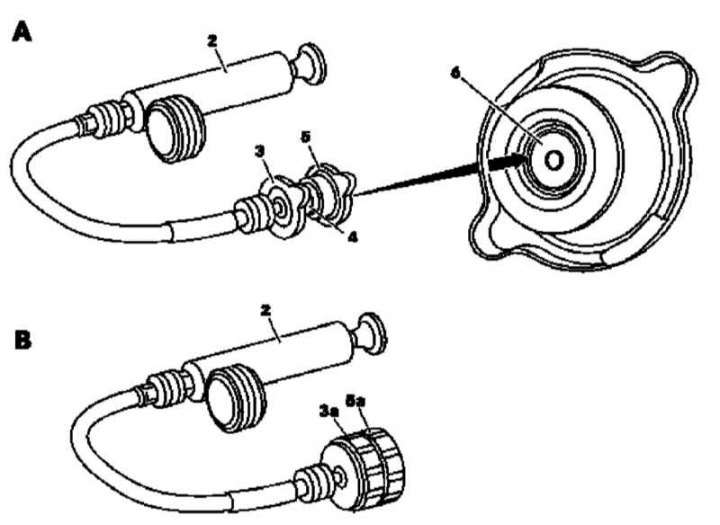
Checking the cooling system cap
A - Bayonet type cover; 2 - Tester; 3 - Nozzle cover; 4 - Nozzle; 5 - Cooling system cover; 6 - Pressure reducing valve; B - Threaded type cover; 2 - Tester; 3a - Nozzle; 5a - Cooling system cover
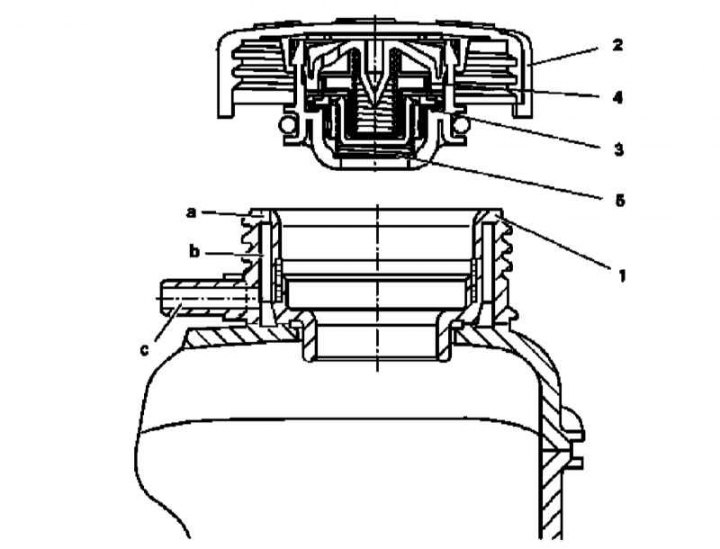
Two-stage type threaded cap design
1 - Expansion tank neck; 2 - Cooling system cover; 3 - Lower pressure reducing valve; 4 - Upper pressure reducing valve; 5 - Vacuum valve; a - Ventilation drilling; b - Annular recess; c - Bleed nipple
1. After letting the engine cool down, carefully open the cooling system cap - the cap can be of a bayonet (A) or threaded (B) design: the former is used on petrol models, the latter - on diesel models. It makes sense to dwell in a little more detail on the operating principle of the threaded cap used on models equipped with a 612 series engine. The cap is opened in two steps: when the pressure in the system increases to the first control value, the lower pressure-reducing valve built into the cap opens, providing access to the inner chamber of the cap. With a further increase in pressure, the upper pressure-reducing valve is triggered and the pressure is released through special ventilation holes in the neck of the expansion tank - excess gas phase enters the annular groove of the neck and then through the outlet nipple into the atmosphere. This design prevents overfilling of the expansion tank.
Bayonet type cap
1. Connect the nozzle (4) with the cover (3) to the tester (2).
2. Connect the cooling system cover (5) to the nozzle (4).
3. Having created the required pressure (see Specifications), make sure that the pressure reducing valve (6) operates properly - the valve should press tightly against the rubber seal (arrow) and rise slightly when the spring is released.
4. Replace the faulty cover.
Two-stage type threaded cap
1. Connect the nozzle (3a) to the tester (2).
2. Screw the cooling system cover (5a) onto the nozzle.
3. Having pumped up the required pressure (see Specifications), make sure that both pressure reducing valves operate properly.
4. Replace the faulty cover.
Replacing hoses
Note: See also Sections Checking the condition and replacing engine compartment hoses, localizing leaks and Checking the functioning of the cooling system and frost resistance of the coolant, replacing the liquid.
1. Identified during the inspection of the condition of the components of the cooling system (see Chapter Routine care and maintenance) damaged hoses must be replaced without fail.
Original material on the website MERCEDESMAN.ru
2. Drain the cooling system (see Chapter Routine care and maintenance).
3. Loosen and move aside the fastening clamps. Carefully remove the hose from the inlet pipes. If the hose does not come off, try to rotate it, trying not to damage the pipe, the breakage of which is fraught with significant costs - remember that radiator pipes are quite fragile components! If the hose does not give in, it must be cut - the cost of a new hose is incomparable with the cost of purchasing a replacement radiator. Before cutting the hose, prepare a replacement element of a suitable size.
4. When installing a new hose, first put the clamps on it, then install the hose on the nozzles. If the clamps were originally of the compression type, replace them with screw/worm type. To facilitate the installation of rigid hoses, wet the inner surfaces of their ends with soapy water or heat them in hot water - to avoid delamination, do not lower the hose into boiling water.
5. After installing the hose on the pipes, check that it is correctly laid in the engine compartment. Install clamps on the ends of the hose, placing them behind the flared pipes, and tighten them.
6. Fill the cooling system (see Chapter Routine care and maintenance).
7. Start the engine and check for signs of coolant leaks from the serviced unit.