



Contents: Petrol models ↡ Diesel models ↡
Petrol models
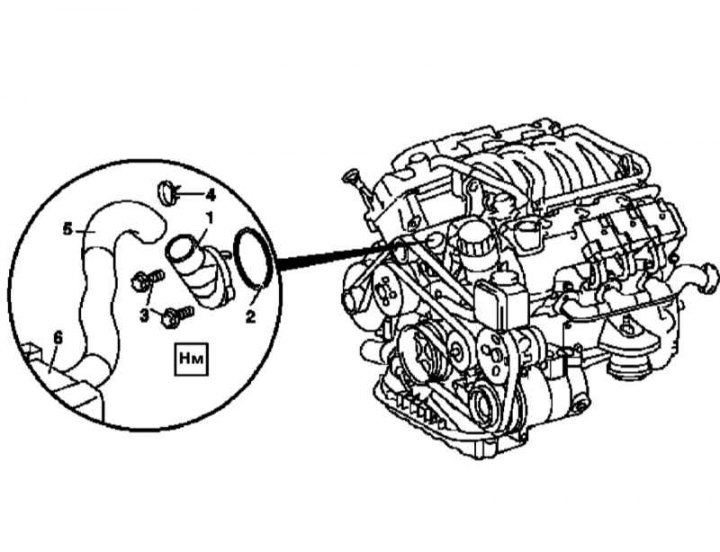
Installation details of thermostat assembly on petrol engines
1 - Thermostat housing; 2 - Sealing ring; 3 - Mounting bolts; 4 - Clamp; 5 - Cooling tract hose; 6 - Radiator
1. Drain the cooling system (see Chapter Routine care and maintenance).
2. Remove the powertrain trim panel/air cleaner assembly.
3. Disconnect the cooling system hose (5).
4. Unscrew the mounting bolts (3) and remove the thermostat housing (1) together with the working element.
Attention! To avoid irreversible damage, the working element should not be removed from the cover - if necessary, the element is replaced together with the latter!
5. Installation is carried out in the reverse order. Do not forget to replace the sealing ring (2), make sure that the fasteners are tightened with the required force.
6. Finally, check the cooling system for signs of developing leaks.
Diesel models
M612
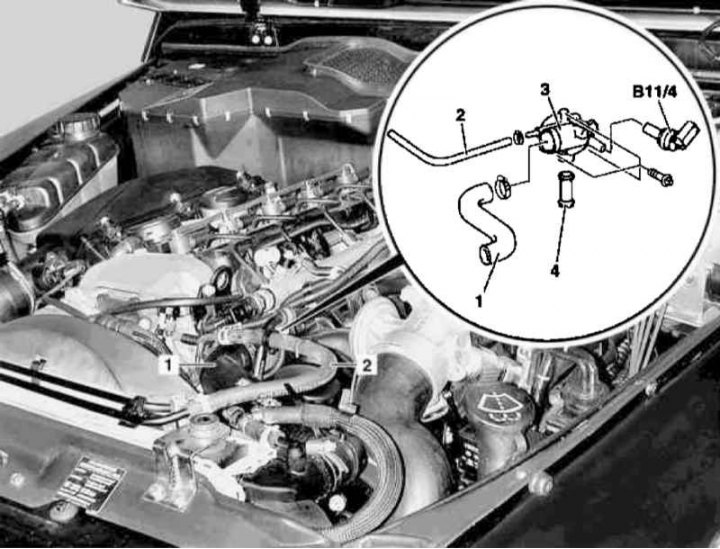
Thermostat and Coolant Temperature Sensor Installation Details for a 612 Series Diesel Engine
1 - Cooling tract hose; 2 - Ventilation hose; 3 - Thermostat housing; 4 - Connecting nipple; B11/4 - Coolant temperature sensor
1. Remove the crankcase guard.
2. Drain the cooling system (see Chapter Routine care and maintenance).
3. Remove the cylinder head cover trim panels.
4. Disconnect the electrical wiring from the coolant temperature sensor (B11/4).
5. Disconnect the cooling (1) and ventilation (2) lines from the thermostat housing (3) - check the condition of the fastening clamps, prepare a replacement if necessary.
6. Remove the thermostat housing (3), pay attention to the installation position of the connecting nipple (4), prepare a new sealing gasket.
7. Installation is carried out in reverse order.
8. Finally, check the cooling system for signs of developing leaks.
M628
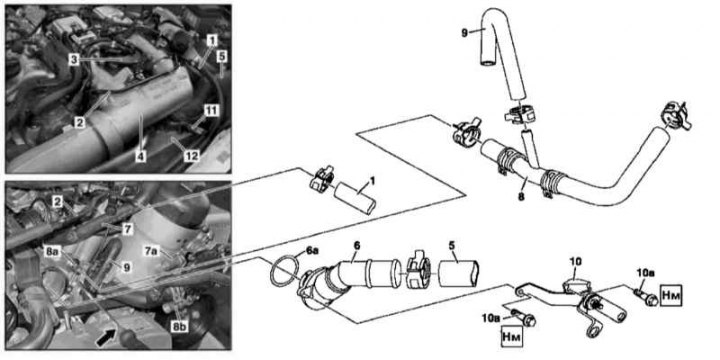
Thermostat installation details on a 628 series diesel engine
1 - Cooling tract hose (ventilation); 2 - Ventilation line; 3 - Fuel filter; 4 - Upper air duct; 5 - Cooling tract hose; 6 - Thermostat housing; 6a - Sealing ring; 7 - Cooling tract hose; 7a - Connecting nipple on the oil filter housing; 8 - Cooling tract line; 8a - Connecting nipple on the engine crankcase; 8b - Connecting nipple on the oil filter housing; 9 - Cooling tract hose; 10 - Charge air cooler support bracket; 10a - Bolts; 11 - Cooling tract hose; 12 - Charge air cooler
1. Jack up the car and place it on supports.
2. Drain the cooling system (see Chapter Routine care and maintenance).
3. Remove the air cleaner.
4. Remove the cooling fan shroud (see Section Removal and installation the cooling system fan assembly).
5. Install the air conditioning radiator/condenser protection screen (a metal or plastic plate measuring 400x680x1 mm equipped with a suitable support bracket).
6. Remove the fuel filter (3) (see Chapter Routine care and maintenance), - it would be wise to replace the filter when installing.
7. Disconnect the cooling tract hose (1) from the ventilation line (2) - check the condition of the fastening clamp, prepare a replacement if necessary.
8. Disconnect the cooling tract hose (11) from the charge air cooler (12), check the condition of the mounting clamp, prepare a replacement if necessary.
9. Remove the throttle actuator assembly with the upper air duct (4).
10. Disconnect the cooling system hose (5) from the thermostat housing (6) - check the condition of the mounting clamp, prepare a replacement if necessary.
11. Disconnect the cooling tract hose (7) from the fitting (7a) of the crankcase ventilation system control valve - check the condition of the mounting clamp, prepare a replacement if necessary.
12. Disconnect from the fittings (8a and 8b) and the hose (9), remove the cooling tract line (8).
13. Remove the support bracket (10) of the charge air cooler - in order to provide access to the mounting bolt (10a), use a screwdriver (arrow) to pry the hose (9) to the side.
14. Remove the thermostat housing (6) together with the working element.
15. Installation is carried out in reverse order.
16. Finally, check the cooling system for signs of developing leaks.