
Cars BMW Cars Volkswagen Cars Chevrolet Cars Land Rover Cars Lada Cars Honda Cars Peugeot
English Русский
Български
Беларускі
Український
Српски
Hrvatski
Română
Polski
Slovenský
Magyar
Bookmark News and articles Sitemap Feedback Site search
MercedesMan.ru


A-Class C-Class E-Class G-Class M-Class S-Class Others
W123 (1976-1985) W124 (1984-1995) W210 (1996-2002)
  • Main
  • E-Class
  • W210 (1996-2002)
  • Transmission
  • Automatic gearbox
  • Checking the automatic transmission

Checking the automatic transmission (Mercedes-Benz E-Class W210)

0
Contents: Checking the switching process ↡ Checking the oil level in the…↡ Transmission oil condition ↡
The list of possible independent actions to check the functionality and repair the automatic transmission is very limited even for experienced motorists. This requires a special tool and experience in this area. Therefore, even at service stations, adjustment and repair of the automatic transmission is entrusted only to well-trained specialists. Below are simple recommendations for timely detection of faults:
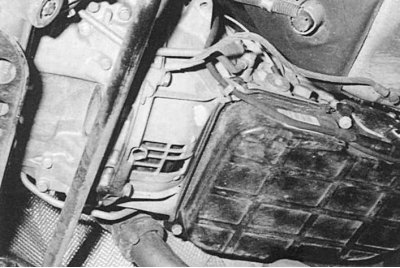
Fig. 6.13. If the transmission fluid level drops, look under the car. Oil stains on the automatic…

Fig. 6.13. If the transmission fluid level drops, look under the car. Oil stains on the automatic transmission housing will indicate the cause of the leak


1. In case of any automatic transmission failures, first check the transmission fluid level (Fig. 6.13).

2. During a test drive, check the switching points. There are special tables for this at the service station.

3. Correct adjustment of the linkage system between the automatic transmission and the accelerator is an important component of proper operation.

4. Measuring the pump operating pressure, regulation pressure and modulation pressure is a task for specialists. Some pressure values can be adjusted.


Information copied from the website: MercedesMan.ru

5. For a correct assessment of the switching process, the idle speed must correspond to the norm.

Checking the switching process


When driving, pay attention to the automatic transmission: is it working properly? The gear shifting process gives an idea of the condition of the unit.


Shifting to higher gears. When the accelerator pedal is partially depressed, the gear change is not very noticeable. In the "full throttle" ("Kick-down") the shifts are more noticeable, but the shift to a higher gear is still smooth. A short revving of the engine to high revs when shifting indicates a possible malfunction.

Downshifting. Downshifts should be barely noticeable at low speeds (foot removed from accelerator pedal). A jerk during forced downshifting with the accelerator pedal fully or partially depressed is normal. Downshifting with the selector lever with the accelerator pedal released occurs with a delay of 1–2 s. If, however, during forced downshifting with the selector lever you simultaneously add "gas", the shift will occur without a delay.

Checking the oil level in the automatic transmission


The check is usually carried out after an oil change or if a leak is suspected. The prescribed oil level in the automatic transmission is very important for its flawless operation, so the check should be carried out with special care:


1. When the oil level is low the clutches do not close tightly enough and slip because the oil hydraulic pump captures air. The resulting foaming causes premature wear of the automatic transmission parts. In addition, the oil decomposes, becomes resinous, and sediment forms in it.

2. When the oil level is high there is increased contact of oil with gearbox parts, causing it to overheat. This leads to the same consequences as when air is sucked in due to a low level.

The transmission fluid filler hole is located in the engine compartment. The fluid level is checked through it using a dipstick.

Sequence of works


1. Apply the parking brake and move the automatic transmission selector lever to the "P" position.

2. Start the engine and let it idle for 1–2 minutes.
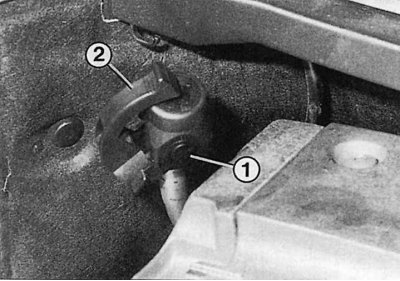
Fig. 6.14. Checking the oil level in the automatic transmission: 1 – transmission fluid level…

Fig. 6.14. Checking the oil level in the automatic transmission: 1 – transmission fluid level dipstick (located on the rear right side of the cylinder head); 2 – closing clamp


3. Remove the closing clip 2 (Fig. 6.14) above the dipstick 1, pull out the dipstick and wipe it with a lint-free cloth.

4. To measure the level, insert the dipstick with the marking facing the back (then when you pull out the dipstick the reading will not be blurred).

5. At the operating temperature of the automatic transmission (about +80°C), the oil level should be between the "MIN" and "MAX" marks.

6. When the automatic transmission temperature is about +25°C, the oil level should be no lower than 12 mm from the "MIN" mark.

7. Check the condition of the oil by color and smell - both signs allow you to judge the condition of the automatic transmission.

8. If necessary, add transmission oil. Its amount should not exceed the required level. The volume of oil between two divisions is 0.3 l. In case of overflow, pump out or drain excess oil.

Transmission oil condition


1. Clean, red color - the oil condition is normal.

2. Burnt and darkened - the clutches are burnt. The automatic transmission must be replaced, the oil lines and oil radiator must be flushed.

3. Presence of solid particles in oil (metal particles) – The automatic transmission needs to be replaced.

4. Resinous and sticky oil - the automatic transmission was often overheated. Dismantling and overhaul are necessary.
This article is available at: russian, bulgarian, belarusian, ukrainian, serbian, croatian, romanian, polish, slovak, hungarian
The article has been verified: Polyakov Zakhar Grigorievich
Share with friends:
◀ Previous
E-Class W210 / Automatic gearbox
Next ▶

Selector lever positions
Torque Converter — General Description
How an automatic transmission works
Automatic transmission — general description
Possible malfunctions of automatic transmission, their causes and methods of elimination
More similar articles for repairing other models

☛ Automatic transmission Mercedes W168 (1997-2004)
☛ Checking the oil level in an automatic transmission Mercedes W202 (1993-2000)
☛ Starting the movement and switching the automatic transmission Mercedes W463 (1999-2019)
☛ Automatic transmission specifications Mercedes W163 (1997-2005)
☛ Checking the Automatic Transmission Oil Level Mercedes W220 (1998-2005)
☛ Checking the automatic transmission Mercedes Sprinter (1995-2000, diesel)
Link in different formats to this article
Comments and feedback from visitors
No comments yet


How much will 18 + 20 ?


W210 (1996-2002) 
  • General information
  • Vehicle description
  • Working conditions and tools
  • Car care
  • Diesel engines
  • Engine repair
  • Lubrication system
  • Cooling system
  • Injection system
  • Supply system
  • Exhaust system
  • Gasoline engines
  • Engine repair
  • Lubrication system
  • Cooling system
  • Control system
  • Power and exhaust system
  • Transmission
  • Clutch
  • Mechanical gearbox
  • Automatic gearbox
  • Drive shafts
  • Chassis
  • Car suspension
  • Steering
  • Tires and wheels
  • Brake system
  • Body
  • Exterior (external elements)
  • Interior (internal elements)
  • Doors and windows
  • Heating and ventilation
  • Electrical equipment
  • Equipment and devices
  • Power devices
  • Lighting and signaling
  • Electrical circuits
W124 (1984-1995) 
  • General information
  • Governing bodies
  • Driving and operation
  • Weekly care
  • Maintenance (gasoline)
  • Maintenance (diesel)
  • Troubleshooting
  • Power unit
  • I4 petrol engine
  • V6 petrol engine (SOHC)
  • V6 petrol engine (DOHC)
  • Diesel engines
  • Engine overhaul
  • Cooling system
  • Heating and ventilation
  • Fuel system (carburetor)
  • Injection system «Bosch CIS-E»
  • Injection system «Bosch HFM»
  • Diesel fuel system
  • Supply system
  • Starting and charging system
  • Ignition system (I4)
  • Ignition system (V6)
  • Preheating
  • Transmission
  • Clutch
  • Mechanical gearbox
  • Automatic gearbox
  • Drive shafts
  • Chassis
  • Brake system
  • Car suspension
  • Steering
  • Body
  • Exterior (external elements)
  • Interior (internal elements)
  • Doors, locks and windows
  • Electrical equipment
  • Equipment and devices
  • Switches
  • Headlights and lighting
  • Electrical circuits
W123 (1976-1985) 
  • General information
  • Introduction to the guide
  • Power unit
  • Engine device
  • Repair M102 engines
  • Repair M110 and M123 engines
  • Cooling and lubrication (M102)
  • Cooling (M110 and M123)
  • Ignition system
  • Power system «Stromberg»
  • Power system «Solex 4A1»
  • Fuel injection «K-Jetronic»
  • Fuel injection «L-Jetronic»
  • Transmission
  • Clutch
  • Mechanical gearbox
  • Automatic gearbox
  • Cardan and rear axle
  • Chassis
  • Front suspension
  • Rear suspension
  • Steering
  • Brake system
  • Body
  • Exterior (external elements)
  • Interior (internal elements)
  • Doors, locks and windows
  • Electrical equipment
  • Equipment and devices
  • Power devices
  • Electrical circuits
 
MercedesMan.ru © 2017–2026 · Mobile version · Read about Mercedes · Sitemap: EN BG BY UA RS HR RO PL SK HU · Feedback · Site search · Bookmark A-Class (W168) · C-Class (W201) · C-Class (W202) · C-Class (W203) · E-Class (W123) · E-Class (W124) · E-Class (W210) · G-Class (W463) · M-Class (W163) · S-Class (W116, petrol) · S-Class (W126, petrol) · S-Class (W140) · S-Class (W220) · Sprinter · Vito 1 · Vito 2 · Vario 814D ·
 
We only use cookies without which some of the site's features may not be available.