
Cars BMW Cars Volkswagen Cars Chevrolet Cars Land Rover Cars Lada Cars Honda Cars Peugeot
English Русский
Български
Беларускі
Український
Српски
Hrvatski
Română
Polski
Slovenský
Magyar
Bookmark News and articles Sitemap Feedback Site search
MercedesMan.ru


A-Class C-Class E-Class G-Class M-Class S-Class Others
W123 (1976-1985) W124 (1984-1995) W210 (1996-2002)
  • Main
  • E-Class
  • W210 (1996-2002)
  • Diesel engines
  • Exhaust system
  • Reducing toxicity of exhaust gases

Reducing toxicity of exhaust gases (Mercedes-Benz E-Class W210)

0
Contents: Exhaust gases ↡ Improved exhaust gas parameters…↡ Exhaust Gas Recirculation (AGR) ↡
Fuel combustion in a diesel engine is economical due to the high density and excess air and - with reservations - environmentally friendly. The exhaust gases contain only a small amount of carbon monoxide (CO) and nitrogen oxide (NOx). Even if diesel engines can be rated as better in terms of CO, HC and NOx emissions compared to petrol engines, there are disadvantages. For example, soot emissions (particles) and sulphur dioxide (SO ₂) content.

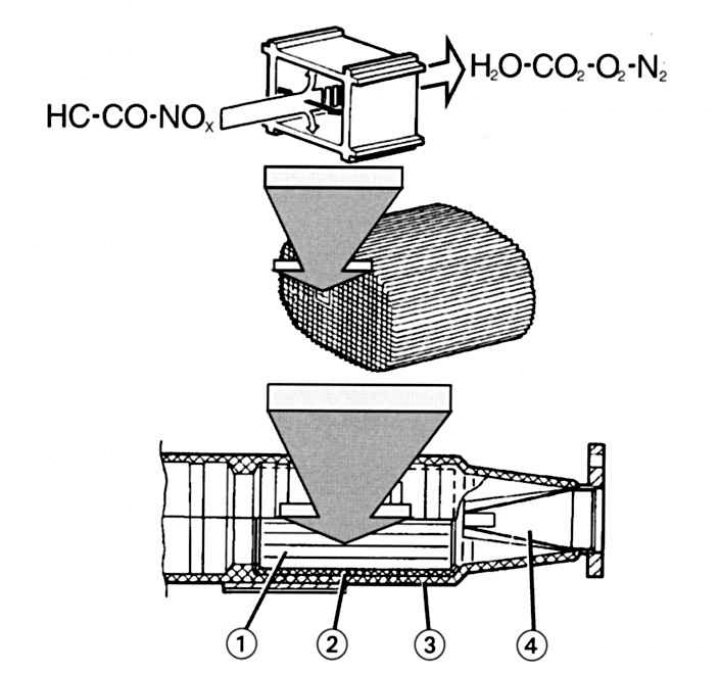
Fig. 4.98. Schematic operation of a catalytic converter: 1 – ceramic carrier of honeycomb…

Fig. 4.98. Schematic operation of a catalytic converter: 1 – ceramic carrier of honeycomb structure; 2 – metal fabric; 3 – casing made of heat-resistant alloy steel; 4 – mesh funnel


An oxidation neutralizer is installed as standard on E-class diesel engines. The catalytic converter housing and tubes are made of alloy steel. The coating of noble metals on the catalytic converter (Fig. 4.98) activates additional oxidation in the exhaust gases, whereby hydrocarbons (HC) and carbon monoxide (CO) are converted into carbon dioxide (CO₂) and water (H2O). Due to this process, the emission of solid substances is also reduced. Soot particles cannot settle on hydrocarbon compounds and are discharged to the outside.


Exhaust gases


Carbon monoxide (CO). Measured during exhaust gas testing. The prerequisite for low CO content is precise regulation of the injection quantity and timing, as well as uniform vortex mixing of the mixture. Toxic in closed rooms, in the air it combines with atmospheric oxygen to form harmless carbon dioxide, which, however, can cause a greenhouse effect.

Hydrocarbons (CH). May not partially burn in cold areas and narrow corners of the combustion chamber. Their proportion depends on the engine design (unchangeable size); too rich or too lean a mixture increases their emissions. Together with nitrogen oxides they form smog.

Nitrogen oxides (NOx). Their proportion increases with increasing combustion temperature. They are emitted, for example, in engines adjusted for low CO and HC content in exhaust gases (reduced fuel consumption). At high concentrations they cause burning in the respiratory tract. When interacting with water they form nitric acid (acid rain).

Sulfur dioxide (SO2). Formed in small quantities only in diesel engines. The reason is the sulfur content in diesel fuel. In the light it forms sulfuric or sulfurous acid, both of which lead to acid rain. However, sulfurous acids from automobile exhausts make up only 3% of all sulfurous acids formed.

Improved exhaust gas parameters using Electronic Diesel System (EDS)


In order to reduce the amount of nitrogen oxides, hydrocarbons and soot in the exhaust, diesel engines are equipped with an exhaust gas recirculation system (Fig. 4.98) and intake pressure regulation in addition to the oxidation catalytic converter.


Exhaust Gas Recirculation (AGR)
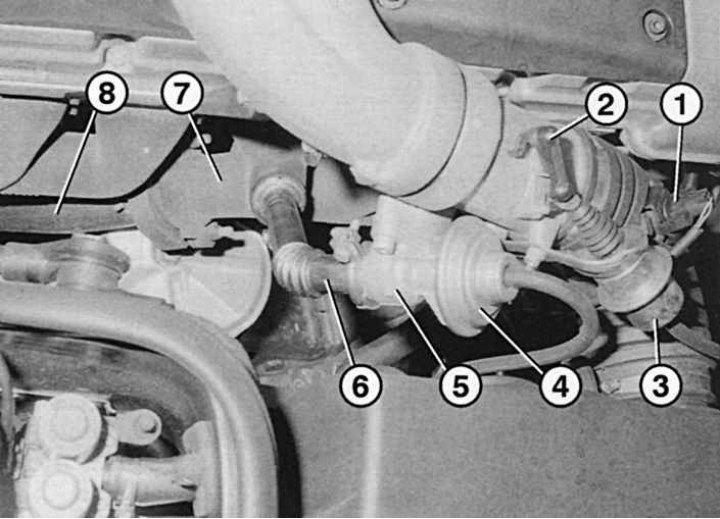


Fig. 4.99. Exhaust gas recirculation system components: 1 – intake air temperature sensor; 2 –…

Fig. 4.99. Exhaust gas recirculation system components: 1 – intake air temperature sensor; 2 – pressure control valve lever; 3 – vacuum cell of the pressure control valve; 4 – exhaust gas recirculation system (ARF) vacuum cell; 5 – exhaust gas return system control valve; 6 – exhaust gas intake pipe; 7 – outlet pipe; 8 – front part of the muffler


At high combustion temperatures, the proportion of nitrogen oxides in the exhaust gases of diesel engines increases sharply. A way to reduce the temperature in the combustion chamber is to supply exhaust gases. A portion of the total flow of engine exhaust gases is removed using the exhaust gas recirculation system (Fig. 4.99). The dose is determined depending on the engine load and is sent back to the air supply line behind the pressure control valve. Since the exhaust gas contains virtually no combustible substances, it cannot be burned again. However, it limits the supply of fresh air for combustion and thus helps to reduce the temperature in the combustion chamber and the proportion of nitrogen oxides.

In addition to electronically controlled exhaust gas recirculation, which helps reduce nitrogen oxide emissions, CDI engines are equipped with neutralizers and a second exhaust gas cleaner located under the bottom.


When repairing the exhaust system, it is impossible to weld the corroded metal well. This measure is only for a short time. Rubber fasteners and clamps last longer than metal. On systems with two or more muffler sections, after replacing one, the others have to be replaced after a few months. Therefore, service stations usually replace the entire system. However, this is not always necessary. Check the condition of the system and first decide whether you will replace the sections individually or the entire system.

Sequence of works


1. Place the car on a jack.

2. If it is impossible to unscrew the bolts during dismantling, then cut them off or drill them out. Use new bolts and nuts during installation.

3. For safety, also replace rubber clamps, gaskets, etc.

4. If at least one part of the exhaust system has already been replaced, it is better to disconnect the inserted ends of the pipes using heat. A welding torch is used for this purpose in workshops. You can also use a propane torch. But be sure to have a fire extinguisher on hand. If these products are not available, try using a rust remover.


5. The joints of the sections are separated by strong rotational movements or by hammer blows.

6. If this does not help, saw off the pipe 10 cm from the place where it connects to the unusable section. Saw the rest of the section along the length and knock it off using a chisel or a large screwdriver.

7. All bolted connections and nuts will be easier to unscrew next time if you lubricate the threads with heat-resistant grease during installation. It is advisable to do this at the joints of the connections as well.

[Information copied from the website MERCEDESMAN.ru]
This article is available at: russian, bulgarian, belarusian, ukrainian, serbian, croatian, romanian, polish, slovak, hungarian
The article has been verified: Polyakov Zakhar Grigorievich
Share with friends:
◀ Previous
E-Class W210 / Exhaust system
Next ▶

Service life of the exhaust system
Exhaust system — general description
Checking the condition of the exhaust system
Replacing the exhaust system
Replacing the muffler
More similar articles for repairing other models

☛ Exhaust system — visual inspection Mercedes W168 (1997-2004)
☛ Engine and exhaust system Mercedes W202 (1993-2000)
☛ Checking the condition of the exhaust system Mercedes W463 (1999-2019)
☛ Checking the condition of the exhaust system Mercedes W163 (1997-2005)
☛ Adjusting idle speed and CO content in exhaust gases Mercedes W116 (1972-1980, petrol)
☛ Removal and installation of the exhaust system Mercedes Sprinter (1995-2000, diesel)
Link in different formats to this article
Comments and feedback from visitors
No comments yet


How much will 43 + 10 ?


W210 (1996-2002) 
  • General information
  • Vehicle description
  • Working conditions and tools
  • Car care
  • Diesel engines
  • Engine repair
  • Lubrication system
  • Cooling system
  • Injection system
  • Supply system
  • Exhaust system
  • Gasoline engines
  • Engine repair
  • Lubrication system
  • Cooling system
  • Control system
  • Power and exhaust system
  • Transmission
  • Clutch
  • Mechanical gearbox
  • Automatic gearbox
  • Drive shafts
  • Chassis
  • Car suspension
  • Steering
  • Tires and wheels
  • Brake system
  • Body
  • Exterior (external elements)
  • Interior (internal elements)
  • Doors and windows
  • Heating and ventilation
  • Electrical equipment
  • Equipment and devices
  • Power devices
  • Lighting and signaling
  • Electrical circuits
W124 (1984-1995) 
  • General information
  • Governing bodies
  • Driving and operation
  • Weekly care
  • Maintenance (gasoline)
  • Maintenance (diesel)
  • Troubleshooting
  • Power unit
  • I4 petrol engine
  • V6 petrol engine (SOHC)
  • V6 petrol engine (DOHC)
  • Diesel engines
  • Engine overhaul
  • Cooling system
  • Heating and ventilation
  • Fuel system (carburetor)
  • Injection system «Bosch CIS-E»
  • Injection system «Bosch HFM»
  • Diesel fuel system
  • Supply system
  • Starting and charging system
  • Ignition system (I4)
  • Ignition system (V6)
  • Preheating
  • Transmission
  • Clutch
  • Mechanical gearbox
  • Automatic gearbox
  • Drive shafts
  • Chassis
  • Brake system
  • Car suspension
  • Steering
  • Body
  • Exterior (external elements)
  • Interior (internal elements)
  • Doors, locks and windows
  • Electrical equipment
  • Equipment and devices
  • Switches
  • Headlights and lighting
  • Electrical circuits
W123 (1976-1985) 
  • General information
  • Introduction to the guide
  • Power unit
  • Engine device
  • Repair M102 engines
  • Repair M110 and M123 engines
  • Cooling and lubrication (M102)
  • Cooling (M110 and M123)
  • Ignition system
  • Power system «Stromberg»
  • Power system «Solex 4A1»
  • Fuel injection «K-Jetronic»
  • Fuel injection «L-Jetronic»
  • Transmission
  • Clutch
  • Mechanical gearbox
  • Automatic gearbox
  • Cardan and rear axle
  • Chassis
  • Front suspension
  • Rear suspension
  • Steering
  • Brake system
  • Body
  • Exterior (external elements)
  • Interior (internal elements)
  • Doors, locks and windows
  • Electrical equipment
  • Equipment and devices
  • Power devices
  • Electrical circuits
 
MercedesMan.ru © 2017–2026 · Mobile version · Read about Mercedes · Sitemap: EN BG BY UA RS HR RO PL SK HU · Feedback · Site search · Bookmark A-Class (W168) · C-Class (W201) · C-Class (W202) · C-Class (W203) · E-Class (W123) · E-Class (W124) · E-Class (W210) · G-Class (W463) · M-Class (W163) · S-Class (W116, petrol) · S-Class (W126, petrol) · S-Class (W140) · S-Class (W220) · Sprinter · Vito 1 · Vito 2 · Vario 814D ·
 
We only use cookies without which some of the site's features may not be available.