
Cars BMW Cars Volkswagen Cars Chevrolet Cars Land Rover Cars Lada Cars Honda Cars Peugeot
English Русский
Български
Беларускі
Український
Српски
Hrvatski
Română
Polski
Slovenský
Magyar
Bookmark News and articles Sitemap Feedback Site search
MercedesMan.ru


A-Class C-Class E-Class G-Class M-Class S-Class Others
W123 (1976-1985) W124 (1984-1995) W210 (1996-2002)
  • Main
  • E-Class
  • W210 (1996-2002)
  • Body
  • Heating and ventilation
  • How an air conditioner works

How an air conditioner works (Mercedes-Benz E-Class W210)

0
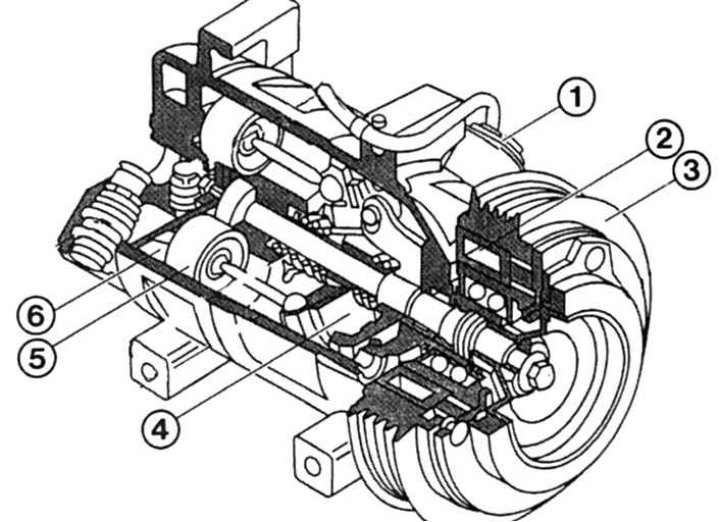
Fig. 10.5. Compressor (in section) with oscillating disks and six pistons: 1 – main control valve;…

Fig. 10.5. Compressor (in section) with oscillating disks and six pistons: 1 – main control valve; 2 – electromagnetic clutch; 3 – belt pulley; 4 – rocking disc; 5 – piston; 6 – compression chamber


The car is equipped with a compressor with oscillating washers. It is located on the left side of the engine and serves to compress the refrigerant under pressure (about 1 kg), which is in a gaseous state. The compressor is driven by a belt drive from the crankshaft. When compressed in the compressor, the refrigerant changes to a liquid state and is fed to the evaporator, located in the heater housing under the instrument panel. There, the refrigerant evaporates again with the absorption of energy, due to which cold is formed. The air flowing past the evaporator is cooled by its plates. Then the refrigerant is fed back to the compressor (Fig. 10.5). For its better condensation after compression, two additional fans are installed in front of the condenser. The cooling capacity of the air conditioner is regulated electronically and depends on the outside air temperature, the interior temperature and the set value of the desired temperature.


Additional information about the air conditioner
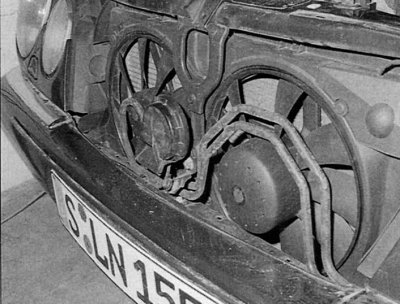


Fig. 10.6. Access to both additional fans is opened after removing the radiator grille

Fig. 10.6. Access to both additional fans is opened after removing the radiator grille


The additional fans (Fig. 10.6) have two speeds. At a coolant pressure of 20 bar, the switch is triggered. Then the relay is triggered, and the additional fans receive voltage via the preliminary resistors. At a coolant temperature of more than +107°C, the fans operate at maximum speed.

When the compressor is turned on, the idle speed setting of the engine is immediately changed so that it does not stop. The compressor consumes about 9 kW.

To avoid thermal overload of the engine, when the coolant temperature is about +115°C, the compressor is switched off.

(Material based on data from the portal: www.mercedesman.ru)

The air conditioner control unit receives information about the compressor speed from an inductive sensor. The engine speed data comes as a TD signal from the Motronic system. If the obtained ratio between the two values is outside the specified range, this may mean that the compressor is rotating with difficulty and the auxiliary drive belt is slipping on the pulleys. In this case, the compressor is switched off protectively.


When removing the engine, the closed circulation system of the air conditioner working fluid, which is under high pressure, should not be opened without special equipment. Topping up the refrigerant in the system is only possible at a service station. Therefore, when removing the engine, it is recommended to unscrew the compressor and system pipes from it together with the brackets and secure them to the side in the engine compartment with wire.

The air conditioner control unit has a self-diagnostic system. Information about any malfunctions that have occurred can then be read from the device's memory at the service station.
This article is available at: russian, bulgarian, belarusian, ukrainian, serbian, croatian, romanian, polish, slovak, hungarian
The article has been verified: Polyakov Zakhar Grigorievich
Share with friends:
◀ Previous
E-Class W210 / Heating and ventilation
Next ▶

Air Conditioner — General Description
Possible malfunctions of the heating system, their causes and methods of elimination
Removal the fan motor
Troubleshooting a Fan
Supply air fan
 
More similar articles for repairing other models

☛ Maintenance — list of works Mercedes W168 (1997-2004)
☛ Ventilation unit, air conditioner Mercedes W202 (1993-2000)
☛ Removal and installation the heater/air conditioner fan and its… Mercedes W463 (1999-2019)
☛ Removal and installation the heater/air conditioner fan and its… Mercedes W163 (1997-2005)
☛ Removal and installation the push-button air conditioner control panel Mercedes W140 (1991-1998)
☛ Air conditioner condenser Mercedes Vito 1 (1996-2003)
Link in different formats to this article
Comments and feedback from visitors
No comments yet


How much will 31 + 37 ?


W210 (1996-2002) 
  • General information
  • Vehicle description
  • Working conditions and tools
  • Car care
  • Diesel engines
  • Engine repair
  • Lubrication system
  • Cooling system
  • Injection system
  • Supply system
  • Exhaust system
  • Gasoline engines
  • Engine repair
  • Lubrication system
  • Cooling system
  • Control system
  • Power and exhaust system
  • Transmission
  • Clutch
  • Mechanical gearbox
  • Automatic gearbox
  • Drive shafts
  • Chassis
  • Car suspension
  • Steering
  • Tires and wheels
  • Brake system
  • Body
  • Exterior (external elements)
  • Interior (internal elements)
  • Doors and windows
  • Heating and ventilation
  • Electrical equipment
  • Equipment and devices
  • Power devices
  • Lighting and signaling
  • Electrical circuits
W124 (1984-1995) 
  • General information
  • Governing bodies
  • Driving and operation
  • Weekly care
  • Maintenance (gasoline)
  • Maintenance (diesel)
  • Troubleshooting
  • Power unit
  • I4 petrol engine
  • V6 petrol engine (SOHC)
  • V6 petrol engine (DOHC)
  • Diesel engines
  • Engine overhaul
  • Cooling system
  • Heating and ventilation
  • Fuel system (carburetor)
  • Injection system «Bosch CIS-E»
  • Injection system «Bosch HFM»
  • Diesel fuel system
  • Supply system
  • Starting and charging system
  • Ignition system (I4)
  • Ignition system (V6)
  • Preheating
  • Transmission
  • Clutch
  • Mechanical gearbox
  • Automatic gearbox
  • Drive shafts
  • Chassis
  • Brake system
  • Car suspension
  • Steering
  • Body
  • Exterior (external elements)
  • Interior (internal elements)
  • Doors, locks and windows
  • Electrical equipment
  • Equipment and devices
  • Switches
  • Headlights and lighting
  • Electrical circuits
W123 (1976-1985) 
  • General information
  • Introduction to the guide
  • Power unit
  • Engine device
  • Repair M102 engines
  • Repair M110 and M123 engines
  • Cooling and lubrication (M102)
  • Cooling (M110 and M123)
  • Ignition system
  • Power system «Stromberg»
  • Power system «Solex 4A1»
  • Fuel injection «K-Jetronic»
  • Fuel injection «L-Jetronic»
  • Transmission
  • Clutch
  • Mechanical gearbox
  • Automatic gearbox
  • Cardan and rear axle
  • Chassis
  • Front suspension
  • Rear suspension
  • Steering
  • Brake system
  • Body
  • Exterior (external elements)
  • Interior (internal elements)
  • Doors, locks and windows
  • Electrical equipment
  • Equipment and devices
  • Power devices
  • Electrical circuits
 
MercedesMan.ru © 2017–2026 · Mobile version · Read about Mercedes · Sitemap: EN BG BY UA RS HR RO PL SK HU · Feedback · Site search · Bookmark A-Class (W168) · C-Class (W201) · C-Class (W202) · C-Class (W203) · E-Class (W123) · E-Class (W124) · E-Class (W210) · G-Class (W463) · M-Class (W163) · S-Class (W116, petrol) · S-Class (W126, petrol) · S-Class (W140) · S-Class (W220) · Sprinter · Vito 1 · Vito 2 · Vario 814D ·
 
We only use cookies without which some of the site's features may not be available.