



Contents: Removal ↡ Installation ↡
Note: If the outer wheel-side constant velocity joint is damaged, the corresponding shaft must be replaced completely.
Removal
1. Apply the parking brake.
Caution! When loosening the wheel nut, the car must be parked with its wheels on the ground. Engage the gear, apply the brake. High loosening torque. There is a risk of accident!
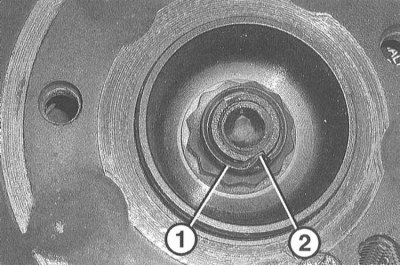
2. Bend the flange of the wheel mounting nut out of the shaft groove with a screwdriver. Unscrew the nut with a twelve-sided head.
3. Release the parking brake.
4. Mark the position of the rear wheels relative to the hub with paint. This will allow you to install the balanced wheels in their original position during assembly. Loosen the wheel mounting bolts before jacking up the car. Raise the rear of the car, place it on stands and remove the rear wheels.
5. Disconnect the rear caliper and secure it with wire to the body, refer to Section Removal and installation the rear caliper.
Caution! Do not disconnect the brake hose. Otherwise, you will have to bleed the brake system after installation.
6. Remove the connecting rod going to the stabilizer.
7. Disconnect the speed sensor from the camshaft.
8. Disconnect the steering rod from the knuckle.
9. Fold the knuckle outward and at the same time push the drive shaft out of the flange.
Caution! Do not overtighten the brake cable. Do not damage the protective boots and the toothed ring of the speed sensor.
10. Throw back your fist and secure it with wire.
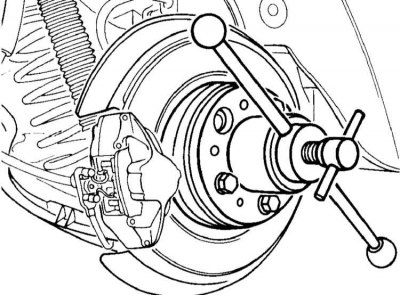
11. If the drive shaft fits tightly in the flange, press it out with a regular puller.
Note: Unlike the accompanying illustration, the caliper is removed.
Drive shaft version 1
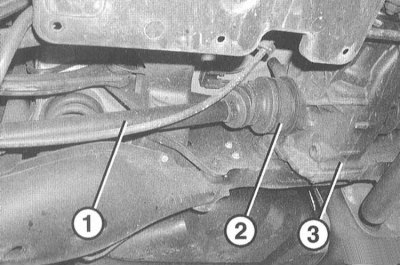
1. Remove the drive shaft (1) with the inner joint (2) from the final drive (3).
Caution: Be careful not to damage the sealing ring in the final drive.
Note: If necessary, disconnect the drive shaft by hitting the outer ring of the joint with a hammer and using a suitable drift.
2. Visually inspect the seal in the main gear for damage and replace if necessary.
Note: To do this, press out the cuff with a screwdriver. Before installation, lubricate the working edge of the cuff with universal hypoid gear oil SAE 85W-90. Press in the cuff using a suitable punch.
Drive shaft version 2
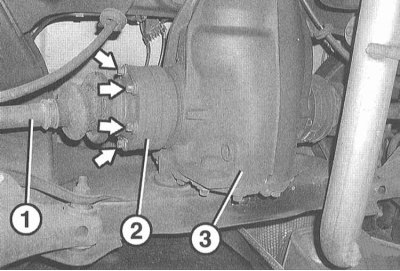
1. Remove the 6 Torx mounting screws and disconnect the drive shaft (1) from the coupling flange (2). (3) – final drive.
Caution! Ensure that the socket head is correctly positioned in the Torx screw head. Clean the Torx screw profile if necessary.
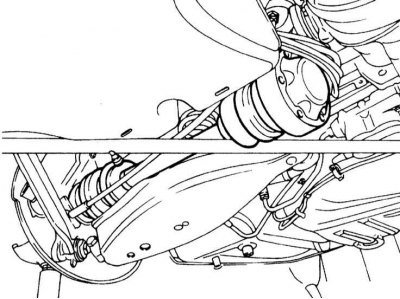
2. Slide the drive shaft, then tilt it down and remove it.
Caution: Be careful not to remove the locking cap when removing the shaft.
3. Check the protective cover and the locking cap for leaks and damage, repair if necessary.
Attention! When the drive shaft is removed, the vehicle must not stand on the wheels with a full load and must not be moved, since in the absence of axial tension, the rolling elements of the wheel bearing may be damaged.
Installation
Caution! If the drive shaft requires a lot of force to remove the wheel hub, it is recommended to cut an internal M8 thread 20 mm deep on the end of the shaft. A dismantling tool can be screwed into this hole. Depending on the drive shaft design, it may have a hole with a diameter of 6.8 mm, which corresponds to the internal diameter of the M8 thread. Before installation, clean the spline profile from grease residues.
Drive shaft version 1: Insert the shaft into the final drive until the retaining ring is clearly engaged.
Attention! When doing this, install the joint housing horizontally so as not to skew the spline shaft during installation. The joint housing must be located tightly to the main gear housing.
Drive shaft version 2
1. Clean the surface between the connecting flange and the shut-off cover.
2. Install the shaft at the connecting flange.
3. Lightly lubricate the threads and head bearing surface of the new Torx screws.
4. Install a new washer and screw in the Torx screws. Tighten the screws crosswise to 70 Nm.
5. Secure the steering rod and rods with new self-locking nuts.
Attention! When tightening the nuts, the drive shaft must be brought to a horizontal position. To do this, lift the wheel holder with a jack.
Tightening torques are given in Specifications.
6. Secure the speed sensor to the knuckle with a torque of 8 Nm.
7. Insert the stabilizer connecting rod and secure it with a torque of 40 Nm.
8. Install the caliper and tighten it to a torque of 55Nm, refer to Section Removal and installation the rear caliper.
9. Reinstall the rear wheels so that the marks made during removal match. Pre-lubricate the centering belt of the wheel disk on the hub with a thin layer of bearing grease. Do not lubricate the wheel mounting bolts. Replace rusty bolts. Tighten the bolts. Lower the car onto the wheels and tighten the bolts crosswise to 110 Nm.
10. Apply the parking brake.
11. Screw on a new twelve-sided flange nut and tighten to 220 Nm.
Attention! The car must be standing with its wheels on the ground. The nut must be replaced with a new one. When tightening, engage the gear and apply the parking brake.
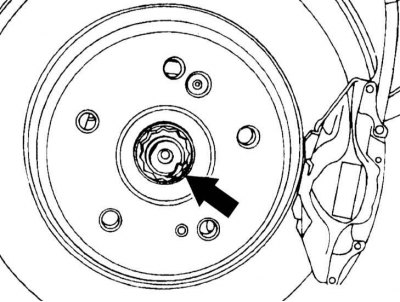
12. Secure the nut by using a punch to drive the flange into the groove so that there is no gap between the groove and the flange.
13. Release the parking brake.
14. Check the oil level in the final drive.