



Front wheel suspension shock absorber
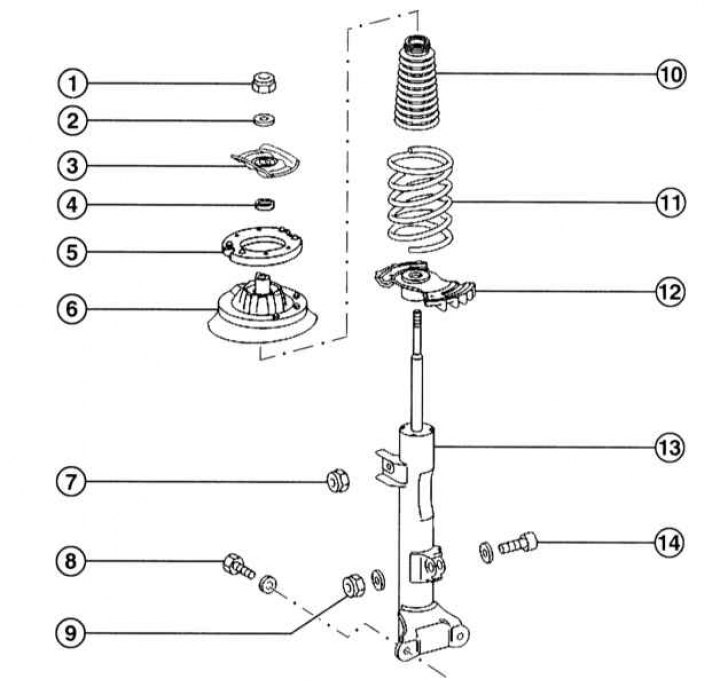
1 - Nut M14 x 1.5, 60Nm; 2 - Washer; 3 - Stop; 4 - Nut, 20Nm, self-locking, must be replaced; 5 - Rubber gasket; 6 - Shock absorber support; 7 - Nut, 40Nm; 8 - Bolt, 110Nm, 2 pcs.; 9 - Nut, 200Nm; 10 - Compression stroke buffer; 11 - Coil spring; 12 - Holder; 13 - Shock absorber; 14 - Bolt
Warning! Attention! You will need a spring compressor to perform the repair. Do not attempt to remove the spring without a compressor - you may be seriously injured and damage the vehicle. Before installing the compressor, carefully read its operating instructions. If you are not going to remove the compressor from the spring after it has been removed from the strut, place it in a safe place.
1. If you find that the rack is faulty (traces of working fluid leaks on its surface, breakage or sagging of the spring, loss of vibration damping efficiency), it should be disassembled and repaired. The struts themselves cannot be repaired and when the shock absorber fails, they should be replaced, but the springs and related components should be replaced in pairs (on both sides of the car).
2. Remove the stand (refer to Section Removal and installation the front caliper), place it on the workbench and clamp it in a vice. Remove all dirt from its surface.
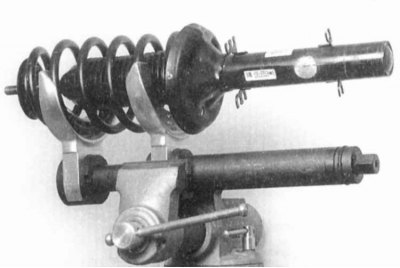
3. Compress the spring with the puller, completely relieving the pressure from the plate. Securely attach the puller to the spring (follow the puller manufacturer's instructions).
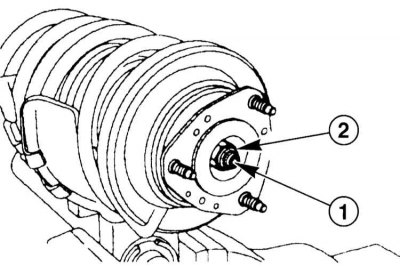
4. Holding the shock absorber rod from turning with a hex key, unscrew the rod mounting nut.
5. Remove the upper support with the support bearing, then the spring plate, spring, boot and bump stop.
6. If you are going to install a new spring, carefully remove the spring puller from the old spring. If you are going to install the old spring, there is no need to remove the spring puller.
7. After you have completely disassembled the rack, carefully inspect all its components. The support bearing should rotate freely. If signs of wear or damage to any components are found, they should be replaced.
8. Inspect the surface of the strut itself. There should be no traces of working fluid on it. Inspect the surface of the shock absorber rod. There should be no traces of corrosion or damage. Place the strut vertically and check its functionality by moving the shock absorber rod first from stop to stop, then with short movements of 50-100 mm. In both cases, the movement of the rod should be uniform. If jerking or jamming occurs, as well as any other signs of malfunction, the strut should be replaced.
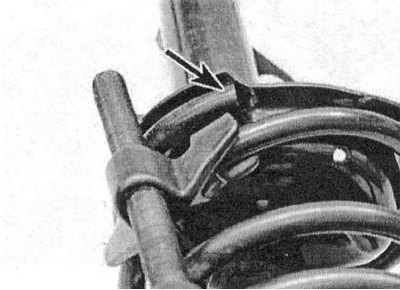
9. Installation is carried out in reverse order. Keep in mind the following:
- a) Place the spring on the stand, making sure it is in the correct position on the lower cup.
- b) Install the support bearing correctly.
- c) Tighten the support bearing mounting nut to the required torque.
- d) The springs should be installed so that the marks on them are oriented downwards.