
Cars BMW Cars Volkswagen Cars Chevrolet Cars Land Rover Cars Lada Cars Honda Cars Peugeot
English Русский
Български
Беларускі
Український
Српски
Hrvatski
Română
Polski
Slovenský
Magyar
Bookmark News and articles Sitemap Feedback Site search
MercedesMan.ru


A-Class C-Class E-Class G-Class M-Class S-Class Others
190 (W201) (1982-1993) W202 (1993-2000) W203 (2000-2007)
  • Main
  • C-Class
  • W203 (2000-2007)
  • Chassis
  • Car suspension
  • Removal and installation the rear spring

Removal and installation the rear spring (Mercedes-Benz C-Class W203)

0
Contents: Removal ↡ Installation ↡
Attention! Depending on the vehicle equipment, rubber supports of different heights are installed. When replacing, it is necessary to measure the height of all supports. Only rubber supports of the same height should be installed.


Removal


1. Raise and support the rear of the vehicle on stands.

2. Unscrew the 2 mounting bolts (1) of the spring lever cover (2). Disconnect the cover and remove it.
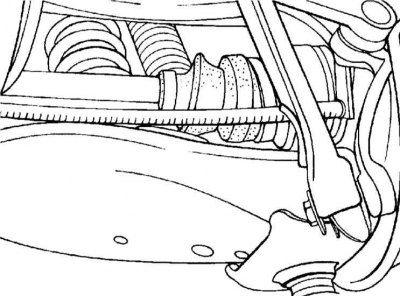
3. Place a garage jack under the spring arm from the outside and lift it so that the rear drive…


3. Place a garage jack under the spring arm from the outside and lift it so that the rear drive shaft is horizontal. Use a wooden shim for this.

When lifting the spring arm, make sure that the car does not come off the stands. If necessary, load the trunk.

4. The spring is strongly compressed. To remove the spring, it must be additionally compressed so as to relieve the support cups. To do this, it is necessary to use a special compression device.

Caution! The spring should only be removed when it is securely compressed by the device!
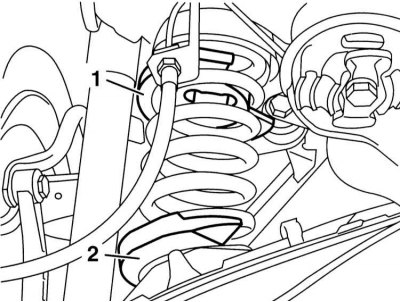

5. Compress the spring with the device. The device should cover 3 to 4 turns of the spring.…


5. Compress the spring with the device. The device should cover 3 to 4 turns of the spring. Compress the spring so that the cups are unloaded.


Note: At the service station, a device is used that is inserted from inside the spring.


Caution! Make sure that the spring coils are securely gripped by the device and that the device cannot slip. The spring is clamped with great force, so only a reliable device should be used. Never compress the spring with wire. There is a risk of accident!
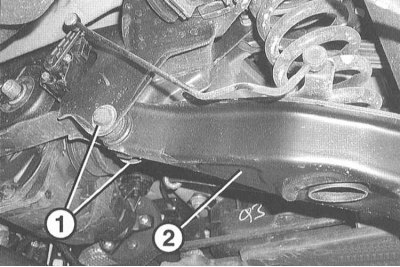

6. Unscrew the self-locking nut (1) securing the spring lever (2) and remove it with the washer.…


6. Unscrew the self-locking nut (1) securing the spring lever (2) and remove it with the washer. Remove the mounting bolt.
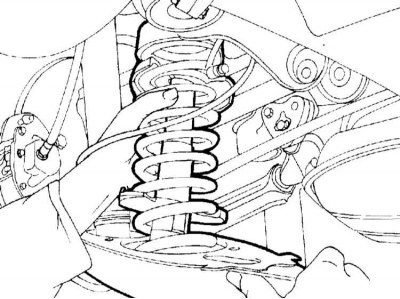
7. Pull the lever down and remove the spring with the rubber support.


7. Pull the lever down and remove the spring with the rubber support.

8. If the spring needs to be replaced, clamp it in a vice. Remove the rubber support by turning it to the left and slowly unload the spring.

Installation


Before installation, check the rubber support for cracks or any damage. Replace the support if necessary. Clean the spring contact area on the lever.


1. Install the fixture and slowly compress the spring.

2. Install the rubber support by turning it to the right. To make installation easier, the support can be lightly lubricated with dishwashing liquid or glycerin.

3. Insert the spring so that the end of the lower coil sits in the recess on the spring lever.

4. Insert the spring arm mounting bolt and screw on a new self-locking nut with a washer, without tightening the nuts.

5. Place a garage jack under the spring arm from the outside and lift it so that the rear drive shaft is horizontal. Use a wooden shim for this.

Caution! When lifting the spring arm, make sure that the car does not come off the stands. If necessary, load the trunk.


6. In this position, tighten the spring lever nut to a torque of 70 Nm.

7. Unload the spring, making sure it is correctly positioned in the upper rubber support and lower spring arm.

8. Remove the spring compressor and jack.

9. Fix the spring lever cover and secure it with two bolts.

10. Lower the car onto its wheels.

11. If new parts were installed, it is necessary to adjust the headlights (work of the service station).

[Full article available on the resource: MercedesMAN]
This article is available at: russian, bulgarian, belarusian, ukrainian, serbian, croatian, romanian, polish, slovak, hungarian
The article has been verified: Rodionov Artyom Semyonovich
Share with friends:
◀ Previous
C-Class W203 / Car suspension
Next ▶

Removal and installation the rear shock absorber
Design and description of rear wheel suspension
Adjusting the clearance in the front wheel bearings
Repair of front wheel suspension strut
Removal and installation the front shock absorber strut
Car Wheel Alignment Angles — General Information
Conditions for checking wheel alignment angles
Front wheel alignment
Rear wheel adjustment
Checking the vehicle body clearance
More similar articles for repairing other models

☛ Rear suspension shock absorber spring — removal and installation Mercedes W168 (1997-2004)
☛ Removal and installation the rear suspension spring Mercedes W123 (1976-1985)
☛ Removal and installation rear ventilation flaps Mercedes W463 (1999-2019)
☛ Removal and installation the end cover, replacing the rear crankshaft… Mercedes W163 (1997-2005)
☛ Removal and installation the rear cover of the gearbox Mercedes W140 (1991-1998)
☛ Rear spring mount Mercedes Sprinter (1995-2000, diesel)
Link in different formats to this article
Comments and feedback from visitors
No comments yet


How much will 37 + 29 ?


W203 (2000-2007) 
  • General information
  • Introduction to guide
  • User manual
  • Maintenance
  • Power unit
  • Gasoline engines
  • Diesel engines
  • Cooling system
  • Ventilation and heating
  • Supply system
  • Injection system (gasoline)
  • Injection system (diesel)
  • Exhaust system
  • Ignition and control system
  • Charge and launch systems
  • Transmission
  • Mechanical gearbox
  • Automatic gearbox
  • Clutch and drive shafts
  • Differential
  • Chassis
  • Brake system
  • Car suspension
  • Steering
  • Body
  • Exterior (external elements)
  • Interior (internal elements)
  • Electrical equipment
  • Equipment and devices
  • Lighting system
  • Electrical diagrams (2000)
  • Electrical diagrams (since 2001)
W202 (1993-2000) 
  • General information
  • User manual
  • Driving a car
  • Car care
  • Maintenance
  • Power unit
  • Gasoline engines
  • Diesel engines
  • Lubrication system
  • Cooling system
  • Heating and ventilation
  • Ignition system
  • Fuel system
  • Injection system (gasoline)
  • Injection system (diesel)
  • Exhaust system
  • Transmission
  • Clutch
  • Car gearbox
  • Chassis
  • Suspension, wheels and tires
  • Steering
  • Brake system
  • Body
  • Exterior (external elements)
  • Interior (internal elements)
  • Doors and windows
  • Electrical equipment
  • Equipment and devices
  • Power devices
  • Lighting system
  • Electrical circuits
190 (W201) (1982-1993) 
  • General information
  • Introduction to the guide
  • Operation and care
  • Maintenance (gasoline)
  • Maintenance (diesel)
  • Troubleshooting
  • Power unit
  • Petrol engine I4
  • Petrol engine V6
  • Diesel engines
  • Engine overhaul
  • Cooling and heating
  • Power system (carburetor)
  • Injection system (gasoline)
  • Injection system (diesel)
  • Exhaust system
  • Charge and start system
  • Ignition system (I4)
  • Ignition system (V6)
  • Diesel heating system
  • Transmission
  • Clutch
  • Mechanical gearbox
  • Automatic gearbox
  • Cardan shaft and axle shafts
  • Chassis
  • Brake system
  • Car suspension
  • Steering
  • Body
  • Exterior (external elements)
  • Interior (internal elements)
  • Doors, locks and windows
  • Electrical equipment
  • Equipment and devices
  • Electrical circuits
 
MercedesMan.ru © 2017–2026 · Mobile version · Read about Mercedes · Sitemap: EN BG BY UA RS HR RO PL SK HU · Feedback · Site search · Bookmark A-Class (W168) · C-Class (W201) · C-Class (W202) · C-Class (W203) · E-Class (W123) · E-Class (W124) · E-Class (W210) · G-Class (W463) · M-Class (W163) · S-Class (W116, petrol) · S-Class (W126, petrol) · S-Class (W140) · S-Class (W220) · Sprinter · Vito 1 · Vito 2 · Vario 814D ·
 
We only use cookies without which some of the site's features may not be available.