



Contents: Removal ↡ Installation ↡
Attention! Depending on the vehicle equipment, different springs with corresponding rubber supports are used. To identify the springs, a colored line is applied to the last coil, and the part number is stamped. When replacing, use springs with the same designation.
Removal
1. Place the rear of the car on stands.
2. If equipped, remove the control arm cover.
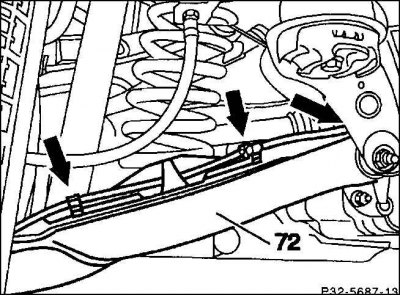
3. Remove the brake pad wear indicator wire (72) from the mountings.
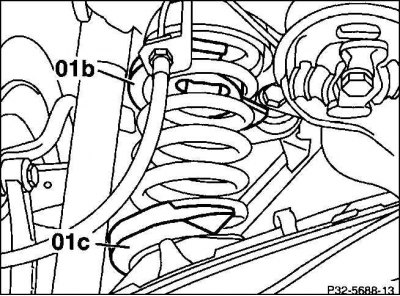
4. The spring is loaded. To remove it, it is necessary to compress it even more to unload the spring plates. In this case, the compression device should cover 4-5 turns.
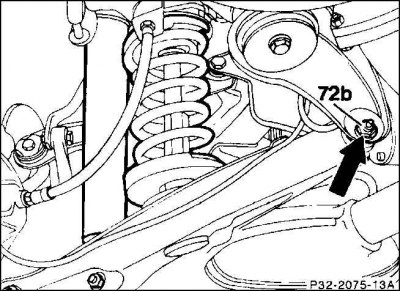
5. Unscrew the self-locking nut of the suspension arm (72b), remove it together with the washer. Remove the bolt.
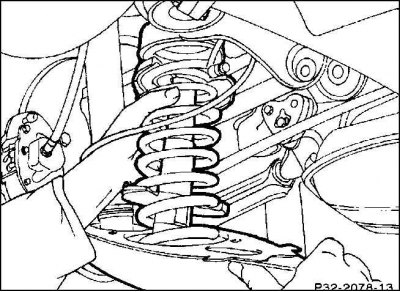
6. Move the lever down and remove the spring together with the rubber supports.
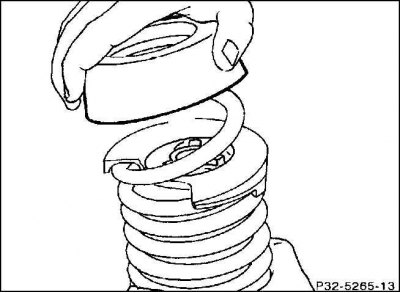
7. Compress the spring in the fixture as shown in the figure, remove the rubber support by rotating it to the left, then slowly release the spring.
Installation
1. Before installation, check the rubber mounts for porosity and damage, replace them if necessary. Clean the mating surface on the suspension arm.
2. Place the compression tool and slowly compress the spring.
3. Install the rubber support by turning it to the right. To make installation easier, you can lubricate the support with liquid soap or glycerin.
4. Position the spring so that the end of the lower coil sits in the recess of the lever.
5. Install the suspension arm bolt and screw on the new self-locking nut (72b) with washer, without tightening it.
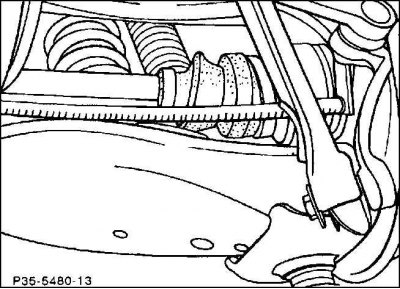
6. Place a garage jack under the suspension arm, lift the arm until the axle shaft is approximately horizontal. Don't forget the wooden spacer between the arm and the jack.
Caution: When lifting, be careful not to lift the vehicle off the stands.
7. In this position, tighten the spring nut to 70 Nm.
8. Release the spring, paying attention to its correct fit in the lever and on the body.
9. Remove the fixture and jack.
10. Replace the brake pad wear sensor wire.
11. If present, install the lever cover.
12. Check the vehicle level on the front axle.
13. Set the headlights to the correct position.