
Cars BMW Cars Volkswagen Cars Chevrolet Cars Land Rover Cars Lada Cars Honda Cars Peugeot
English Русский
Български
Беларускі
Український
Српски
Hrvatski
Română
Polski
Slovenský
Magyar
Bookmark News and articles Sitemap Feedback Site search
MercedesMan.ru


A-Class C-Class E-Class G-Class M-Class S-Class Others
190 (W201) (1982-1993) W202 (1993-2000) W203 (2000-2007)
  • Main
  • C-Class
  • W201 (1982-1993)
  • Power unit
  • Petrol engine I4
  • Compression — checking and analyzing the results

Compression — checking and analyzing the results (Mercedes-Benz C-Class W201)

0
1. When the engine loses throttle response or misfires that cannot be attributed to ignition or fuel system faults, the engine condition can be diagnosed by checking the compression. If this test is performed regularly, it can warn of faults before other symptoms appear.

2. The engine must be fully warmed up to normal operating temperature, the battery must be fully charged, and all spark plugs must be removed. An assistant will be needed to perform the operation.

3. Disable the ignition system by disconnecting the ignition coil high-voltage wire from the distributor cap and grounding it to the cylinder block. On fuel-injected models, disconnect the fuel pump relay to prevent fuel from being injected when the crankshaft is cranked (on carbureted models, the shut-off valve connector can be disconnected).

4. Connect the compression gauge to the spark plug hole of the 1st cylinder (a compression gauge with a threaded tip is preferred).

5. Have your assistant open the throttle fully and engage the engine starter. After one or two engine revolutions, the pressure will rise to its maximum and then stabilize. Record the highest value observed.

6. Repeat the test on the remaining cylinders, recording the resulting compression value each time (see fig. 2.6).
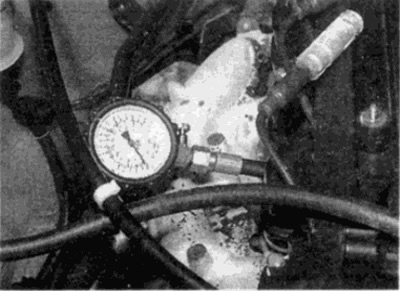
Fig. 2.6. Compression gauge installed in the spark plug hole

Fig. 2.6. Compression gauge installed in the spark plug hole


7. The pressure in all cylinders should be very close, a difference of more than 1.5 bar between cylinders indicates a malfunction. It should be noted that the pressure in a serviceable engine increases quickly, low pressure in the first cycle and its gradual increase in subsequent cycles means wear of the piston tracks. Low pressure in the first cycle, which does not increase in subsequent cycles, indicates a loose valve fit or a breakdown of the cylinder head gasket (the cause could also be a crack in the head). Deposits on the valve working surfaces can also cause low compression.


Information copied from the website [MercedesMAN.ru]

8. Recommended by Mercedes are listed in the section Technical data.

9. If low pressure is observed in any cylinder, perform the following experiment to determine the cause. Pour a teaspoon of clean oil into the spark plug hole and repeat the compression test.

10. If adding oil temporarily increases the compression pressure, this means that cylinder or piston wear is causing gas leakage and pressure loss. If there is no improvement, it should be assumed that there is a leak or burnt valve, as well as a broken head gasket.

11. Low pressure in two adjacent cylinders may indicate a gasket failure between them. The presence of coolant in the oil will confirm this assumption.

12. If the pressure in one of the cylinders is approximately 20% lower than in the others, and the engine runs unsteadily at idle, then the cause may be wear of the camshaft cam.

13. If the compression pressure is unusually high, it may mean that the combustion chambers are covered with a thick layer of carbon deposits. If this is the case, it is necessary to remove the cylinder head and clean the chambers from carbon deposits.

14. After completing the check, screw the spark plugs back in place and reconnect the ignition system and fuel pump relay.
This article is available at: russian, bulgarian, belarusian, ukrainian, serbian, croatian, romanian, polish, slovak, hungarian
The article has been verified: Lukyanov Nikita Ilyich
Share with friends:
◀ Previous
C-Class 190 (W201) / Petrol engine I4
Next ▶

Basic information
Technical data
Engine and Timing Marks — Basic Information and Use
Camshaft Cover — Removal and Installation
Crankshaft Pulley/Vibration Damper and Hub — Removal and Installation
Timing Chain Cover — Removal and Installation
Camshaft Drive Chain — Checking and Replacing
More similar articles for repairing other models

☛ Checking the engine oil level using a dipstick Mercedes W168 (1997-2004)
☛ Checking the compression pressure Mercedes W124 (1984-1995)
☛ Checking compression pressure, assessing the condition of the… Mercedes W463 (1999-2019)
☛ Checking the compression pressure in the cylinders Mercedes W163 (1997-2005)
☛ Checking the compression in the engine cylinders Mercedes W140 (1991-1998)
☛ Checking engine compression Mercedes Vito 1 (1996-2003)
Link in different formats to this article
Comments and feedback from visitors
No comments yet


How much will 47 + 41 ?


W203 (2000-2007) 
  • General information
  • Introduction to guide
  • User manual
  • Maintenance
  • Power unit
  • Gasoline engines
  • Diesel engines
  • Cooling system
  • Ventilation and heating
  • Supply system
  • Injection system (gasoline)
  • Injection system (diesel)
  • Exhaust system
  • Ignition and control system
  • Charge and launch systems
  • Transmission
  • Mechanical gearbox
  • Automatic gearbox
  • Clutch and drive shafts
  • Differential
  • Chassis
  • Brake system
  • Car suspension
  • Steering
  • Body
  • Exterior (external elements)
  • Interior (internal elements)
  • Electrical equipment
  • Equipment and devices
  • Lighting system
  • Electrical diagrams (2000)
  • Electrical diagrams (since 2001)
W202 (1993-2000) 
  • General information
  • User manual
  • Driving a car
  • Car care
  • Maintenance
  • Power unit
  • Gasoline engines
  • Diesel engines
  • Lubrication system
  • Cooling system
  • Heating and ventilation
  • Ignition system
  • Fuel system
  • Injection system (gasoline)
  • Injection system (diesel)
  • Exhaust system
  • Transmission
  • Clutch
  • Car gearbox
  • Chassis
  • Suspension, wheels and tires
  • Steering
  • Brake system
  • Body
  • Exterior (external elements)
  • Interior (internal elements)
  • Doors and windows
  • Electrical equipment
  • Equipment and devices
  • Power devices
  • Lighting system
  • Electrical circuits
190 (W201) (1982-1993) 
  • General information
  • Introduction to the guide
  • Operation and care
  • Maintenance (gasoline)
  • Maintenance (diesel)
  • Troubleshooting
  • Power unit
  • Petrol engine I4
  • Petrol engine V6
  • Diesel engines
  • Engine overhaul
  • Cooling and heating
  • Power system (carburetor)
  • Injection system (gasoline)
  • Injection system (diesel)
  • Exhaust system
  • Charge and start system
  • Ignition system (I4)
  • Ignition system (V6)
  • Diesel heating system
  • Transmission
  • Clutch
  • Mechanical gearbox
  • Automatic gearbox
  • Cardan shaft and axle shafts
  • Chassis
  • Brake system
  • Car suspension
  • Steering
  • Body
  • Exterior (external elements)
  • Interior (internal elements)
  • Doors, locks and windows
  • Electrical equipment
  • Equipment and devices
  • Electrical circuits
 
MercedesMan.ru © 2017–2026 · Mobile version · Read about Mercedes · Sitemap: EN BG BY UA RS HR RO PL SK HU · Feedback · Site search · Bookmark A-Class (W168) · C-Class (W201) · C-Class (W202) · C-Class (W203) · E-Class (W123) · E-Class (W124) · E-Class (W210) · G-Class (W463) · M-Class (W163) · S-Class (W116, petrol) · S-Class (W126, petrol) · S-Class (W140) · S-Class (W220) · Sprinter · Vito 1 · Vito 2 · Vario 814D ·
 
We only use cookies without which some of the site's features may not be available.