



The circulation of the coolant is regulated by a thermostat. As long as the engine is cold, the coolant circulates not only in the cylinder head, but also in the engine block when the heating is on - in the heater heat exchanger. As the temperature increases, the thermostat opens a large circle of coolant circulation. The liquid is driven through the radiator by a constantly running coolant pump. The liquid flows through the radiator from top to bottom and is cooled in the finned tubes of the radiator by the passing air. The fan behind the radiator serves to ensure sufficient air flow, while an additional air flow created during movement passes through the radiator.
Cooling diagram of 8-cylinder engines
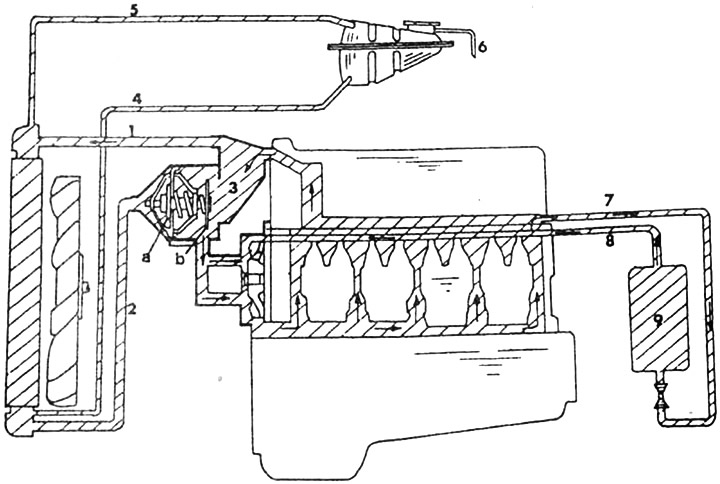
a. Thermostat. b. Cooling system small circuit closing plate. 1. From engine to radiator. 2. From radiator to thermostat. 3. Cooling system small circuit leakage. 4. Supply from expansion tank to radiator. 5. Filling (pouring) line. 6. Excess fluid drain hose. 7. From cylinder head and heat exchanger. 8. Heater return drain channel in cylinder block on the right. 9. Body heater.
Cooling diagram of 6-cylinder engines
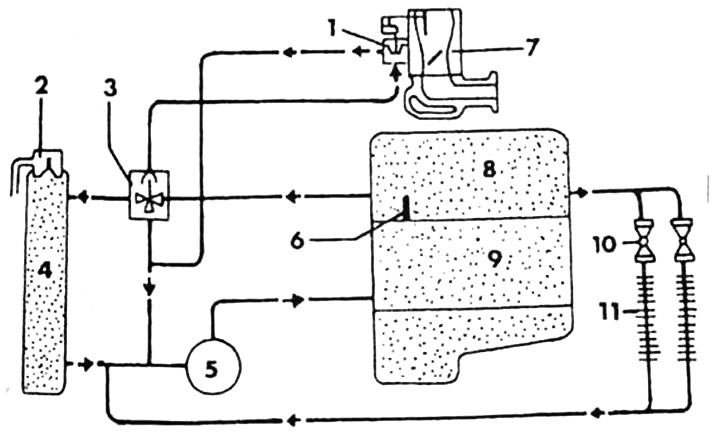
1. Automatic starting heater. 2. Radiator pipe. 3. Thermostat. 4. Radiator. 5. Coolant pump. 6. Temperature gauge sensor. 7. Carburetor. 8. Cylinder head. 9. Cylinder block. 10. Body heater tap. 11. Body heater.
Coolant pump and thermostat housing (8-cylinder engine)
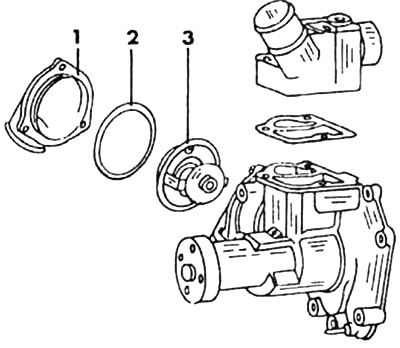
1. Thermostat housing cover. 2. Sealing ring. 3. Thermostat.