



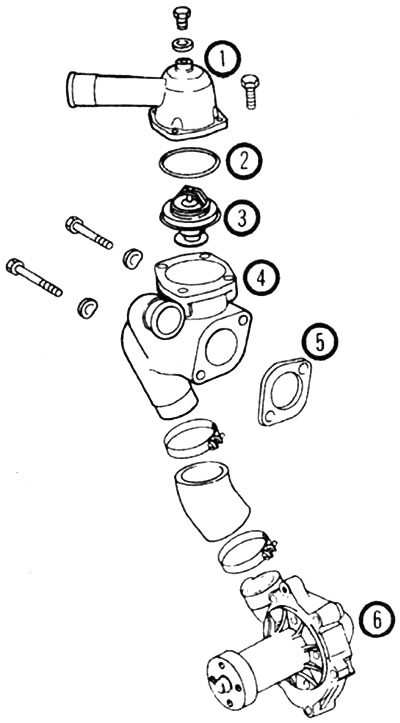
1. Thermostat cover. 3. Thermostat. 5. Gasket. 2. Gasket. 4. Thermostat housing. 6. Water pump.
The thermostat opens a large circle of coolant circulation as the engine temperature increases. If the thermostat remains closed due to a defect, the engine overheats. This is recognized by the temperature gauge, the readings of which are in the red area, while the radiator remains cold. A defective thermostat can also remain open after the coolant has cooled. This is determined by the fact that the engine no longer reaches its operating temperature or the temperature readings rise more slowly than before, or in winter the heater power is reduced.
Attention! When the engine becomes hot after a short trip, the reason for this may be that scale deposits have formed in the radiator.
Removal
Disconnect the ground cable from the battery.
Drain the coolant.
Plug the hose on the thermostat housing cover.
Remove the thermostat housing cover and set aside.
Remove the thermostat from the housing.
Examination
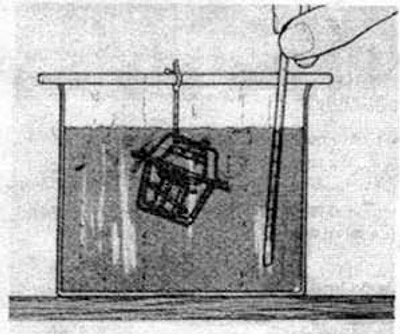
Hang the thermostat on a wire in a vessel with cold water. It should not touch the walls of the vessel. Monitor the temperature with a thermometer. At a temperature of about 87°C (diesel engine - 80°C), the bimetallic spring of the thermostat begins to stretch. The greatest stretch is achieved at 102°C (diesel engine - 94°C).
Check if the thermostat expands and closes back, otherwise replace it.
The thermostat should open approximately 6-8 mm at the set temperature.
Installation
Clean the mating surfaces of the body and cover.
Before installation, check whether the ball in the thermostat air bleed valve moves freely.
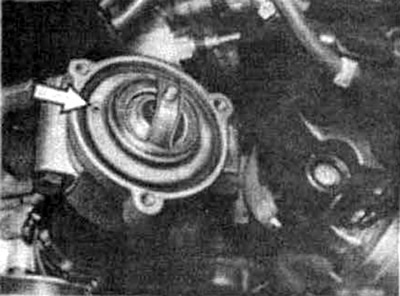
Insert the thermostat with a new gasket into the housing.
The opening start temperature is stamped on the thermostat. When installing the thermostat element, pay attention to the free movement of the ball in the valve, as well as the position of the air bleed valve on the main plate.
In 6-cylinder engines it is installed at the bottom, in 8-cylinder engines - at the top.
Caution: Do not tighten the bolts too tightly.
Wrap the air bleed tube and, where necessary, secure it with a clamp.
Fill with coolant.
Connect the ground wire to the battery.
Warm up the engine until the radiator connects. Check if the radiator becomes warm at the bottom and the tightness of the thermostat housing cover connection.