
Cars BMW Cars Volkswagen Cars Chevrolet Cars Land Rover Cars Lada Cars Honda Cars Peugeot
English Русский
Български
Беларускі
Український
Српски
Hrvatski
Română
Polski
Slovenský
Magyar
Bookmark News and articles Sitemap Feedback Site search
MercedesMan.ru


A-Class C-Class E-Class G-Class M-Class S-Class Others
W123 (1976-1985) W124 (1984-1995) W210 (1996-2002)
  • Main
  • E-Class
  • W124 (1984-1995)
  • Power unit
  • Ignition system (I4)
  • Ignition timing angle

Ignition timing angle (Mercedes-Benz E-Class W124)

0
Contents: EZL Ignition System ↡ Ignition system TFZ ↡ Checking the ignition timing angle ↡ Adjusting the ignition timing angle ↡

EZL Ignition System


The EZL ignition system operates based on the signal received from the crankshaft angle sensor. The ignition system sets the required ignition timing based on engine speed, crankshaft position and manifold vacuum information received from sensors installed on the engine.

A distinctive feature of the EZL ignition system is that it is impossible to adjust the initial ignition timing by turning the distributor housing relative to the shaft.

However, the initial ignition advance angle can be changed depending on the type of fuel used. To do this, it is necessary to change the position of the switching plug in the adjustment socket, located in the engine compartment next to the ECU. The switching plug contains resistors of different resistance. The plug can be installed in several positions in accordance with the marks on the plug. Depending on which resistor of the plug is currently connected to the socket contacts, the ECU of the ignition system increases or decreases the initial ignition advance angle in 3° increments.

The ignition timing angle can also be measured using a stroboscope.

Ignition system TFZ


The TFZ ignition system is controlled by a pulse sensor installed inside the distributor housing. In this case, the initial ignition advance angle can be adjusted by turning the distributor housing relative to the shaft.


Checking the ignition timing angle


Caution! The ignition timing must be checked with the engine warmed up to normal operating temperature. It is advisable to complete the ignition timing check before the coolant temperature exceeds 95°C or before the radiator fan turns on.


Determining the ignition timing angle using the mark on the crankshaft pulley aligned with the pointer
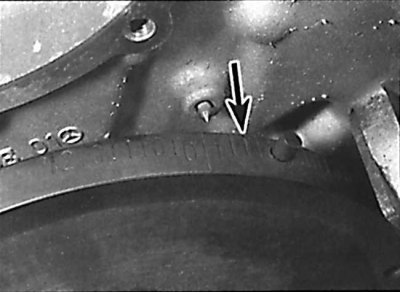


Determining the ignition timing angle using the mark on the crankshaft pulley aligned with the…


1. Connect the stroboscope in accordance with its operating instructions. In this case, the stroboscope should be started from the high-voltage wire of the 1st cylinder.

2. Run the engine at idle speed. Point the strobe light at the pointer on the timing chain cover. The mark on the crankshaft pulley appears to be stationary and should be aligned with the pointer. If the mark moves to one side or the other, the idle speed is unstable. When checking the ignition timing, all electrical consumers should be turned off and the radiator fan should not be running. When idling the engine for some time, even with the engine warmed up to normal operating temperature, especially at high outside temperatures, the idle speed may be unstable.


3. Determine the ignition timing angle using the mark on the crankshaft pulley, aligned with the pointer (see picture).

4. If the ignition timing angle differs by more than 3° from the required value, the plug in the adjustment socket may not be installed correctly. Check the position of the plug in the adjustment socket and, if necessary, install it in accordance with the type of fuel used.

Adjusting the ignition timing angle


Attention! Adjustment of the ignition advance angle is only possible on models with the TSZ ignition system.


1. Adjust the ignition timing with the engine off to avoid electric shock. Loosen the distributor mounting bolt.

Caution: Make an alignment mark on the distributor housing and cylinder head so that the distributor can be returned to its original position if an unsuccessful attempt is made to adjust the ignition timing.


2. To increase the ignition advance angle, turn the distributor housing clockwise, and to decrease it, turn it counterclockwise. Tighten the distributor mounting bolt and, using a stroboscope, check the initial ignition advance angle. Repeat this operation until the required initial ignition advance angle is set. Tighten the distributor mounting bolt to the required torque and disconnect the stroboscope.
This article is available at: russian, bulgarian, belarusian, ukrainian, serbian, croatian, romanian, polish, slovak, hungarian
The article has been verified: Levin Kirill Glebovich
Share with friends:
◀ Previous
E-Class W124 / Ignition system (I4)
Next ▶

Distributor rotor — removal and installation
Ignition distributor — removal and installation
Ignition coil — removal and installation
Checking the ignition system
Ignition system TFZ
Ignition Control System Components — Removal and Installation
More similar articles for repairing other models

☛ Ignition switch Mercedes W168 (1997-2004)
☛ Checking and adjusting the ignition timing angle Mercedes W203 (2000-2007)
☛ Checking and adjusting the ignition timing angle Mercedes W463 (1999-2019)
☛ Checking and adjusting the ignition timing angle Mercedes W163 (1997-2005)
☛ Checking and adjusting the ignition timing angle Mercedes W140 (1991-1998)
☛ Checking the injection start timing Mercedes Sprinter (1995-2000, diesel)
Link in different formats to this article
Comments and feedback from visitors
No comments yet


How much will 29 + 23 ?


W210 (1996-2002) 
  • General information
  • Vehicle description
  • Working conditions and tools
  • Car care
  • Diesel engines
  • Engine repair
  • Lubrication system
  • Cooling system
  • Injection system
  • Supply system
  • Exhaust system
  • Gasoline engines
  • Engine repair
  • Lubrication system
  • Cooling system
  • Control system
  • Power and exhaust system
  • Transmission
  • Clutch
  • Mechanical gearbox
  • Automatic gearbox
  • Drive shafts
  • Chassis
  • Car suspension
  • Steering
  • Tires and wheels
  • Brake system
  • Body
  • Exterior (external elements)
  • Interior (internal elements)
  • Doors and windows
  • Heating and ventilation
  • Electrical equipment
  • Equipment and devices
  • Power devices
  • Lighting and signaling
  • Electrical circuits
W124 (1984-1995) 
  • General information
  • Governing bodies
  • Driving and operation
  • Weekly care
  • Maintenance (gasoline)
  • Maintenance (diesel)
  • Troubleshooting
  • Power unit
  • I4 petrol engine
  • V6 petrol engine (SOHC)
  • V6 petrol engine (DOHC)
  • Diesel engines
  • Engine overhaul
  • Cooling system
  • Heating and ventilation
  • Fuel system (carburetor)
  • Injection system «Bosch CIS-E»
  • Injection system «Bosch HFM»
  • Diesel fuel system
  • Supply system
  • Starting and charging system
  • Ignition system (I4)
  • Ignition system (V6)
  • Preheating
  • Transmission
  • Clutch
  • Mechanical gearbox
  • Automatic gearbox
  • Drive shafts
  • Chassis
  • Brake system
  • Car suspension
  • Steering
  • Body
  • Exterior (external elements)
  • Interior (internal elements)
  • Doors, locks and windows
  • Electrical equipment
  • Equipment and devices
  • Switches
  • Headlights and lighting
  • Electrical circuits
W123 (1976-1985) 
  • General information
  • Introduction to the guide
  • Power unit
  • Engine device
  • Repair M102 engines
  • Repair M110 and M123 engines
  • Cooling and lubrication (M102)
  • Cooling (M110 and M123)
  • Ignition system
  • Power system «Stromberg»
  • Power system «Solex 4A1»
  • Fuel injection «K-Jetronic»
  • Fuel injection «L-Jetronic»
  • Transmission
  • Clutch
  • Mechanical gearbox
  • Automatic gearbox
  • Cardan and rear axle
  • Chassis
  • Front suspension
  • Rear suspension
  • Steering
  • Brake system
  • Body
  • Exterior (external elements)
  • Interior (internal elements)
  • Doors, locks and windows
  • Electrical equipment
  • Equipment and devices
  • Power devices
  • Electrical circuits
 
MercedesMan.ru © 2017–2026 · Mobile version · Read about Mercedes · Sitemap: EN BG BY UA RS HR RO PL SK HU · Feedback · Site search · Bookmark A-Class (W168) · C-Class (W201) · C-Class (W202) · C-Class (W203) · E-Class (W123) · E-Class (W124) · E-Class (W210) · G-Class (W463) · M-Class (W163) · S-Class (W116, petrol) · S-Class (W126, petrol) · S-Class (W140) · S-Class (W220) · Sprinter · Vito 1 · Vito 2 · Vario 814D ·
 
We only use cookies without which some of the site's features may not be available.