



Cooling system circuit diagram
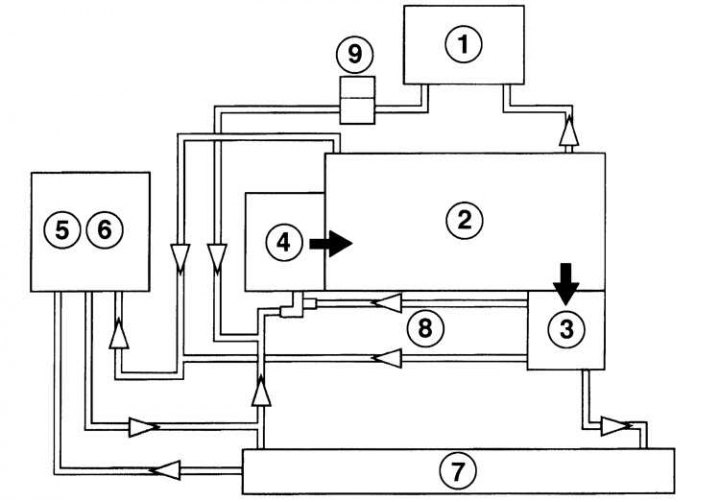
1 - Heater; 2 - Engine; 3 - Thermostat; 4 - Water pump; 5 - Expansion tank; 6 - Lid with valve; 7 - Radiator; 8 - Bypass hose; 9 - Oil radiator
Radiator and fan
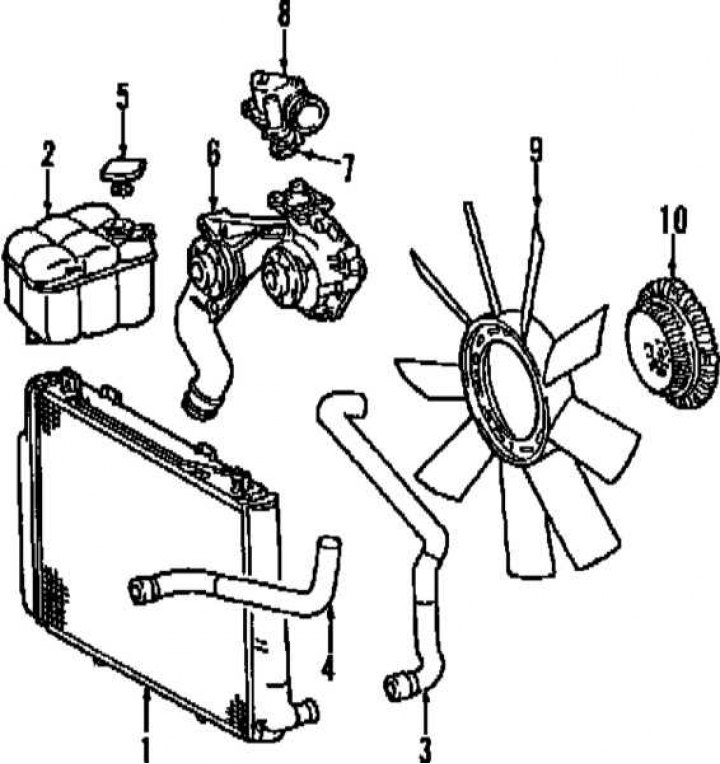
1 - Radiator; 2 - Expansion tank; 3 - Upper radiator hose; 4 - Lower radiator hose; 5 - Expansion tank cap; 6 - Water pump; 8 - Thermostat; 9 - Fan impeller; 10 - Torsional vibration damper
Until the engine is warmed up, the coolant circulates only in the cylinder head and block and in the heat exchanger of the interior heater. As the coolant temperature increases, the thermostat opens the large cooling circuit. The coolant is directed through the radiator by a constantly running pump. The liquid passes through the radiator from top to bottom and is cooled by the air passing through it.
Heating and ventilation system
The heating system consists of fans and heat exchangers located in the front and rear sections of the passenger compartment. Hot coolant passes through the heat exchangers. When the heater control handle located on the control panel is moved, the valves open and hot air begins to flow into the passenger compartment. If you turn on the heater fan, air will be forced into the passenger compartment.
(Full article available on the resource: Mercedesman.ru)
The intake air passes through a filter before entering the passenger compartment (refer to Chapter Routine maintenance). The bulk of dust particles will settle in the filter. It is necessary to observe the frequency of filter replacement. A filter blocked by dust will limit the air supply to the cabin, which will lead to stagnation of air inside the cabin.
Distribution of air flows of the ventilation system is carried out using dampers. An air circulation mode is provided. The dampers are controlled using servo drives.