



Functional diagram of the air conditioner refrigerator
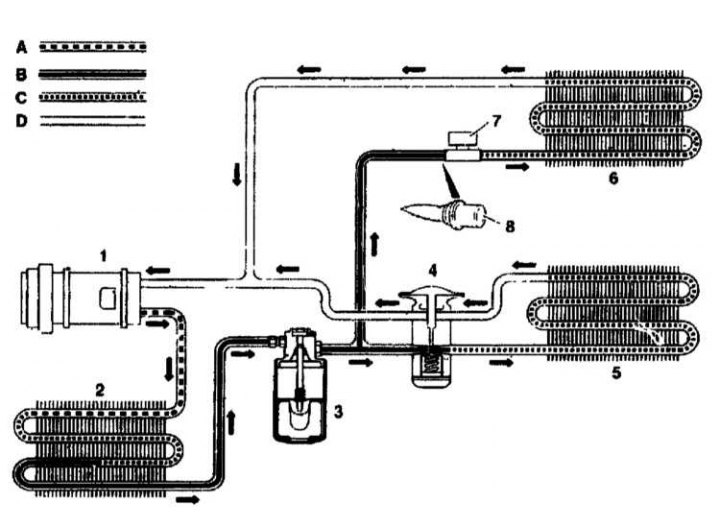
1 - Compressor K/V; 2 - Capacitor; 3 - Receiver-dryer; 4 - Expansion valve; 5 - Evaporator; 6 - Rear air conditioner evaporator; 7 - Rear air conditioner refrigerant shut-off valve; 8 - Rear air conditioner refrigerant injection valve; A - High pressure (gaseous phase); B - High pressure (liquid phase); C - Low pressure (liquid phase); D - Low pressure (gaseous phase)
Additional heater. Diesel models
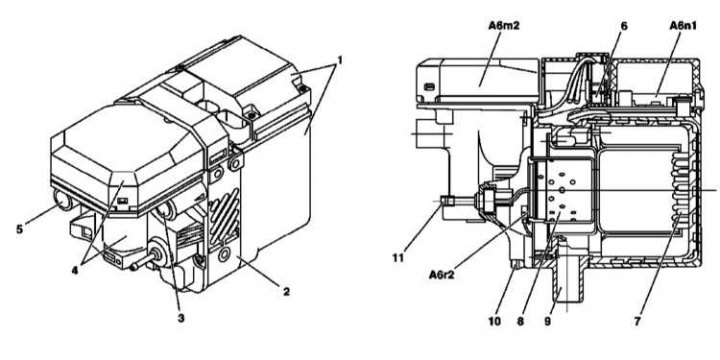
1 - Heat transfer module control unit; 2 - Burner body; 3 - Coolant outlet; 4 - Combustion air purge module; 5 - Combustion air supply; 6 - Connector; 7 - Heat transfer module; 8 - Burner; 9 - Exhaust outlet; 10 - Coolant supply; 11 - Fuel supply; A6m² - Combustion air purge; A6n1 - Additional heater control unit; A6r2 - Heater
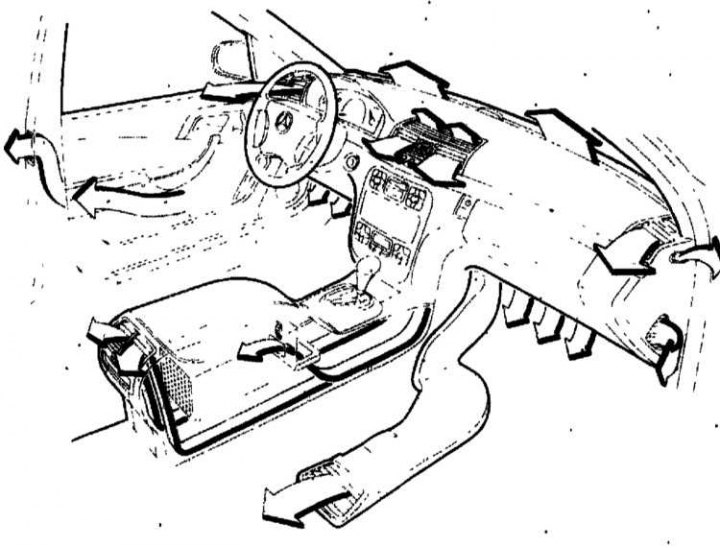
Ventilation flows
The air supplied by the ventilation system to the car's interior through the filter can be heated or cooled depending on the choice of the driver and passengers. The heater or air conditioner is located in the interior, in the housing under the instrument panel. The entire flow of air supplied to the interior is directed for heating or cooling through the same casing. The temperature and speed of the air flow are regulated using the controls located on the control panel.
The heat generated by the engine is transferred by the coolant to the heater radiator located in the passenger compartment. The air flow supplied by the ventilation system passes through the radiator and is heated by the heat of the engine coolant flowing inside the radiator. The degree of heating is regulated by mixing cold and hot air in a certain ratio using a servo-driven mixing flap.
Used air is removed from the passenger compartment through ventilation openings with check valves.
The fresh air fan increases the air flow through the heat exchanger.
If it is necessary to turn off the fresh air supply, for example due to a bad smell, the system switches to recirculation mode, in which only the air that is present in the cabin circulates.
Switching the system to circulation mode is confirmed by the control lamp lighting up.
Interior air conditioning system
Work on the air conditioning system must be carried out by a specialized workshop. Never open the refrigerant circuit, as the refrigerant may cause frostbite if it comes into contact with the skin.
With the help of the air conditioning system, the temperature of the air in the cabin can be lowered below the outside temperature. When the system is operating, the humidity in the cabin decreases. In damp weather, the incoming fresh air is pre-cooled, after which it is heated again to the set temperature. This is how it is dried. This procedure removes fogging of the windows.
The air conditioning system consists of a heater and a refrigerator. The refrigerator KV consists of a compressor, condenser, throttle, evaporator, refrigerant tank and pipelines. The refrigerant (type R134a) circulates in the system, which, depending on the temperature and pressure, can be in a liquid or gaseous state.
The air conditioner compressor is driven by the engine crankshaft via a ribbed belt. It creates a pressure of up to 30 atm in the cooling circuit of the unit, causing the refrigerant, which is a gas, to heat up. In the condenser, the refrigerant is cooled by the air flowing outside (cooling air remains in the external environment). As a result, the heated refrigerant condenses, turning into a liquid.
Having high pressure, it passes through the throttle, as a result of which its pressure drops. After this, the refrigerant evaporates in the circuit, simultaneously cooling down strongly. In the evaporator, the refrigerant takes heat from the air blown through it. As a result, the air cools down. The cooled air enters the car's interior. As a result of heating in the evaporator, the refrigerant turns into gas and under low pressure enters the compressor, after which the circulation process is repeated.
Additional heater
An additional fuel heater is installed on models with diesel engines. When the engine is started, it automatically starts working depending on the coolant and ambient temperatures. Manual control is not provided. It can only be turned on or off using a switch on the center console.
In addition to the fuel-fired heater, an additional electric heater is also installed.