



Functional diagram of the HF circuit
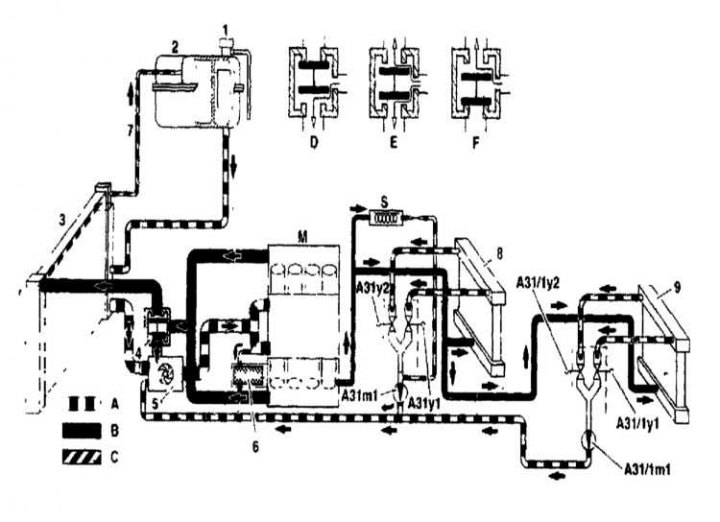
1 - End cap; 2 - Expansion tank; 3 - Radiator; 4 - Thermostat; 5 - Water pump; 6 - Oil filter equipped with heat exchanger; 7 - Ventilation line; 8 - Heat exchanger heater; A - Coolant return; B - Coolant supply; C - Ventilation line; D - Short Loop Mode; E - Combined mode; F - Fan mode; M - Motor; S - Windscreen washer fluid reservoir; A31m1 - Water pump; A31y1 - Left double valve; A31y2 - Right double valve. On models with rear air conditioning (code 528); 9 - Heat exchanger heater; A31 1m1 - Water pump; A31 1y1 - Left double valve; A31 1y2 - Right double valve
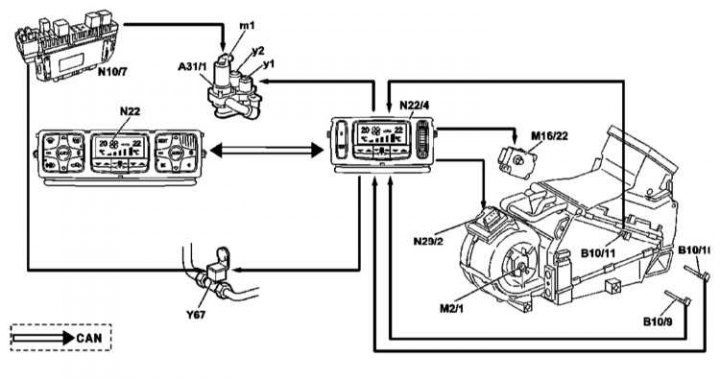
Temperature control of the KV
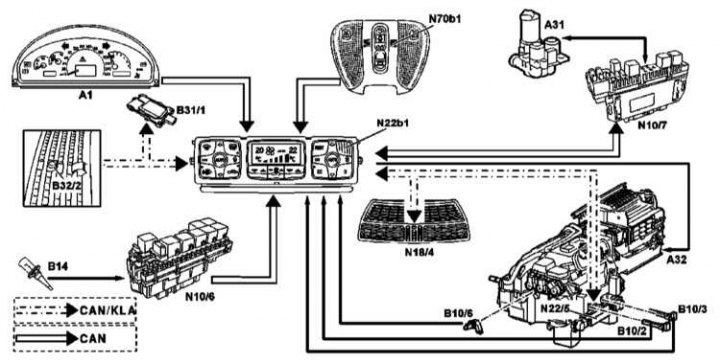
The captions also apply to the figures below.
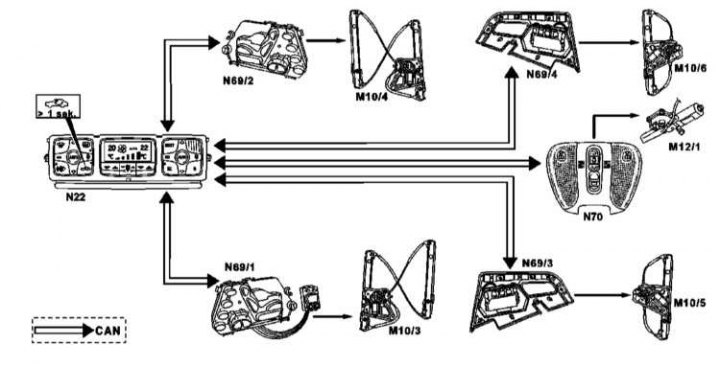
A1 - Instrument panel; A9 - Compressor K/V; A31 - Heating System Delivery Unit (including coolant circulation pump and right and left double valves); A31/1 - Rear Reinforced Heater Power Supply; A31/1m1 - Coolant circulation pump; A31/1y1 - Left double valve; A31/1y2 - Right double valve; A32 - Heating system circulation unit; B10/2 - Left heater temperature sensor; B10/3 - Right heater temperature sensor; B10/6 - Evaporator temperature sensor; B10/09 - Left rear heater temperature sensor; B10/10 - Right rear heater temperature sensor; B10/11 - Rear A/C Evaporator Temperature Sensor; B11/4 - Coolant temperature sensor; B12 - Refrigerant pressure sensor; B12/1 - Coolant temperature sensor; B14 - Outside temperature sensor; B32/2 - Additional Air Control (AAC) Sensor; K40/7 - Front right relay and fuse box; M2/1 - Rear blown motor; M4/3 - Exhaust fan (engine/AAC); M16/22 - Motor for driving the distribution of ascending and descending air flows; N3 - Continuous Fuel Injection (CFI) Control Unit; N10/6 - Front left SAM; N10/7 - Front right SAM; N₂2 - AAC off button control unit; N₂2/b1 - Interior temperature sensor in the AAC off button control unit; N₂2/4 - Rear A/C control unit; N₂2/5 - Stepper motor electronic control unit; N₂9/2 - Rear A/C purge regulator; N70/b1 - Interior temperature sensor in the upper console control unit; N76 - Engine Fan and A/C Control Unit; Y67 - Rear A/C Coolant Shut-Off Valve; M10/3 - Left front window lifter motor; M10/4 - Right front window lifter motor; M10/5 - Left rear window lifter motor; M10/6 - Right rear window lifter motor; M12/1 - Upper hatch drive; N69/1 - Left front door control unit; N69/2 - Right front door control unit; N69/3 - Left rear door control unit; N69/4 - Right rear door control unit; N70 - Overhead console control unit
Refrigerator compressor control KV (the decoding of the symbols is given above)
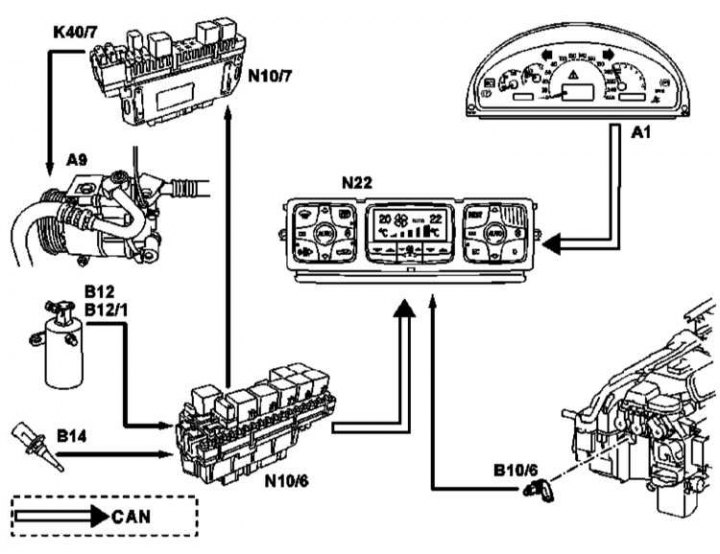
(Information copied from the website MercedesMAN.ru)
Cooling system fan control/ CF (the decoding of the symbols is given above)
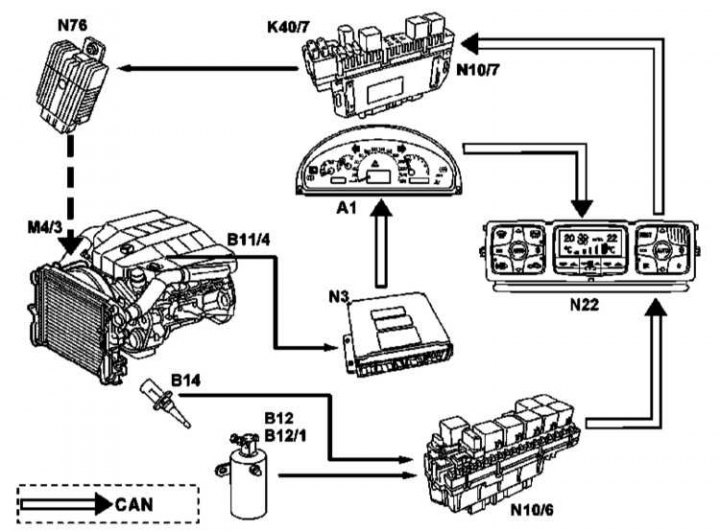
Temperature control (the decoding of the symbols is given above)
Control of comfort system locks (the decoding of the symbols is given above)
The air conditioning system consists of a condenser located in front of the radiator of the cooling system, an evaporator located near the heat exchanger of the heater, a compressor driven by a drive belt, a receiver/dryer, and various tubes connecting the above components. At the inlet of the evaporator, a damper is installed, which provides the pressure difference necessary for the operation of the system.
The fan supplies warm air from the passenger compartment to the evaporator (radiator analogue), where the heat from the air is transferred to the refrigerant. In this case, the refrigerant evaporates and exits the evaporator.
The diagrams of the devices and components interconnected with the HF are presented in the illustrations.
Warning! The system is under pressure. Do not attempt to disconnect any pipes related to the air conditioning system without first removing the working fluid from it. Removing fluid from the system is a fairly complex operation that should be performed at a service station. The system contains R134a refrigerant. Make sure that the station has the necessary equipment for this type of refrigerant. Use safety glasses when disconnecting system pipes.
If your vehicle has an air conditioning system, take the following precautions when servicing any of its components:
- a) The refrigerant R134a used today is much less aggressive than the previously used refrigerant type R12. However, it is very dangerous to health. Do not allow it to come into contact with your eyes or skin - you can get a burn. Although it is not toxic, its vapors can cause suffocation - do not remove it from the system in a closed room. Its vapors are heavier than air, so do not stand under the car when removing it from the system.
- b) Do not allow refrigerant vapors to come into contact with an open flame. When it burns, it produces toxic gas. The gas, mixed with air in a certain proportion, can become explosive. Inhaling vapors through a lit cigarette can lead to tragic consequences.
- c) Do not allow the refrigerant to enter the atmosphere. Unlike R12, the refrigerant type R134a does not cause destruction of the ozone layer, but it does cause a greenhouse effect in the atmosphere.
- d) The system uses seals made of a special material designed to work with a given type of refrigerant (for R134a - green). In order to avoid accidentally mixing different types of refrigerants, a specific type of adapter is used to charge a certain type of refrigerant.
- e) The system must be discharged at a Daimler-Benz service station.
- f) Before carrying out any work related to heating any vehicle components (welding, soldering, drying after painting), discharge the system. It is also necessary to discharge the system before servicing any of the air conditioning system components.