



Note: There should be no foreign objects in the driver's footwell that could restrict the freedom of movement of the pedals! When using non-standard mats or rugs, it is necessary to ensure sufficient pedal travel.
Full load on the engine should be given only after it has been preheated to normal operating temperature, which happens quite quickly during movement.
When starting off on slippery road surfaces, avoid turning any of the drive wheels for a long time, as this may damage the power unit.
Models with manual transmission
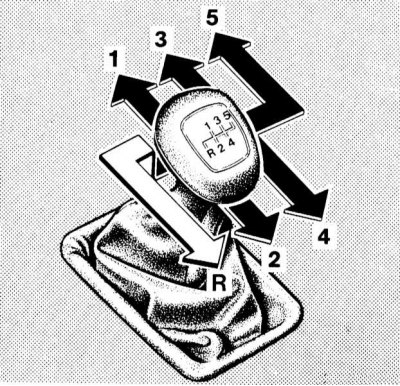
The gear shift pattern is printed on the end surface of the gear shift lever handle
Shift gears while driving in accordance with the technical characteristics of the transmission - try not to allow excessive increase in speed Specifications this Chapter includes a table of gear shift speed modes.
Reverse gear should be engaged only after the vehicle has come to a complete stop - before engaging, the lever handle should be pulled up.
Note: When driving on slippery road surfaces, do not brake with the transmission, as this may lead to loss of traction of the wheels with the road! Remember that engine braking is always associated with a sharp increase in its speed, which is fraught with serious internal damage to the power unit.
Models with AT
Gear shifting while the vehicle is moving is performed automatically depending on the position of the AT selector lever, the position of the program switch, the position of the accelerator pedal and the current driving speed.
Automatic transmission shifts are automatically adapted to individual driving style by adjusting the gear shift moments. The adaptation process is continuous, taking into account the current values of the operating parameters of the power unit, driving characteristics, and the driver's actions. The AT responds to changes in driving characteristics with an adapted gear shift program.
Before starting to move, depress the foot brake pedal to release the AT selector lever lock, then release the parking brake (see section Car parking) and shift the selector lever to one of the driving positions. Wait until the gear is fully engaged, especially if the engine is cold, then release the foot brake and press the gas pedal.
Remember that until the engine has fully warmed up, gear shifting is performed at slightly higher revs, which ensures accelerated warming up of the catalytic converter to normal operating temperature.
When driving, keep in mind that lightly pressing the gas pedal ensures that the transmission shifts to a higher gear earlier, while pressing hard causes the shifts to occur later.
Pressing the gas pedal to the floor causes the AT to automatically downshift (kickdown mode), providing the car with increased dynamic qualities. When the pedal is released, the transmission returns to a higher gear that meets the characteristics of the current speed mode.
When stopping, leave the selector lever in the drive position and use the foot or parking brake to prevent the car from moving forward, or from rolling backwards on an incline.
When maneuvering in a confined space, regulate your speed by gradually releasing the foot brake. Press the accelerator pedal only slightly and do not play with it.
Towing a trailer should be done in standard AT mode - move the mode switch to the left of the selector lever to the "S" position.
AT selector lever positions
Note. When driving on slippery road surfaces, do not brake the transmission by moving the selector lever to the limited range modes "D2" and "D1", as this may lead to loss of traction! Remember that engine braking is always associated with a sharp increase in its speed, which is fraught with serious internal damage to the power unit.
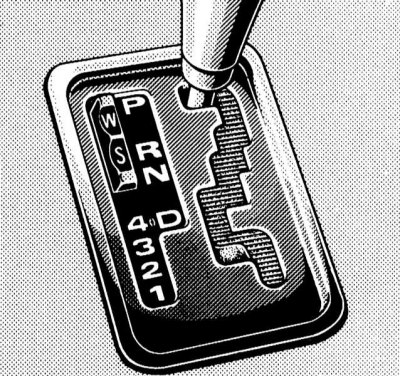
The transmission range selector lever can be in one of seven fixed positions. The engine can only be started in the "P" or "N" positions of the lever. If the vehicle is stopped while the AT is in one of the ranges of movement, "D4", "D3", "D2", "D1", "R", or "N", then you must completely release the gas pedal and press the brake pedal to reliably brake the car.
When switching the automatic transmission, move the lever along the guide groove. When the key is removed from the ignition switch, the selector lever is locked in the "P" position. In this case, it is impossible to move the lever from the "P" position even when the brake pedal is depressed. To avoid damage to the automatic transmission, move the lever to the "P" position only after the car has come to a complete stop.
Note: Removing the key from the ignition switch becomes possible only after moving the selector lever to the "P" position and releasing the foot brake pedal.
Position "P"
In this position of the selector lever, the transmission is locked, providing additional protection for the parked vehicle. Always move the selector lever to the "P" position when turning off or starting the engine. In order to move the range selector lever out of the "P" position, it is necessary to depress the brake pedal, having previously released the gas pedal. Move the selector lever to the right and move it out of the "P" position.
Position "R"
Techniques for operating the range selector lever when moving it from position "P" to position "R" (Reverse) described above. Only engage the lever in the "R" position from the "N" (Neutral) position after the vehicle has come to a complete stop. If reverse gear does not engage after the vehicle has come to a complete stop, depress the foot brake pedal and slowly move the selector lever first to the "N" position, then to the "R" position.
Position "N"
Use the "N" (Neutral) position when starting a stalled engine while driving and when briefly stopping the car with the engine running. If you need to leave the car for any reason, first move the range selector lever to the "P" position. When moving the lever from the "N" position, depress the foot brake pedal.
Note: Shifting the transmission into the "N" position while driving carries the risk of serious internal damage! Use this position only if there is a risk of skidding when driving on slippery road surfaces.
Position "D4"
The range selector lever should be kept in this position at all times when the vehicle is moving under normal road conditions.
In the "D4" (Drive) range, automatic shifting of forward gears is ensured depending on the vehicle speed and the degree to which the gas pedal is depressed.
Position "D3"
If the range selector lever is in the "D3" position, the automatic transmission operates in the same way as when the "D4" (Drive) range is engaged.
The difference is that the shift to fourth gear is excluded. The "D3" range is recommended for use when towing a trailer in hilly terrain or for engine braking on a steep descent. Switching on the "D3" range is also useful for eliminating unnecessary cyclic shifts of the automatic transmission between third and fourth gears - such cyclic shifts of the gearbox can be observed, for example, when driving in dense traffic with frequent slowdowns and stops.
To accelerate the car sharply when the transmission is operating in the "D4" or "D3" range, press the gas pedal all the way down. The gearbox will automatically switch to the adjacent lower gear (kickdown mode).
If the vehicle speed is low, the gear shift may occur down two gears at once.
Position "D2"
When the "D2" range is engaged, the automatic transmission will constantly operate in second gear.
When the car stops, the gearbox does not shift to first gear. Constant engagement of second gear ensures good traction dynamics of the car on climbs and the possibility of intensive engine braking on steep descents.
The "D2" range can be used as an alternative to the winter mode (W, - see below) when starting to move on a slippery road surface, as well as when driving in deep snow. This helps prevent severe slippage of the vehicle's drive wheels.
It is recommended to use the "D2" range when driving on steep passes, when towing a trailer in hilly terrain, and for engine braking on particularly steep descents.
When the "2" range is engaged while the vehicle is moving, the activation of the second gear in the transmission is automatically delayed and occurs only after the vehicle speed has dropped to a safe level at which the engine crankshaft speed does not exceed the maximum permissible value.
Position "D1"
When the "D1" range is engaged, the automatic transmission will operate in first gear all the time.
If the "D1" range is engaged at a speed of over 50 km/h, the transmission will first shift to second gear. Engaging the intermediate stage allows avoiding sudden and unexpected engine braking.
The mode can be used when driving with a trailer on particularly steep descents and long passes.
Switching AT operating modes
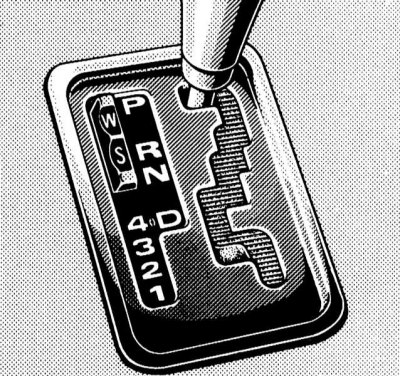
The AT operating mode switch is located to the left of the gear selector lever and is marked with the letters "W" and "S".
Standard mode "S"
Standard mode is activated in the "S" position of the switch and is intended for driving in normal road conditions.
Winter mode "W"
To switch to the winter mode of operation of the AT, press the "W" section of the switch.
In winter mode, the car starts moving in second gear - except when driving with a full load or in the "D1" position of the AT selector lever.
The transmission shifts by pressing the accelerator pedal hard at a lower driving speed and engine speed than in the "S" position.
Note: The reverse gear ratio is reduced in the "W" position.
Emergency mode
The transmission's transition to emergency mode is indicated by deterioration of dynamic characteristics and the transmission's refusal to shift. The possibility of shifting to 2nd gear or reverse gear cannot be ruled out.
In such a situation, you should stop driving, park in a safe place, move the selector lever to the "P" position and turn off the engine.
After waiting at least 10 seconds, start the engine again and move the selector lever to position "D" - 2nd gear will be engaged. Moving the lever to position "R" will engage reverse gear.
The vehicle should be immediately taken to the nearest Mercedes-Benz service station for a detailed diagnostic of the AT and the necessary repairs.