Cars BMW Cars Volkswagen Cars Chevrolet Cars Land Rover Cars Lada Cars Honda Cars Peugeot
English Русский
Български
Беларускі
Український
Српски
Hrvatski
Română
Polski
Slovenský
Magyar
Bookmark News and articles Sitemap Feedback Site search
MercedesMan.ru


A-Class C-Class E-Class G-Class M-Class S-Class Others
W123 (1976-1985) W124 (1984-1995) W210 (1996-2002)
  • Main
  • E-Class
  • W124 (1984-1995)
  • Power unit
  • Diesel engines
  • Crankshaft Pulley/Vibration Damper and Hubs

Crankshaft Pulley/Vibration Damper and Hubs (Mercedes-Benz E-Class W124)

0
Contents: Crankshaft pulley / vibration damper ↡ Hub ↡
On 4-cylinder engines of early releases, a torsional vibration damper was not installed. On 4-cylinder engines of later releases and all 5 - and 6-cylinder engines, a crankshaft pulley / torsional vibration damper and a hub were installed in the form of a single block.

Aligning the mark on the crankshaft pulley with the pointer on the timing chain cover
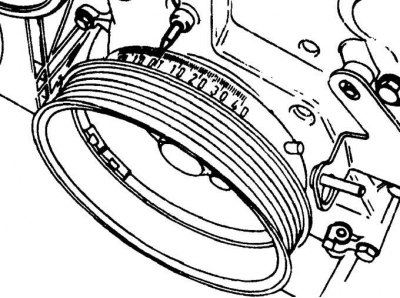


Aligning the mark on the crankshaft pulley with the pointer on the timing chain cover


Alignment of the groove on the front flange of the camshaft with the protrusion on the front cover of the camshaft bearing
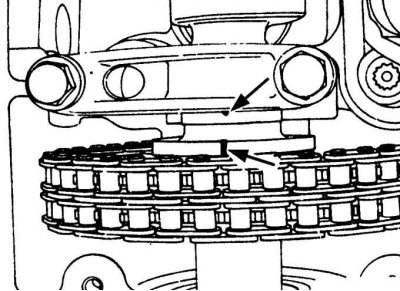


Alignment of the groove on the front flange of the camshaft with the protrusion on the front cover…


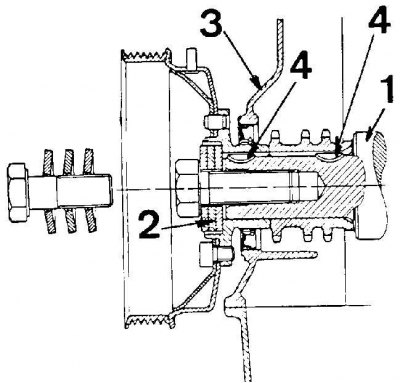
Crankshaft pulley mounting


1 – crankshaft;

1 – crankshaft;
2 – disc washers;
3 – front cover;
4 - segment key


Crankshaft pulley / vibration damper


Publication reprinted from this resource (MercedesMAN.ru)

Removal


Using a special tool to prevent the hub from turning
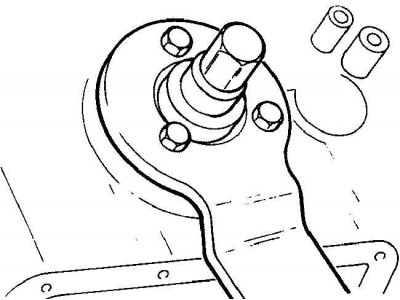


Using a special tool to prevent the hub from turning


1. Remove the ground cable from the battery.

2. Open the hood and secure it in a vertical position.

3. Remove the radiator fan impeller and hydraulic clutch.

4. Loosen the radiator fan pulley mounting bolts.

5. Remove the auxiliary drive belt.

6. To avoid damage to the radiator and to increase the working space, remove the radiator or, as a last resort, install a sheet of cardboard on the inside of the radiator.

7. Unscrew the radiator fan pulley mounting bolts and remove the pulley.

8. Secure the crankshaft pulley/vibration damper from turning using the special tool bolted to the crankshaft pulley (see fig. Using a special tool to prevent the hub from turning).

9. Remove the bolts and crankshaft pulley/vibration damper.

Installation


1. Installation is carried out in the reverse order of removal.

Hub


Attention! When tightening the hub mounting bolt, it is necessary to use a torque wrench that provides a tightening torque of 400 Nm. To remove the hub from the crankshaft, it is necessary to use a puller.


Removal


1. Remove the crankshaft pulley/vibration damper.

2. Secure the hub from turning using a special tool screwed to the hub.

3. Unscrew the hub mounting bolt and remove it along with the four spring washers or large conical washer.

4. Using a puller, remove the hub from the front end of the crankshaft.

5. Remove the woodruff key from the crankshaft groove.

Installation


Location of disc washers on hub mounting bolt
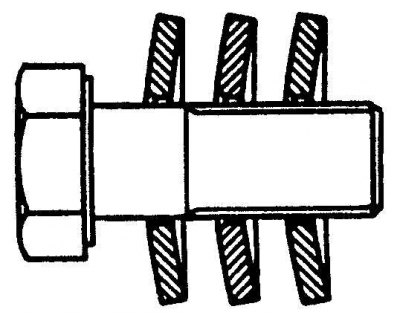


Location of disc washers on hub mounting bolt


1. Install the woodruff key into the crankshaft keyway.

2. Align the groove on the hub with the woodruff key and install the hub onto the crankshaft.

3. On models with Belleville spring washers, lubricate the spring washers and install them on the bolt with the convex side facing the bolt head (see fig. Location of disc washers on the hub mounting bolt).

4. On models with a conical washer, install the washer onto the larger diameter bolt towards the hub.

5. Lubricate the threads of the mounting bolt.

6. Using a special tool, secure the hub from turning and tighten the hub mounting bolt to the required torque.

7. Install the crankshaft/vibration damper pulley.
This article is available at: russian, bulgarian, belarusian, ukrainian, serbian, croatian, romanian, polish, slovak, hungarian
The article has been verified: Levin Kirill Glebovich
Share with friends:
◀ Previous
E-Class W124 / Diesel engines
Next ▶

Cylinder Head Cover — Removal and Installation
Top dead center (TDC) of the piston of the first cylinder
Checking the compression pressure
Repair operations on the engine installed in the vehicle
General engine data
Timing Chain Cover — Removal and Installation
Drive chain — checking and replacing
Drive chain tensioning mechanism
Camshaft and crankshaft sprocket
Chain Tensioners — Removal, Checking and Installation
More similar articles for repairing other models

☛ Crankshaft Position Sensor — Removal and Installation Mercedes W168 (1997-2004)
☛ Crankshaft Pulley/Vibration Damper and Hub — Removal and Installation Mercedes 190 (W201) (1982-1993)
☛ Removal and installation the crankshaft position sensor (CKP) Mercedes W463 (1999-2019)
☛ Removal and installation the torsional vibration damper / drive belt… Mercedes W163 (1997-2005)
☛ Damper and crankshaft pulley Mercedes W116 (1972-1980, petrol)
☛ Belt pulley and torsional vibration damper of the crankshaft Mercedes Sprinter (1995-2000, diesel)
Link in different formats to this article
Comments and feedback from visitors
No comments yet


How much will 21 + 24 ?


W210 (1996-2002) 
  • General information
  • Vehicle description
  • Working conditions and tools
  • Car care
  • Diesel engines
  • Engine repair
  • Lubrication system
  • Cooling system
  • Injection system
  • Supply system
  • Exhaust system
  • Gasoline engines
  • Engine repair
  • Lubrication system
  • Cooling system
  • Control system
  • Power and exhaust system
  • Transmission
  • Clutch
  • Mechanical gearbox
  • Automatic gearbox
  • Drive shafts
  • Chassis
  • Car suspension
  • Steering
  • Tires and wheels
  • Brake system
  • Body
  • Exterior (external elements)
  • Interior (internal elements)
  • Doors and windows
  • Heating and ventilation
  • Electrical equipment
  • Equipment and devices
  • Power devices
  • Lighting and signaling
  • Electrical circuits
W124 (1984-1995) 
  • General information
  • Governing bodies
  • Driving and operation
  • Weekly care
  • Maintenance (gasoline)
  • Maintenance (diesel)
  • Troubleshooting
  • Power unit
  • I4 petrol engine
  • V6 petrol engine (SOHC)
  • V6 petrol engine (DOHC)
  • Diesel engines
  • Engine overhaul
  • Cooling system
  • Heating and ventilation
  • Fuel system (carburetor)
  • Injection system «Bosch CIS-E»
  • Injection system «Bosch HFM»
  • Diesel fuel system
  • Supply system
  • Starting and charging system
  • Ignition system (I4)
  • Ignition system (V6)
  • Preheating
  • Transmission
  • Clutch
  • Mechanical gearbox
  • Automatic gearbox
  • Drive shafts
  • Chassis
  • Brake system
  • Car suspension
  • Steering
  • Body
  • Exterior (external elements)
  • Interior (internal elements)
  • Doors, locks and windows
  • Electrical equipment
  • Equipment and devices
  • Switches
  • Headlights and lighting
  • Electrical circuits
W123 (1976-1985) 
  • General information
  • Introduction to the guide
  • Power unit
  • Engine device
  • Repair M102 engines
  • Repair M110 and M123 engines
  • Cooling and lubrication (M102)
  • Cooling (M110 and M123)
  • Ignition system
  • Power system «Stromberg»
  • Power system «Solex 4A1»
  • Fuel injection «K-Jetronic»
  • Fuel injection «L-Jetronic»
  • Transmission
  • Clutch
  • Mechanical gearbox
  • Automatic gearbox
  • Cardan and rear axle
  • Chassis
  • Front suspension
  • Rear suspension
  • Steering
  • Brake system
  • Body
  • Exterior (external elements)
  • Interior (internal elements)
  • Doors, locks and windows
  • Electrical equipment
  • Equipment and devices
  • Power devices
  • Electrical circuits
 
MercedesMan.ru © 2017–2026 · Mobile version · Read about Mercedes · Sitemap: EN BG BY UA RS HR RO PL SK HU · Feedback · Site search · Bookmark A-Class (W168) · C-Class (W201) · C-Class (W202) · C-Class (W203) · E-Class (W123) · E-Class (W124) · E-Class (W210) · G-Class (W463) · M-Class (W163) · S-Class (W116, petrol) · S-Class (W126, petrol) · S-Class (W140) · S-Class (W220) · Sprinter · Vito 1 · Vito 2 · Vario 814D ·
 
We only use cookies without which some of the site's features may not be available.