



General Provisions
Models with EZL ignition system
1. The EZL ignition system is interrupted by an electronic signal generated by the crankshaft position sensor. The ignition control system determines the correct ignition timing and contact angle according to engine speed, crankshaft position and manifold vacuum. Information about these parameters comes from sensors located on the engine (for more information, refer to paragraphs 1 and 7).
2. Unlike contactless ignition systems, which are interrupted by a rotor fixed to the distributor shaft, the ignition timing in the EZL system cannot be changed by rotating the housing relative to the distributor shaft.
3. However, the basic setting of the ignition timing can be changed in steps to suit the fuel used. This is achieved by the compensator socket, located in the engine compartment next to the ignition system ECU. The socket has a plug that contains resistors with a fixed resistance. The connector can be installed in the socket in various positions, indicated on the top of the socket (see fig. 6.3). Setting the plug to a different position connects another resistor between the socket contacts - this changes the setting of the ignition system ECU, which in a stepwise manner shifts the ignition timing earlier or later than the main one by 3°. For more information, refer to Chapter 5, Part B, paragraph "Ignition Timing - Checking and Setting".
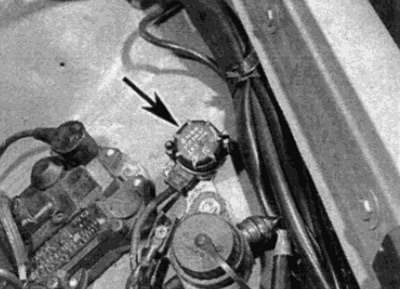
Fig. 3.3. Ignition timing compensator socket (shown by arrow)
4. You can determine the ignition timing in the usual way using a strobe lamp, as described below.
Models with TSZ ignition system
5. The system is interrupted by a sensor mounted inside the distributor housing. This design means that the basic ignition timing can be adjusted by rotating the housing relative to the distributor shaft. Likewise, if the distributor is removed, the ignition timing should be checked and adjusted as described in the next section.
Checking the ignition timing
Note: The engine must be warmed up to normal operating temperature. It is best to perform the check before the engine temperature rises to 95°C or before the radiator fan turns on.
6. Connect the stroboscope to the engine according to the manufacturer's instructions so that the stroboscope is triggered from the high-voltage wire of the 1st cylinder.
7. Start the engine and let it idle. Point the strobe light at the pointer protruding from the chain case. The strobe effect should freeze the movement of the rotating timing mark on the crankshaft pulley/damper relative to the fixed mark on the case. If the mark moves forward or backward, the idle speed is unstable - make sure all electrical devices are switched off and that the radiator fan is not spinning. The engine should be at normal operating temperature, but the idle speed may become unstable on a particularly hot day or if the engine has been idling for a long time.
8. Determine the ignition timing angle using the pointer on the chain cover and the marks on the crankshaft pulley/vibration damper (see fig. 6.8).
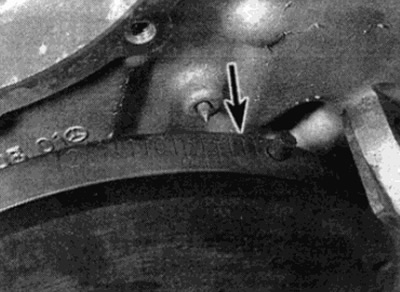
Fig. 6.8. Determine the position of the pointer on the target casing relative to the marks (shown by arrows) on the crankshaft pulley / vibration damper
9. Compare the value with Technical data. On EZL models, if the ignition timing is retarded by 3, the compensator shoe may be installed incorrectly. Refer to the Technical Data section and check that the plug position matches the fuel type. Note that the idle speed ignition advance values are determined in the mode with and without a vacuum from the intake manifold.
Ignition timing - adjustment
Note: This procedure only applies to TSZ ignition systems - see "General" at the beginning of this section.
10. To adjust the main ignition timing, first turn off the ignition to avoid the risk of electric shock from high voltage. Refer to paragraph 4 and loosen the distributor clamp bolts.
Note: Before making adjustments, it is recommended to mark the relative positions of the distributor housing and the engine with paint. This will allow you to return to the original ignition timing if the setting is disturbed for any reason.
11. Turn the distributor a small amount clockwise to advance the ignition timing or counterclockwise to retard the ignition timing. Lightly tighten the bolts and recheck the ignition timing with the timing light. Repeat these steps until the desired ignition timing is achieved. Then tighten the distributor clamp bolts securely and disconnect the timing light.
Publication taken from an online resource (MercedesMAN)