



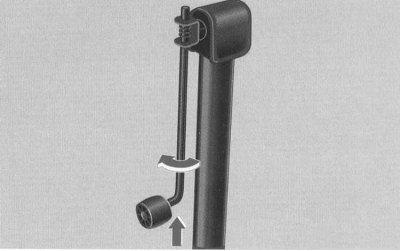
Press the jack handle up and turn it in the direction of the arrow until it locks
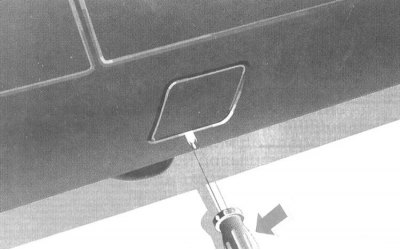
Use a screwdriver to remove the cover from the jack mounting hole
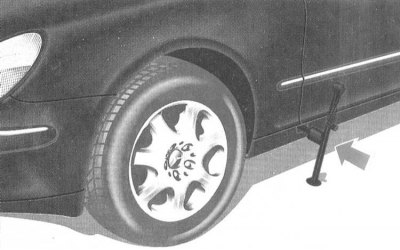
Push the jack pin in until it stops
Jacking up
The car jack is located in an additional compartment under the trunk floor, next to the spare tire.
Preparing a car jack for use
Remove the car jack from the additional compartment under the trunk floor, press the handle up and turn it to the right until it locks (working position).
Stowing a Car Jack in the Trunk
Turn the jack support pin back to the jack support, press the handle up and turn it to the left until it stops (starting position).
The support area of the car jack must be firm and level. In case of loose soil, use a car jack pad.
Park the vehicle on level ground, if possible.
Press the parking brake pedal firmly. Do not release the parking brake while the vehicle is raised.
Move the AT selector lever to position "P".
Prevent the vehicle from rolling away by placing wheel chocks, etc.
On a level road: Place chocks under the diagonally positioned wheel at the front and rear.
On uphill and downhill gradients: Place chocks under both wheels of the other axle facing downhill.
From the on-board tool kit, remove the two-piece wheel wrench and assemble it.
Loosen the wheel mounting bolts with a wrench, but do not remove them completely yet.
Remove the cover from the car jack mounting hole.
The holes for installing a car jack are located behind the wheel arches of the front wheels and in front of the wheel arches of the rear wheels.
Push the jack support pin fully into the jack mounting hole.
The car jack must always stand vertically - also on slopes.
Raise the vehicle until the wheel is off the ground.
To prevent the vehicle from slipping, insert the jack support pin into the jack mounting hole on the vehicle as far as it will go.
Towing
General remarks
The requirements of the "Road Traffic Regulations" regarding towing must be observed.
The towing rope must be elastic to avoid damaging both vehicles. Only ropes made of synthetic fibers or similar elastic materials should be used. However, it is safer to use a towing rod!
Care must be taken to ensure that there is no unacceptably high tension and that there is no significant rolling resistance to the vehicle. When towing a vehicle along the edge of a dirt road, there is always a risk of drifting to the side of the road.
Before attempting to tow start the engine, you should, if possible, use another vehicle's battery to jump start the engine - refer to the previous section.
Both drivers must be familiar with the towing handling precautions outlined below and have sufficient experience. Inexperienced drivers should not be driving either vehicle.
When using a towing rope, the driver of the towing vehicle must release the clutch pedal especially smoothly when starting off and changing gears.
The driver of the towed vehicle must ensure that the towing rope is kept taut at all times.
Both vehicles must have external lights on in accordance with the Road Traffic Regulations.
The ignition must be on so that the steering wheel does not lock and it is possible to turn on the direction indicator, horn, windscreen wipers and washers if necessary.
The power steering of the service brake system performs its function only when the engine is running, therefore, when braking with the engine off, it is necessary to press the brake pedal much harder.
Since the power steering does not function when the engine is not running, more force must be applied to the steering wheel when turning.
If there is no oil in the automatic transmission, the vehicle must be towed only with the drive wheels raised.
There is a danger of being left outside when pushing or towing a vehicle:
The vehicle is locked when the electronic key is in the ignition switch in position 2 (models with KEYLESS-GO system: in driving position) and the car moves.
The "Automatic locking while driving" function can be switched off (refer to the "AUTOMATIC DOOR LOCKING" subsection in the "Custom setting" section).
Article obtained from this portal: MercedesMAN.ru
Note: After disconnecting the battery terminals or when the battery is discharged, the electronic key in the ignition switch no longer turns and the AT selector lever remains locked in the "P" position. (Charging the battery is discussed in Chapter Routine maintenance, or Section Starting the engine using an auxiliary battery).
Caution! Towing is permitted only with the towing eyes. Do not attach the towing rope or towing bar to any part of the chassis.
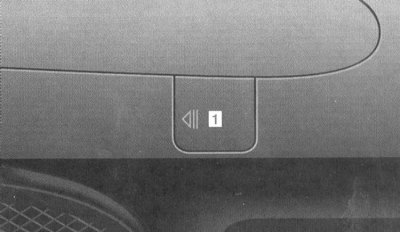
Plug 1 on the front bumper
The receptacles for the screw-in towing eye are located behind the bumper caps.
The towing eye is included in the on-board tool kit.
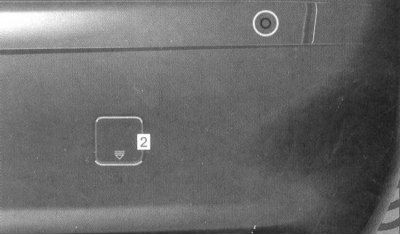
Plug 2 on the rear bumper
Installing a towing eye
At the marking point, press in the direction of the arrow, lift the plug, do not pull it off. Screw the towing eye in until it stops and tighten it with the wheel wrench lever (from the on-board tool kit).
Removal the towing eye
Unscrew the towing eye and store it in the toolbox.
Place the plug on and secure it.
Instead of towing, preference should be given to transporting the vehicle on a special vehicle or trailer.
In cases where towing is unavoidable, we recommend using a towing bar.
Note: The electronic key can only be turned in the ignition switch when the battery is connected and charged. If the electronic key cannot be turned in the ignition switch, the AT selector lever remains locked in the "P" position.
Turn the electronic key in the ignition switch to position 2.
Move the AT selector lever to the "N" position.
Maximum towing speed: 50 km/h.
Maximum towing distance: 50 km.
Failure to comply with maximum towing speed or distance may result in transmission damage.
For longer distances or in case of gearbox damage, towing is only permitted with the rear axle raised or disconnected (from the rear axle) cardan shaft.
Caution! When towing with the front axle raised or checking the parking brake on a brake test stand, the engine must be switched off. Otherwise, the active braking effect of the electronic traction control system (ESP) will damage the rear axle brake system.
Towing for the purpose of starting the engine
Emergency engine starting by towing is not possible.
Transportation of the car
Towing eyes can be used to load the vehicle onto a special vehicle or trailer.
When pushing the vehicle, move the AT selector lever to the "N" position.
The vehicle is secured only by wheels/disks.
Caution! To avoid damage, do not secure the vehicle to chassis components such as transverse or longitudinal suspension arms.