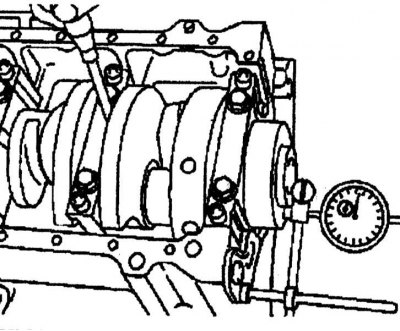
Checking the radial clearance of the crankshaft
1. Install the main bearing caps. If the cap is installed correctly, its tab should be offset to the left when viewed in the direction of travel (i.e. located on the intake manifold side).
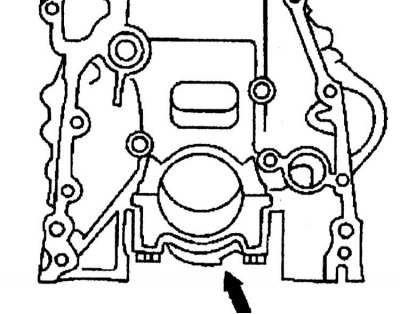
2. Measure the diameter of the crankshaft bore in the cylinder block (with main bearing caps installed) in directions A, B and C.
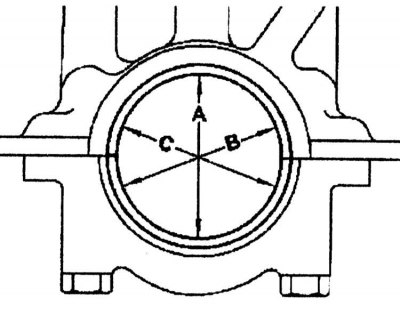 |
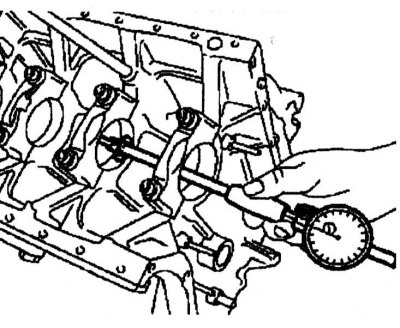 |
3. Measure the diameter of the hole in direction A and write it down. Let it be, for example, 62.51 mm.
4. Remove the main bearing cap.
5. Measure the main bearing journal diameter. Let it be, for example, 57.95 mm.
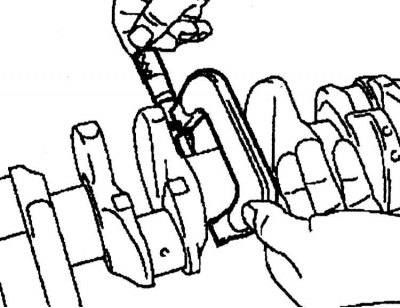
6. Calculate the gap:
Bore diameter (62.51 mm) - Crankshaft main bearing journal diameter (57.35 mm) = 4.55 mm.
From this result, subtract the nominal value of the radial clearance of 0.04 mm (refer to Specifications table) and get 4.51 mm. Divide this result by 2 and get the liner thickness of 2.255 mm.
7. Select the liner of the appropriate thickness. For example: the liner thickness is 2.255 mm. In accordance with the requirements Specifications select the insert by color. In this case, it is a blue insert.
8. Insert the connecting rod bearing shells into the connecting rod cap and secure them with bolts.
9. Measure the diameter of the lower connecting rod head with bearings.
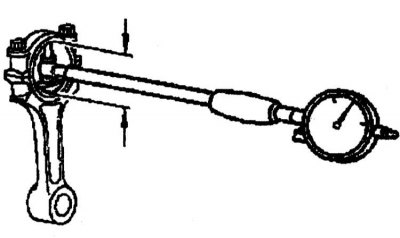
10. Measure the diameter of the connecting rod journals and use the measured value to determine the radial clearance in the crankshaft bearings. Connecting rod lower head diameter (with inserts) - Connecting rod journal diameter = Crankshaft radial clearance.
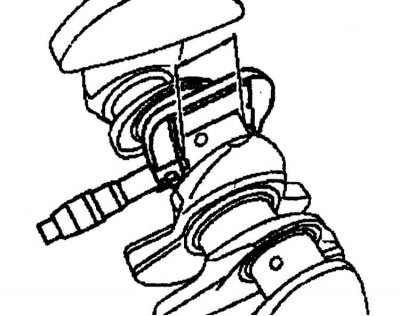
Checking the axial play of the crankshaft
1. Measure the width of the crankshaft main bearing journal.
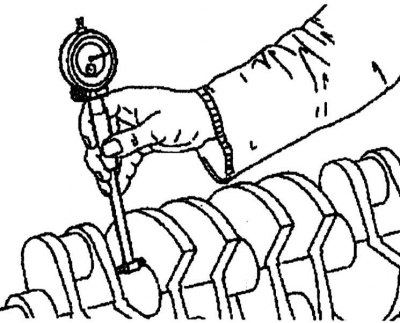
2. Determine the thickness of the end play adjuster. The thickness of the end play adjusters varies from 2.15 to 2.40 mm in 0.05 mm increments.
3. Install the end play adjusters. The oil passages should be lubricated and installed forward.
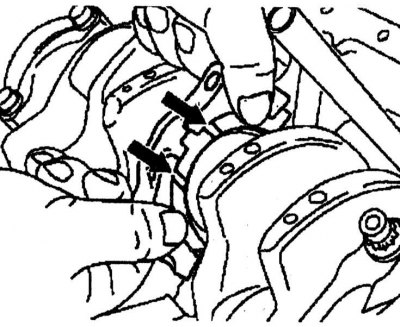
4. Measure the crankshaft axial play and adjust it if necessary.