
Cars BMW Cars Volkswagen Cars Chevrolet Cars Land Rover Cars Lada Cars Honda Cars Peugeot
English Русский
Български
Беларускі
Український
Српски
Hrvatski
Română
Polski
Slovenský
Magyar
Bookmark News and articles Sitemap Feedback Site search
MercedesMan.ru


A-Class C-Class E-Class G-Class M-Class S-Class Others
W116 (1972-1980, petrol) W126 (1979-1991, petrol) W140 (1991-1998) W220 (1998-2005)
  • Main
  • S-Class
  • W126 (1979-1991)
  • Chassis
  • Steering
  • Wheel alignment angles

Wheel alignment angles (Mercedes-Benz S-Class W126)

0
Contents: Convergence ↡ Adjusting the front wheel alignment…↡
Optimal driving conditions and minimal tire wear can only be achieved with correct wheel alignment angles. In case of uneven tire wear or if the car does not "hold" the road well and does not respond to the steering wheel, it is necessary to contact specialists to check the wheel alignment angles.

This work requires special equipment and cannot be done independently, so here we will only cover the basic concepts.

Convergence


Toe-in is the lateral distance between the wheels. As a rule, the front wheels should have a positive toe-in, since due to rolling resistance they tend to diverge when moving in a straight line. When specifying a positive toe-in for the front wheels, the distance between them is measured at the height of the wheel centers - at the front it should be slightly less than at the rear.

With negative toe-in of the front wheels, the distance measured at the height of their centers should be slightly greater at the front than at the rear.

On a Mercedes, both the front and rear wheels can be adjusted for positive toe-in.

Front wheel camber and kingpin angle in the transverse plane:
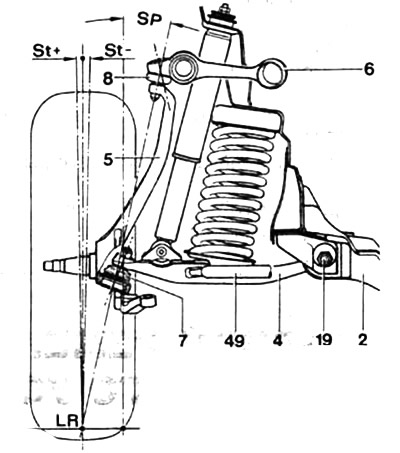


Front wheel camber and kingpin angle in the transverse plane:


Front axle:


  • St - Collapse.
  • Sp - Angle of inclination of the kingpin in the transverse plane.
  • LR - Turning radius.
  • 2 - Crosspiece.
  • 4 - Lower control arm.
  • 5 - Steering knuckle.
  • 6 - Upper control lever.
  • 7 - Lower ball joint.
  • B - Upper ball joint.
  • 19 - Eccentric bolt for adjusting wheel alignment.
  • 49 - Support tube.

Correctly set wheel camber and kingpin angle in the transverse plane soften the shocks transmitted from road irregularities to the steering and reduce tire friction on the road when turning.

Camber is the angle between the plane of the wheel and the vertical. With positive camber, the distance between the front wheels at the bottom is less than at the top. The turning radius of a Mercedes is zero.

The angle of inclination of the front wheel kingpins in the longitudinal plane:
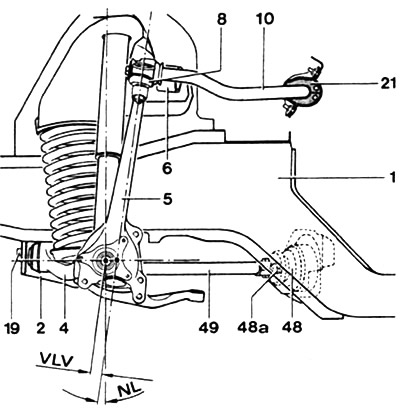


The angle of inclination of the front wheel kingpins in the longitudinal plane:


Front axle:
  • NL - Angle of inclination of kingpin in longitudinal plane.
  • VLV - rear wheel camber.
  • 1 - Side element.
  • 2 - Crosspiece:
  • 4 - Lower control arm.
  • 5 - Steering knuckle.
  • 6 - Upper control lever.
  • 8 - Upper ball joint.
  • 10 - Stabilizer.
  • 19 - Eccentric bolt for adjusting wheel alignment.
  • 21 - Rubber bushing of the stabilizer.
  • 48 - Ball joint.
  • 48a - Ball joint for adjusting the steering angle of the front wheels.
  • 49 - Support tube.

The angle of the kingpin in the longitudinal plane is determined relative to the vertical drawn through the wheel axis. The angles of the kingpin inclination, both in the longitudinal and transverse planes, are adjusted using two eccentric bolts.


The caster angle of the kingpins affects how well the front wheels "hold" the straight-line. Too little caster angle causes deviations from the straight-line on poor roads or in strong winds, and also prevents the steering mechanism from returning to the center position after completing a turn.

Adjusting the front wheel alignment angles


To adjust the front wheel alignment angles, you will need a pit or lift. Before you begin taking measurements, check the following:

Is the tire pressure correct?.

The car must be empty, the fuel tank must be full, the spare wheel and tool kit must be in place.

Check the steering adjustment.

Check the steering rods for excessive play.

Check the wheel suspension for excessive play.
This article is available at: russian, bulgarian, belarusian, ukrainian, serbian, croatian, romanian, polish, slovak, hungarian
The article has been verified: Burova Vera Semenovna
Share with friends:
◀ Previous
S-Class W126 / Steering
Next ▶

Power steering hydraulic pump drive belt
Steering system clamp bolts — tightening
Checking the oil level
Steering gear play — check
Tie rod/steering rod joint boots — check
Steering Specifications
Tightening torques for threaded connections
More similar articles for repairing other models

☛ Adjusting the position of the steering wheel Mercedes W168 (1997-2004)
☛ Conditions for checking wheel alignment angles Mercedes W203 (2000-2007)
☛ Checking and adjusting the front wheel alignment angles Mercedes W123 (1976-1985)
☛ Car Wheel Alignment Angles — General Information Mercedes W463 (1999-2019)
☛ Car Wheel Alignment Angles — General Information Mercedes W163 (1997-2005)
☛ Adjusting the front wheel alignment angles Mercedes Sprinter (1995-2000, diesel)
Link in different formats to this article
Comments and feedback from visitors
No comments yet


How much will 13 + 23 ?


W220 (1998-2005) 
  • General information
  • Introduction to guide
  • User manual
  • Maintenance
  • Power unit
  • Engine repair
  • Cooling and heating systems
  • Power and exhaust systems
  • Ignition and control system
  • Charge and launch systems
  • Transmission
  • Automatic gearbox
  • Drive shafts
  • Chassis
  • Brake system
  • Front suspension
  • Rear suspension
  • Steering
  • Body
  • Body elements
  • Electrical equipment
  • Equipment and devices
  • Electrical circuits
W140 (1991-1998) 
  • User manual
  • Controls and instruments
  • Driving and operation
  • Maintenance
  • Power unit
  • Petrol engine V6
  • Petrol engine V8
  • Petrol engine V12
  • Diesel engine OM603
  • Diesel engine OM606
  • Cooling system
  • Power supply and injection system
  • Control system HFM-SFI
  • Control system LH-SFI
  • Control systems ME-SFI
  • Diesel control system
  • Ignition system
  • Charge and launch system
  • Transmission
  • Mechanical gearbox 717.438
  • Mechanical gearbox 717.454
  • Automatic gearbox 722.5
  • Automatic gearbox 722.6
  • Clutch and drive shafts
  • Differential
  • Chassis
  • Brake system
  • Steering
  • Front suspension
  • Rear suspension
  • Body
  • Exterior (external elements)
  • Interior (internal elements)
  • Electrical equipment
  • Equipment and devices
  • Electrical circuits
W126 (1979-1991, petrol) 
  • Power unit
  • Engine repair
  • Ignition system
  • Lubrication system
  • Cooling system
  • Fuel system
  • Fuel injection system
  • Transmission
  • Clutch and cardan
  • Mechanical gearbox
  • Automatic gearbox
  • Chassis
  • Front suspension
  • Rear suspension
  • Steering
  • Brake system
  • Electrical equipment
  • Power devices
  • Electrical circuits
W116 (1972-1980, petrol) 
  • General information
  • Introduction to guide
  • Power unit
  • 8-cylinder V8 engine
  • 6-cylinder I6 engine
  • Cooling and lubrication system
  • Power system (carburetor)
  • Fuel injection system
  • Ignition system
  • Transmission
  • Clutch and cardan
  • Car gearbox
  • Chassis
  • Front suspension
  • Rear suspension
  • Steering
  • Brake system
  • Electrical equipment
  • Power devices
  • Electrical circuits
 
MercedesMan.ru © 2017–2026 · Mobile version · Read about Mercedes · Sitemap: EN BG BY UA RS HR RO PL SK HU · Feedback · Site search · Bookmark A-Class (W168) · C-Class (W201) · C-Class (W202) · C-Class (W203) · E-Class (W123) · E-Class (W124) · E-Class (W210) · G-Class (W463) · M-Class (W163) · S-Class (W116, petrol) · S-Class (W126, petrol) · S-Class (W140) · S-Class (W220) · Sprinter · Vito 1 · Vito 2 · Vario 814D ·
 
We only use cookies without which some of the site's features may not be available.