



Contents: Removal and installation ↡ Adjusting the breaker contacts ↡ Centrifugal and vacuum regulators ↡
Removal and installation
To turn the engine crankshaft, use a socket wrench or a ball-head socket placed on the head of the damper mounting bolt. Rotate the shaft only in the direction of travel.
Disconnect the wire from the battery. For safety, disconnect the two wires and secure them.
Remove the distributor cap, connecting wires and vacuum regulator hose.
Turn the crankshaft to TDC of the piston of the first cylinder. Check the alignment of the marks on the rotor and the distributor housing, as shown in Fig. 157.
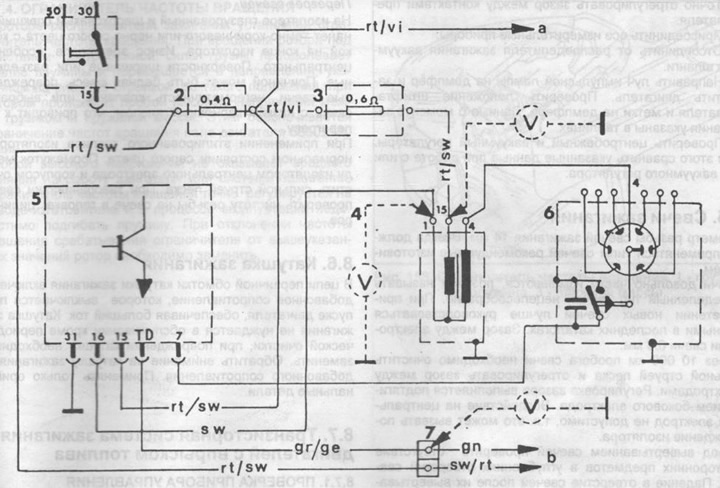
Fig. 156. Diagram of a transistor ignition system with unified control devices.
1 - ignition switch,
2 - additional resistance 0.4 Ohm,
3 - additional resistance 0.6 Ohm,
4 - ignition coil,
5 - unified control device,
6 - ignition distributor,
a - to the terminal,
in - to the central plug connector,
7 - connection panel with a terminal for testing the TD.
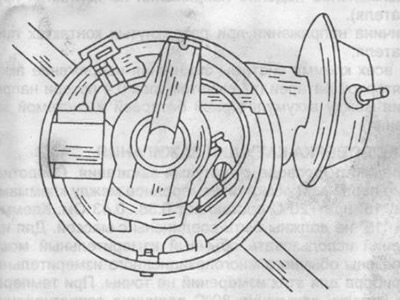
Fig. 157. Marks on the rotor and distributor housing.
Check that the pin on the camshaft drive cover matches the "0" mark on the damper.
Loosen the distributor mounting bolt with an internal hexagon.
Remove the ignition distributor.
The ignition distributor is installed in the reverse order. If the shaft has been turned during removal and installation, it is necessary to set the TDC of the piston of the first cylinder again. When installing the ignition distributor, align the marks on the rotor and the distributor housing. After installing the distributor, adjust the ignition timing as described in section 8.4.
Adjusting the breaker contacts
Check the condition of the breaker contacts. Replace faulty contacts.
Using a feeler gauge, adjust the gap between the breaker contacts. The plastic block should be located on the camshaft cam protrusion. In this position, loosen the fastening screw and tighten it after adjustment.
Check that the contacts of the breaker in the closed position are adjacent to each other over the entire surface. The gap between the contacts is 0.3...0.4 mm. Fine adjustment of the contacts can be performed using a device for measuring the angle of the closed state in accordance with the manufacturer's instructions.
Centrifugal and vacuum regulators
Special devices are required for a complete check of the regulators. It is advisable to perform these works at a service station. The following simple works can be performed to eliminate possible causes of errors.
Vacuum regulator
Check the tightness of the housing and pipelines. Check the ease of rotation of the breaker plate.
Centrifugal governor
Check the wear of the weights, springs and weight axles. Remove thickened grease or excess grease from the weights, as they may have a detrimental effect on the operation of the mechanism.