



Contents: Adjusting the accelerator pump ↡ Checking the check valve ↡ Checking the pneumatic damping drive…↡ Adjustment of idle speed and exhaust…↡ Adjusting the fuel supply drive rods ↡ Checking the full load stop ↡ Adjusting the vacuum regulator ↡ Adjustment of the starting automation ↡
Adjusting the accelerator pump
Press the accelerator pump lever several times. Strong jets of fuel should appear (see arrows in Fig. 120). If they are not available, perform the following work:
Remove the accelerator pump cover.
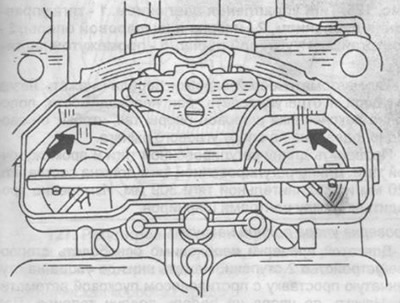
Fig. 120. Checking the accelerator pump.
Check the condition of the diaphragm and blow out the inlet and outlet channels.
Assemble the accelerator pump. If fuel does not flow when the pump is pressed, remove the carburetor cover and check the accelerator pump operation again. If fuel appears in both valves, blow out the injection holes in the carburetor cover with compressed air.
Checking the check valve
Disconnect the hose from the fuel return line (below the fuel pump). Lower the hose into the container and check the fuel flow at idle speed, with the automatic transmission control lever in different positions and with the air conditioner on.
Checking the pneumatic damping drive of the 2nd stage
Start the engine at idle speed and bring the pneumatic drive diaphragm to the stop against the housing. Pinch the hose, open and close the air damper several times. The diaphragm should always return to its original position with a characteristic sound. Raising the diaphragm during testing is a sign of its leakage and the diaphragm must be replaced.
Adjustment of idle speed and exhaust gas composition for CO emission level
The idle speed adjustment screw has a protective seal to prevent unqualified adjustment of the idle speed. The mixture composition adjustment may also be sealed. In Fig. 121, the arrows show the location of the seals. For this reason, adjustment work must be carried out at a service station. In the absence of a seal and with the appropriate experience, the idle speed is adjusted as follows:
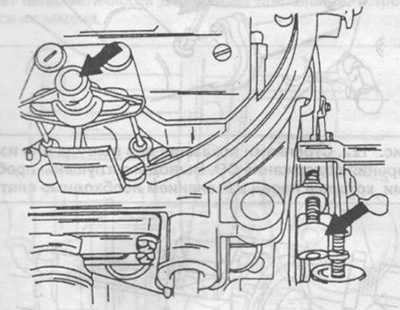
Fig. 121. Locations of seals on mixture composition adjustment screws (left arrow) and idle speed (right arrow).
Start the engine and warm it up to operating temperature. Check that the air damper is fully open. Check the ease of rotation of the throttles. To do this, increase the rotation speed to 2000...25000 rpm by turning the throttle lever and release the lever. The lever should automatically return to its original position.
Connect the tachometer and CO meter in accordance with the operating instructions.
Start the engine and note the tachometer readings. If the rotation speed is not within 800...900 rpm, adjust with the screw (2), as shown in Fig. 123. On the other side, remove the cap - seal shown in Fig. 120 and adjust the idle speed accordingly. After adjustment, install a new seal (part # 000 988 513 5). Check the position of the throttle lever, it should reach the stop and not touch the vacuum regulator. If necessary, loosen the vacuum regulator spring by turning the nut (1) (see fig. 123).
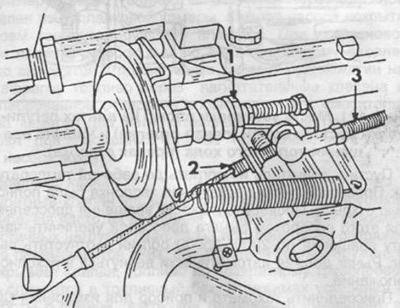
Fig. 123. Adjusting the idle speed.
1 - adjusting nut,
2 - idle speed adjustment screw,
3 - adjustable traction.
Determine the CO content using the device. To do this, connect the device to the terminals on the two exhaust pipes, if any (see fig. 122), otherwise connect the device in accordance with its operating instructions. When checking, perform the following work:
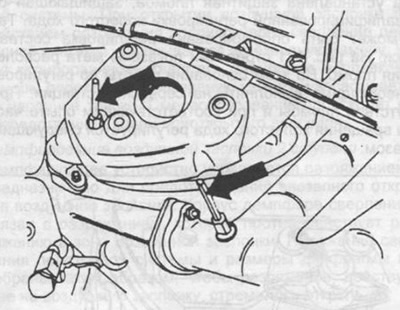
Fig. 122. The arrows show two terminals for measuring CO content. The terminals are plugged with stoppers, which must be removed before making any changes.
Start the engine and read the instrument readings. The readings should be within 2.5%.
If necessary, remove the seals from the adjusting screws, as shown in Fig. 124, and turn both screws to the right until they stop. Then turn the screws to the left by the same angle until the desired CO value is achieved. When unscrewed, the mixture is enriched; when screwed, it is leaner.
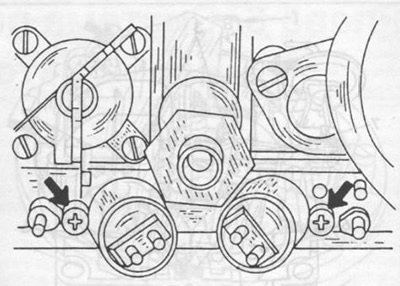
Fig. 124. The arrows show the adjusting screws for regulating the composition of exhaust gases at idle speed.
Check the idle speed and adjust if necessary. After adjustment, check the CO content in the exhaust gases again. Install new seals.
Adjusting the fuel supply drive rods
For vehicles with manual transmission:
Start the engine at idle speed.
Adjust the length of the drive rod so that the rocker arm roller reaches the stop without tension.
For cars with automatic transmission (see fig. 125):
Start the engine at idle speed.
Remove the automatic transmission pressure control rod (1).
Press back on the angle lever as shown in Fig. 125.
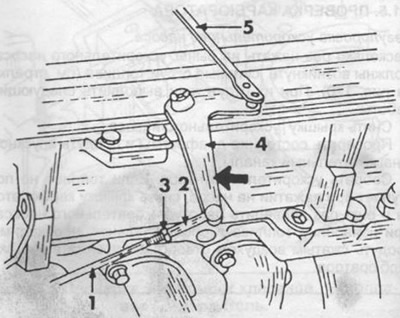
Fig. 125. Pressure control rod.
1 - pressure control rod,
2 - ball joint tip,
3 - lock nut,
4 - angular lever,
5 - intermediate thrust.
Press the automatic transmission rod back as far as it will go and, if necessary, adjust the position of the ball joint tip so that it fits freely onto the corner lever support.
Check the length of the adjusting rod and the intermediate rod. The length of the adjusting rod should be 120 mm and the connecting rod 309 mm. The measurement is taken between the centers of the hinges.
Checking the full load stop
For this check, it is necessary to release the 2nd stage locking device. Press down the stop part on the step spacer with the counterweight of the starting automation. Press the fuel pedal all the way down. In this case, the throttle levers should also reach the limit stop. If necessary, adjust the position of the lever after loosening the mounting bolt in the engine compartment (see fig. 126).
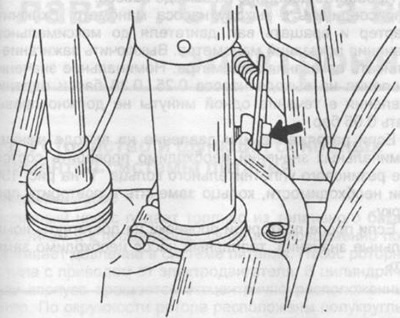
Fig. 126. Adjusting the full load stop.
Adjusting the vacuum regulator
Before performing work, adjust the idle speed and warm up the engine. The engine runs at idle.
Disconnect the hose from the regulator.
Using the adjusting bolt (5) in Fig. 127, increase the rotation speed to 1600 rpm.
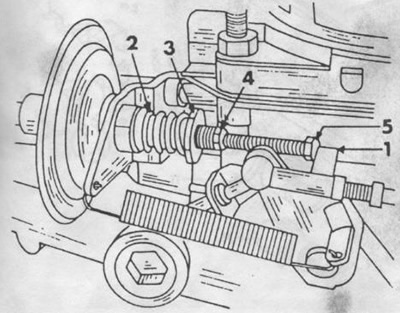
Fig. 127. Adjusting the vacuum regulator.
1 - throttle lever,
2 - spring,
3 - adjusting nut,
4 - lock nut,
5 - adjusting bolt.
Connect the hose.
Before adjustment, loosen the lock nut (4), holding the diaphragm rod with a wrench from turning. If the diaphragm rod is poorly fixed, this indicates damage to the diaphragm in the regulator body.
Adjust the spring force:
Automatic transmission
Set the gearbox control lever to the drive position. The rotation speed should be within 600...700 rpm. Adjust the spring force (2) using the nut (3) to this rotation speed. Then turn the front wheels of the car to the stop and turn on the air conditioner. Repeat the adjustment if necessary.
Manual transmission
The engine runs at idle speed. Adjust the spring force with the nut so that there is a gap of 1.0 mm between the head of the adjusting bolt and the throttle lever.
Adjustment of the starting automation
Check the ease of rotation of the starting damper.
Turn on the ignition and check the starting damper opening time.
Check the adjustment of the starter cover. The marks on the body and cover should be in line.
Start the engine at idle speed until the diaphragm stops against the pneumatic drive housing under the action of vacuum.
Information copied from the website www.MercedesMan.ru
Place a clamp on the hose and pinch the hose.
Stop the engine and check the diaphragm travel time.
Raise the throttle lever and move the stepped spacer up to the stop. Release the throttle lever.
Press the bimetallic spring lever with a screwdriver until it noticeably stops. Insert the end of the rod into the lever hole. Lower the lever slightly until the diaphragm acts on it.
Using a rod or a drill with a diameter of 1.5 mm, check the gap between the lower open edge of the starting flap and the carburetor wall. To adjust the gap, remove the rear coolant supply hose from the automatic starting housing. Hold the rod with a screwdriver and bend it with a second screwdriver as shown in Fig. 128. If the gap is large, the rod must be straightened; if small, bend it. During the adjustments, check the position of the diaphragm; it must be pressed against the housing as far as it will go. If not, this means that the diaphragm or hose is not tight and must be replaced.
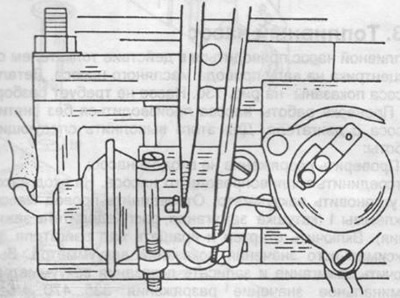
Fig. 128. Adjusting the starting damper.
Check the cold start speed and adjust if necessary. Work is performed on a warm engine with an adjusted idle speed.
- start the engine at idle speed.
- lift the lever and press the stepped spacer up to the stop, release the throttle lever.
- measure the rotation speed, if necessary, adjust the screw. The rotation speed at cold start is 2400...2600 rpm (see fig. 129).
- in the second version carburetors, the adjustment is made using a screw located in the cover of the starting device. In carburetors with a TN device, the cold start speed adjustment is not required, since the throttle control is performed by the vacuum regulator. The adjusting screw "1", shown in Fig. 129, is therefore not installed.
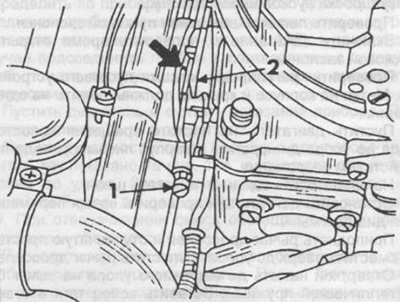
Fig. 129. Adjusting the rotation speed during cold start.
1 - adjusting screw,
2-stage spacer.