



Disassembling the carburetor
Unscrew the four carburetor mounting nuts.
Remove the safety spring ("1" Fig. 117).
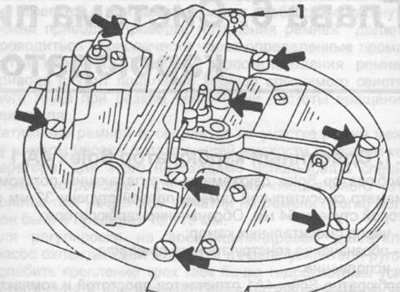
Fig. 117. Removing the carburetor.
1 - safety spring.
Remove the control rods.
Remove the eight cap screws securing the carburetor cover (arrow in Fig. 117), lift the cover with a screwdriver in the designated places and then remove the cover.
Check the operation of the accelerator pump. In this case, from two ball valves (are shown by arrows in Fig. 118) fuel should appear at the same time. If there is no fuel in the valves, remove the pump cover, check the condition of the diaphragm and blow out the inlet and outlet channels.
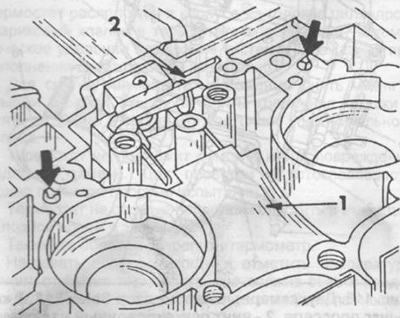
Fig. 118. Checking ball valves.
1 - float,
2 - holder.
Remove the holder ("2", Fig. 118) and take out the float and needle valve.
Remove the two main jets and two plugs from the idle fuel channels (see fig. 119).
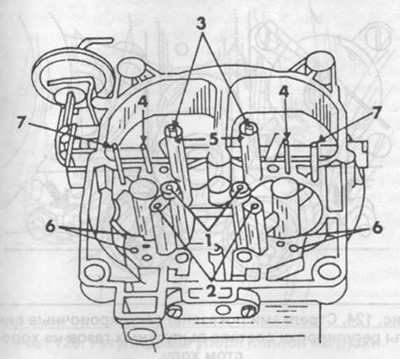
Fig. 119. Disassembling the carburetor.
1 - main jets of the 1st stage,
2 - idle fuel channel plugs (to idle fuel jets),
3 - 2nd stage jet needles,
4 - pressure pipes of the 2nd stage transition system,
5 - main jets,
6 - calibrated holes for fuel injection,
7 - pressure tubes of the device for enriching the mixture during start-up.
Cleaning the carburetor
Blow out the carburetor body, all holes and pressure tubes in the carburetor cover and all jets with compressed air. Do not use needles or wire to clean the jets, as this may damage or change the size of the holes, which affects engine power.
Assembling the carburetor
Install the jets, float, needle valve and holder.
Install a new gasket on the carburetor body.
Check that the gasket does not block the channels in the carburetor body.
Install the carburetor cover.
Tighten the carburetor mounting nuts crosswise to 15 Nm.