



Ignition coils
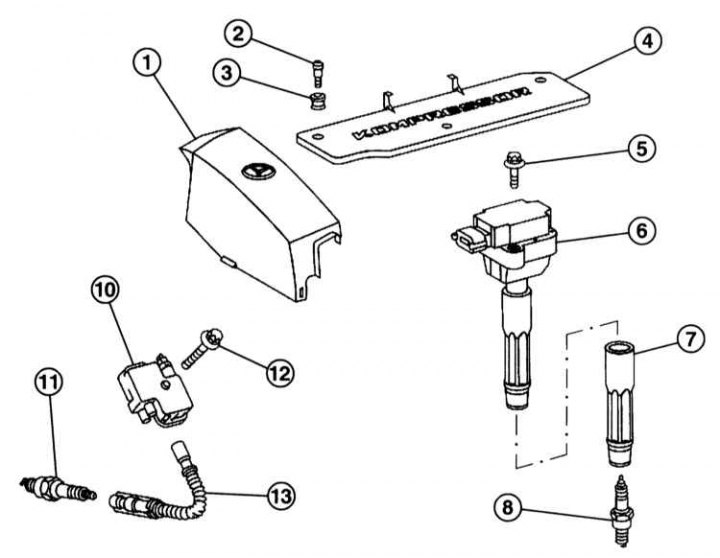
4-cylinder petrol engine
1 - Front engine cover; 2 - Bolt; 3 - Spacer; 4 - Ignition coil cover; 5 - Bolt M6x25, 9Nm; 6 - Ignition coil; 7 - Spark plug connector; 8 - Spark plug: Engine 111: 28Nm, Engine 271: 25Nm
6-cylinder petrol engine
10 - Ignition coil; 11 - Spark plug, 28Nm; 12 - Bolt, 8Nm; 13 - Ignition cable with spark plug plug, from ignition coil to spark plug
Control system component layout diagram. Models C240 and C320
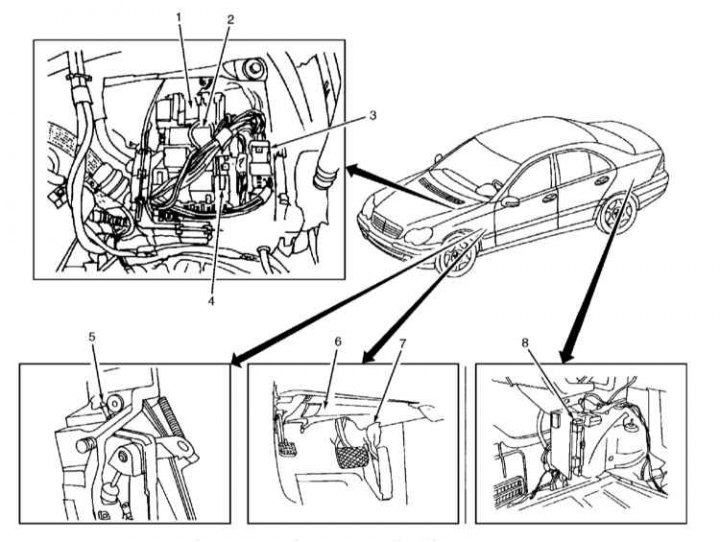
1 - Front signal selection and registration control unit (SAM) with relay/fuse box and secondary air mixing system relay; 2 - Fan Relay Module; 3 - ECM; 4 - SAM control unit with relay/fuse box and starter relay; 5 - Clutch pedal switch sensor; 6 - DLC connector; 7 - Pedal position sensor; 8 - Rear SAM control unit with relay/fuse box and fuel pump relay
The ignition system produces sparks that ignite the sucked-in fuel-air mixture. To do this, the ignition coils convert the 12 V voltage into 30,000 V.
The electronic direct ignition system is part of the engine management system and includes spark plugs as well as ignition coils with integrated spark plug plugs. In the 6-cylinder engine, the ignition coils and spark plug plugs are connected by a short cable.
The distribution of ignition current to the spark plugs is controlled by the electronic control unit.
External adjustment of the ignition timing is not performed. If the ignition timing deviates from the specified value, it is necessary to replace the damaged elements.
The ignition system does not wear out and does not require maintenance. According to the maintenance schedule, only the spark plugs need to be replaced.
Basic information on the operation and sensors of the control and injection systems of gasoline and diesel engines is presented in Section Functioning of the control and injection system of a gasoline engine.
The main elements of electrical equipment, the location of ignition and fuel injection control units, sensors, valves and drive elements are shown in the accompanying illustrations.
Safety precautions when working with the ignition and injection system
To avoid injury to people and/or damage to the injection and ignition system, the following must be observed:
- Do not touch or disconnect spark plug wires while the engine is running or the starter is engaged.
- Disconnect and connect injection system pipes and ignition wires, as well as electrical wires of measuring devices only with the ignition switched off.
- Do not allow people with a pacemaker to work on the electronic ignition system.
- It is not allowed to short-circuit terminal 1 of the ignition coils to ground.
- When working at engine cranking speeds, such as when checking compression pressure, turn off the ignition and disconnect the crankshaft position sensor connector.
- Do not connect the test lamp to terminal 1 of the ignition coils.