
Cars BMW Cars Volkswagen Cars Chevrolet Cars Land Rover Cars Lada Cars Honda Cars Peugeot
English Русский
Български
Беларускі
Український
Српски
Hrvatski
Română
Polski
Slovenský
Magyar
Bookmark News and articles Sitemap Feedback Site search
MercedesMan.ru


A-Class C-Class E-Class G-Class M-Class S-Class Others
190 (W201) (1982-1993) W202 (1993-2000) W203 (2000-2007)
  • Main
  • C-Class
  • W203 (2000-2007)
  • Power unit
  • Exhaust system
  • Turbocharger — General Information and Precautions

Turbocharger — General Information and Precautions (Mercedes-Benz C-Class W203)

0
Contents: General information ↡ Precautionary measures ↡
Some petrol models may be equipped with a belt-driven supercharger. This is discussed in Section…


Some petrol models may be equipped with a belt-driven supercharger. This is discussed in Section Belt driven blown air compressor.

General information


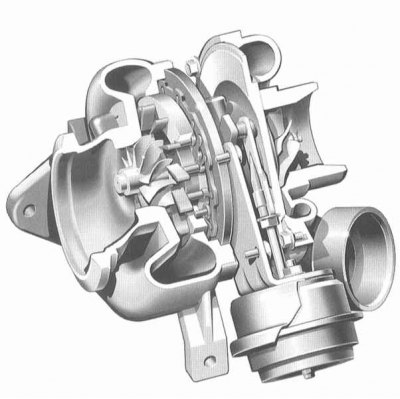
On the turbocharger shaft, two working wheels are located in two separate housings. The turbine wheels are driven by exhaust gases. They ensure rotation of the turbocharger shaft and thus both turbine wheels at a speed of 300,000 rpm. The turbocharger is lubricated by the engine lubrication system.

Due to good filling of the cylinders with forced air, the engine power increases up to 100%.

The turbocharger is designed to increase engine power (up to 100%) by increasing the air pressure in the intake manifold. Air does not simply enter the cylinders, but is supplied to them under pressure. Along with power, boost creates an increase in engine torque. The increase in power, among other things, depends on the pressure of the supercharged air, which is usually 1.0 atm. The pressure of the supercharged air is constantly monitored and regulated by the engine control unit. This eliminates the possibility of exceeding the pressure above the set value. In accordance with the increase in air supply, the high-pressure fuel pump increases the fuel supply.


The compressor turbine is driven by the exhaust gases. The gases pass through a special casing (compressor casing), are fed to the compressor turbine. The turbine rotates on a shaft, at the other end of which is a compressor wheel in a separate casing. It is this that feeds air under pressure into the pipeline.

Text republished from the website (MercedesMan.ru)

An intercooler is installed between the compressor and the pipeline (refer to Section Removal and installation the air mass meter). In the intercooler, the air is cooled, compressing itself. The partial pressure of oxygen increases, which leads to an increase in engine power.

The air pressure in the pipeline is limited by a special sensor. When the maximum pressure is reached, the sensor opens the valve, thereby limiting the supply of exhaust gases to the turbine.

The compressor shaft is lubricated with engine oil, which is supplied through a specially designed hose. The shaft constantly "floats" in oil. From the compressor, the oil is discharged into the pan through the return hose.

Compared to a petrol engine, a diesel engine does not need to reduce the compression ratio due to turbocharging, which ensures that the injected fuel is fully utilised even in the lower rev range.

The turbocharger is an integral part of the exhaust manifold and cannot be separated from it.

The turbocharger is a precision mechanism. Therefore, if a malfunction occurs, it must be completely replaced.

Precautionary measures


The rotation speed of the compressor turbines is enormous and the operating temperature is very high. In order to avoid injury and damage to the turbocharger, observe the following precautions:


  • Do not start the engine after removing any turbocharger component. Foreign objects getting into the turbine blades can cause them to fail. You also risk injury from objects thrown from the turbine.
  • After removing any turbocharger components or air intake hoses, cover it with a clean rag.
  • Do not give gas immediately after starting the engine, especially if it is not warmed up. Oil cannot immediately lubricate the turbine shaft.
  • Never turn off the ignition immediately after stopping the car. Do not press the accelerator pedal before stopping the engine. Immediately after turning off the ignition, oil is no longer supplied to the compressor shaft, and it will rotate for some time without lubrication.
  • Before turning off the engine, let it idle for a few minutes, during which time the turbine speed will decrease significantly.
  • Change the oil, oil filter and air cleaner regularly. Using old oil will cause deposits to form on the compressor shaft and cause it to fail. Before disconnecting the oil supply and return hoses from the compressor, thoroughly clean the surrounding surfaces. Store removed components in sealed containers.
This article is available at: russian, bulgarian, belarusian, ukrainian, serbian, croatian, romanian, polish, slovak, hungarian
The article has been verified: Rodionov Artyom Semyonovich
Share with friends:
◀ Previous
C-Class W203 / Exhaust system
Next ▶

Catalytic converter
Emission Control Systems — General Information
Checking the tightness of the exhaust system
Removal and installation of the exhaust system
Exhaust system — general information
Belt driven blown air compressor
Intercooler — General Information
More similar articles for repairing other models

☛ General description and precautions Mercedes W168 (1997-2004)
☛ Generator Maintenance and Special Precautions Mercedes W123 (1976-1985)
☛ General information and safety precautions Mercedes W463 (1999-2019)
☛ General information and safety precautions Mercedes W163 (1997-2005)
☛ Air Conditioning System — Information and Precautions Mercedes W140 (1991-1998)
☛ Precautions when working with the injection system Mercedes Sprinter (1995-2000, diesel)
Link in different formats to this article
Comments and feedback from visitors
No comments yet


How much will 33 + 44 ?


W203 (2000-2007) 
  • General information
  • Introduction to guide
  • User manual
  • Maintenance
  • Power unit
  • Gasoline engines
  • Diesel engines
  • Cooling system
  • Ventilation and heating
  • Supply system
  • Injection system (gasoline)
  • Injection system (diesel)
  • Exhaust system
  • Ignition and control system
  • Charge and launch systems
  • Transmission
  • Mechanical gearbox
  • Automatic gearbox
  • Clutch and drive shafts
  • Differential
  • Chassis
  • Brake system
  • Car suspension
  • Steering
  • Body
  • Exterior (external elements)
  • Interior (internal elements)
  • Electrical equipment
  • Equipment and devices
  • Lighting system
  • Electrical diagrams (2000)
  • Electrical diagrams (since 2001)
W202 (1993-2000) 
  • General information
  • User manual
  • Driving a car
  • Car care
  • Maintenance
  • Power unit
  • Gasoline engines
  • Diesel engines
  • Lubrication system
  • Cooling system
  • Heating and ventilation
  • Ignition system
  • Fuel system
  • Injection system (gasoline)
  • Injection system (diesel)
  • Exhaust system
  • Transmission
  • Clutch
  • Car gearbox
  • Chassis
  • Suspension, wheels and tires
  • Steering
  • Brake system
  • Body
  • Exterior (external elements)
  • Interior (internal elements)
  • Doors and windows
  • Electrical equipment
  • Equipment and devices
  • Power devices
  • Lighting system
  • Electrical circuits
190 (W201) (1982-1993) 
  • General information
  • Introduction to the guide
  • Operation and care
  • Maintenance (gasoline)
  • Maintenance (diesel)
  • Troubleshooting
  • Power unit
  • Petrol engine I4
  • Petrol engine V6
  • Diesel engines
  • Engine overhaul
  • Cooling and heating
  • Power system (carburetor)
  • Injection system (gasoline)
  • Injection system (diesel)
  • Exhaust system
  • Charge and start system
  • Ignition system (I4)
  • Ignition system (V6)
  • Diesel heating system
  • Transmission
  • Clutch
  • Mechanical gearbox
  • Automatic gearbox
  • Cardan shaft and axle shafts
  • Chassis
  • Brake system
  • Car suspension
  • Steering
  • Body
  • Exterior (external elements)
  • Interior (internal elements)
  • Doors, locks and windows
  • Electrical equipment
  • Equipment and devices
  • Electrical circuits
 
MercedesMan.ru © 2017–2026 · Mobile version · Read about Mercedes · Sitemap: EN BG BY UA RS HR RO PL SK HU · Feedback · Site search · Bookmark A-Class (W168) · C-Class (W201) · C-Class (W202) · C-Class (W203) · E-Class (W123) · E-Class (W124) · E-Class (W210) · G-Class (W463) · M-Class (W163) · S-Class (W116, petrol) · S-Class (W126, petrol) · S-Class (W140) · S-Class (W220) · Sprinter · Vito 1 · Vito 2 · Vario 814D ·
 
We only use cookies without which some of the site's features may not be available.