



Contents: Petrol models ↡ Crankcase ventilation system ↡ Catalytic converter ↡ Exhaust gas recirculation system ↡ Fuel vapor recovery system ↡ Diesel models ↡ Controlled crankcase ventilation…↡ Exhaust gas recirculation system ↡
Layout of emission control system components. Models C240 and C320
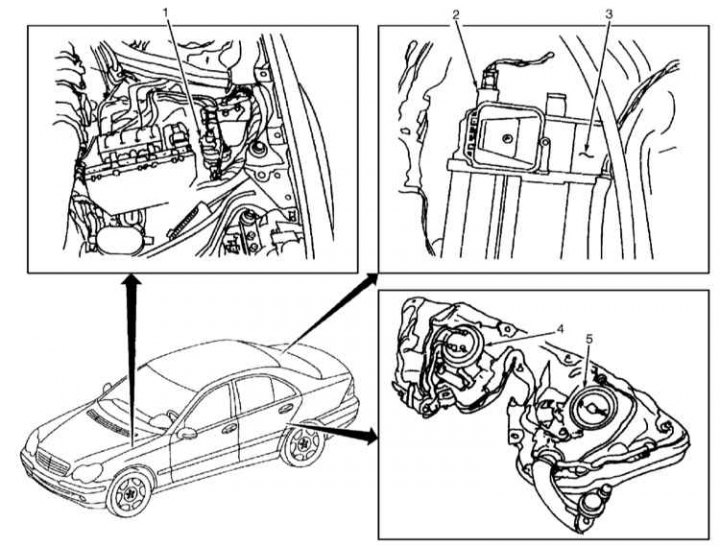
1 - Evaporative Evaporative Blow-Off Control Valve; 2 - Carbon adsorber shut-off valve; 3 - Carbon adsorber; 4 - Fuel tank pressure sensor; 5 - Fuel pump
Vacuum line connection diagram (models with 111 engine equipped with air compressor)
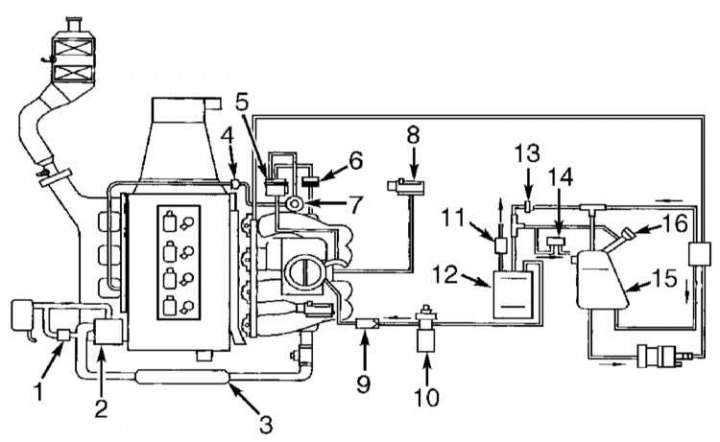
1 - Recirculation flap actuator; 2 - Air supply compressor; 3 - Intercooler (Intercooler); 4 - Secondary air mixing control valve; 5 - Air pump switch valve; 6 - Vacuum control valve; 7 - Secondary air cut-off valve; 8 - Pressure sensor; 9 - Check valve (carbon adsorber); 10 - Carbon adsorber purge control valve; 11 - Carbon adsorber shut-off valve; 12 - Carbon adsorber; 13 - Ventilation valve; 14 - Pressure relief valve (ORVR); 15 - Fuel tank; 16 - Fuel tank filler neck with fuel evaporative emission system connector
Vacuum line connection diagram (models with V6 engine)
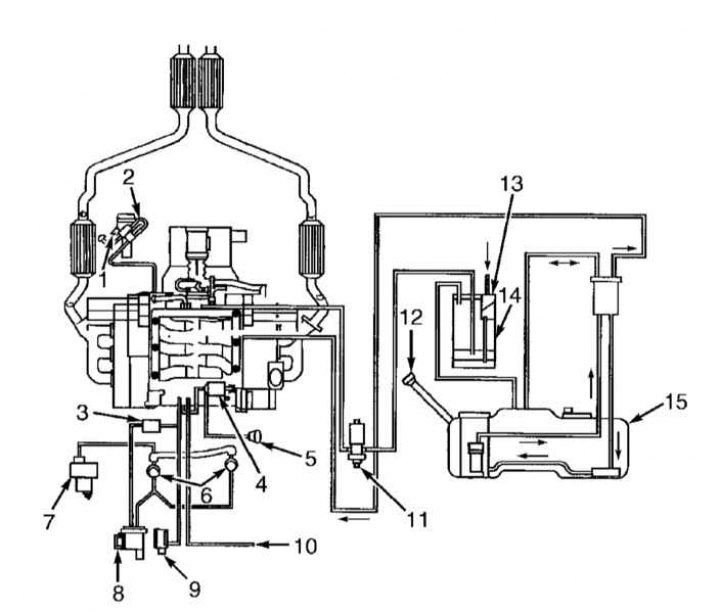
1 - EGR valve pressure transducer; 2 - EGR valve; 3 - Vacuum control valve; 4 - Intake manifold geometry switching valve; 5 - Intake manifold switching unit; 6 - Secondary air shut-off valve with built-in check valve; 7 - Electric air pump; 9 - Pressure sensor; 10 - To other vacuum consumers; 12 - Fuel tank filler neck with fuel evaporative emission system connector; 13 - Carbon adsorber shut-off valve; 14 - Carbon adsorber; 15 - Fuel tank
Petrol models
All petrol models must use unleaded petrol in their fuel systems. The engine management system is designed to provide maximum engine performance with minimum fuel consumption and emissions. The fuel vapor recovery system prevents fuel from escaping from the fuel tank into the atmosphere. An exhaust gas recirculation system is installed.
Crankcase ventilation system
To eliminate leaks of unburned hydrocarbons into the atmosphere, the engine is completely sealed. Gases and oil vapors formed in the crankcase enter the intake manifold through a mesh filter and burn in the cylinders together with the fuel.
(Material taken from a web resource www.mercedesman.ru)
Gases are removed from the crankcase due to the pressure difference in the crankcase and the intake manifold (crankcase pressure is higher).
Catalytic converter
To reduce the amount of harmful emissions into the atmosphere, all petrol models have a three-function catalytic converter built into the exhaust system. The fuel injection control system has a feedback loop, which includes an oxygen sensor. This sensor, installed in the exhaust system, constantly informs the control unit about the composition of the exhaust gases. Depending on the data received, the control unit adjusts the quality of the mixture supplied to the combustion chambers and thus optimizes fuel combustion.
The lambda probe has a built-in heating element, which is switched on by the control unit via a special relay. The working surface of the lambda probe is sensitive to changes in the oxygen content in the gases. Depending on the oxygen concentration, the sensor sends signals of different voltages. If the mixture is over-enriched - the oxygen content in the exhaust gases is very low, the sensor sends signals with low voltage. The voltage increases as the mixture becomes leaner and the oxygen content in the gases increases. The converter works most effectively with an optimal composition of the combustible mixture (14.7 parts air to 1 part fuel). At the optimum concentration of oxygen in the exhaust gases, a jump in voltage occurs on the sensor. This jump is the starting point for the control unit when adjusting the mixture quality.
Two sensors are installed. One is before and the other is after the converter. This allows for more accurate monitoring of the exhaust gas composition.
Exhaust gas recirculation system
The exhaust gas recirculation system reduces the amount of NOx in the exhaust gases. To do this, a small portion of the exhaust gases is fed into the intake manifold through a special valve. The recirculation system valve is controlled by the control unit.
Fuel vapor recovery system
To reduce the emission of unburned hydrocarbons into the atmosphere, all petrol models are equipped with a fuel recovery system. The fuel filler neck of the fuel tank is hermetically sealed with a lid, and a carbon adsorber is installed under the fuel tank. It collects fuel vapors that form in the tank when the car is parked and stores them there until the control unit signals the filter to start purging. Then the fuel vapors begin to be supplied through the purging valve(s) into the intake manifold, where they mix with the working mixture and then burn in the usual way in the combustion chambers.
To ensure normal engine operation at idle speed and during warm-up, the control unit keeps the valve closed. This prevents unburned fuel from entering the converter (at high idle speed the mixture is too rich). After the engine warms up, the valve begins to open and close, supplying fuel vapors into the intake tract.
Diesel models
The engine management system operates in such a way as to obtain maximum output from the engine with minimum fuel consumption and toxicity of exhaust gases. To further reduce toxicity of gases, several additional systems are installed on the car. The crankcase ventilation system reduces gas leaks into the atmosphere from the engine lubrication system. The catalytic converter reduces toxicity of exhaust gases. An exhaust gas recirculation system is installed.
Controlled crankcase ventilation system
To eliminate leaks of unburned hydrocarbons into the atmosphere, the engine is completely sealed. Gases and oil vapors formed in the crankcase enter the intake manifold through a mesh filter and burn in the cylinders together with the fuel.
Gases are removed from the crankcase due to the pressure difference in the crankcase and the intake manifold (crankcase pressure is higher). All diesel models are equipped with a ventilation valve. It is located on the cylinder head cover and controls the flow of gases from the crankcase.
Exhaust gas recirculation system
All diesel models are also equipped with an exhaust gas recirculation system. This system reduces the amount of NOx in the exhaust gases. To do this, a small portion of the exhaust gases is fed into the intake manifold through a special valve. The recirculation valve is controlled by the control unit.