
Cars BMW Cars Volkswagen Cars Chevrolet Cars Land Rover Cars Lada Cars Honda Cars Peugeot
English Русский
Български
Беларускі
Український
Српски
Hrvatski
Română
Polski
Slovenský
Magyar
Bookmark News and articles Sitemap Feedback Site search
MercedesMan.ru


A-Class C-Class E-Class G-Class M-Class S-Class Others
190 (W201) (1982-1993) W202 (1993-2000) W203 (2000-2007)
  • Main
  • C-Class
  • W203 (2000-2007)
  • Power unit
  • Exhaust system
  • Catalytic converter

Catalytic converter (Mercedes-Benz C-Class W203)

0
Contents: Petrol engines ↡ Safety precautions to avoid damage…↡
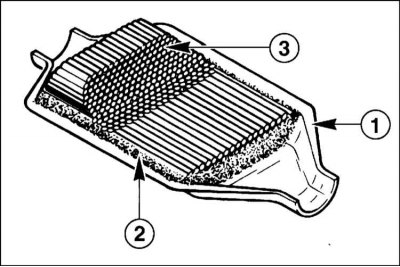
The catalytic converter has a central ceramic part of a honeycomb structure «3» covered with a…

The catalytic converter has a central ceramic part of a honeycomb structure "3" covered with a carrier layer. On the carrier layer are salts of noble metals acting as converters. The catalytic converter is fixed in the housing "1" by means of an insulating support layer "2" that simultaneously compensates for the thermal expansion of the catalytic converter.

Petrol engines


In order to reduce harmful emissions with the help of a catalytic converter, the injection system must precisely dose the amount of injected fuel required for combustion. The oxygen sensor is located in the intake pipe before the catalytic converter and is washed by the flow of exhaust gases. The oxygen sensor is an electronic sensor that measures the oxygen content in the exhaust gases and represents it in the form of voltage fluctuations. Information from the oxygen sensor is transmitted to the injection system control unit. The obtained value allows you to adjust the composition of the air-gasoline mixture. On the one hand, this is necessary, since operating conditions are constantly changing (idle, full throttle), on the other hand, since optimal afterburning of fuel in the catalytic converter occurs only in this case if the exhaust gases contain a sufficient amount of fuel.


In order for the fuel to be burned in the catalytic converter, a temperature of 300-800°C is required. This requires a higher fuel content in the mixture than for clean combustion.

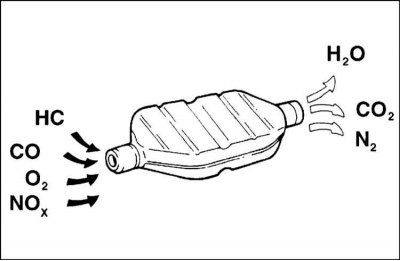
The catalytic converter of a gasoline engine is a so-called three-function device. In the controlled conversion process, carbon monoxide (CO) and hydrocarbon (HC) are oxidized, and the concentration of nitrogen oxides (NOx) is reduced.

Safety precautions to avoid damage to the catalytic converter


To avoid damage to the oxygen sensor and catalytic converter, the following requirements must be met:

Petrol engines


Be sure to use only unleaded gasoline.

Starting a warmed-up petrol engine by pushing or towing is permitted only in one attempt and at a distance of no more than 50 m. It is better to use a jumper cable for this purpose. Unburned fuel during ignition can lead to overheating of the catalytic converter and its destruction.

Note: Starting vehicles with AT towing is not possible.


If you have difficulty starting the engine, do not engage the starter for too long. This will cause continuous fuel injection. It is necessary to identify and eliminate the cause of the malfunction.

If there are problems with the ignition system, when determining their nature, it is necessary to exclude fuel injection when the starter is turned on. To do this, disconnect the fuel pump relay.

Never empty the fuel tank completely.

If misfiring occurs, do not increase engine speed and correct the problem immediately.

Use only recommended spark plugs.


Do not perform spark testing with the spark plug connector disconnected.

It is not allowed to test the operation of the cylinder by disconnecting the spark plug wire from its spark plug. This will cause unburned fuel to enter the catalytic converter.

Petrol and diesel engines


Do not park the vehicle over dry leaves or grass. The exhaust system in the area of the catalytic converter is very hot and radiates heat even after the engine has stopped.

Do not apply underbody protection products to exhaust system components.

It is not permitted to change the design of heat shields.

When filling the engine with oil, pay special attention to the fact that under no circumstances should the level indicated on the indicator be exceeded as Max. Excess oil due to incomplete combustion enters the catalytic converter and can damage its alloy metal coating or completely destroy the catalytic converter.
This article is available at: russian, bulgarian, belarusian, ukrainian, serbian, croatian, romanian, polish, slovak, hungarian
The article has been verified: Rodionov Artyom Semyonovich
Share with friends:
◀ Previous
C-Class W203 / Exhaust system
Next ▶

Emission Control Systems — General Information
Checking the tightness of the exhaust system
Removal and installation of the exhaust system
Exhaust system — general information
Turbocharger — General Information and Precautions
Belt driven blown air compressor
Intercooler — General Information
More similar articles for repairing other models

☛ Intake pipe with catalytic converter — removal and installation Mercedes W168 (1997-2004)
☛ Catalytic converter Mercedes W124 (1984-1995)
☛ Removal and installation of AT with a torque converter Mercedes W463 (1999-2019)
☛ Features of operation of vehicles equipped with a three-function… Mercedes W163 (1997-2005)
☛ Catalytic converter (petrol models) Mercedes W140 (1991-1998)
☛ Exhaust Gas Recirculation System Vacuum Converter Mercedes Vito 1 (1996-2003)
Link in different formats to this article
Comments and feedback from visitors
No comments yet


How much will 38 + 47 ?


W203 (2000-2007) 
  • General information
  • Introduction to guide
  • User manual
  • Maintenance
  • Power unit
  • Gasoline engines
  • Diesel engines
  • Cooling system
  • Ventilation and heating
  • Supply system
  • Injection system (gasoline)
  • Injection system (diesel)
  • Exhaust system
  • Ignition and control system
  • Charge and launch systems
  • Transmission
  • Mechanical gearbox
  • Automatic gearbox
  • Clutch and drive shafts
  • Differential
  • Chassis
  • Brake system
  • Car suspension
  • Steering
  • Body
  • Exterior (external elements)
  • Interior (internal elements)
  • Electrical equipment
  • Equipment and devices
  • Lighting system
  • Electrical diagrams (2000)
  • Electrical diagrams (since 2001)
W202 (1993-2000) 
  • General information
  • User manual
  • Driving a car
  • Car care
  • Maintenance
  • Power unit
  • Gasoline engines
  • Diesel engines
  • Lubrication system
  • Cooling system
  • Heating and ventilation
  • Ignition system
  • Fuel system
  • Injection system (gasoline)
  • Injection system (diesel)
  • Exhaust system
  • Transmission
  • Clutch
  • Car gearbox
  • Chassis
  • Suspension, wheels and tires
  • Steering
  • Brake system
  • Body
  • Exterior (external elements)
  • Interior (internal elements)
  • Doors and windows
  • Electrical equipment
  • Equipment and devices
  • Power devices
  • Lighting system
  • Electrical circuits
190 (W201) (1982-1993) 
  • General information
  • Introduction to the guide
  • Operation and care
  • Maintenance (gasoline)
  • Maintenance (diesel)
  • Troubleshooting
  • Power unit
  • Petrol engine I4
  • Petrol engine V6
  • Diesel engines
  • Engine overhaul
  • Cooling and heating
  • Power system (carburetor)
  • Injection system (gasoline)
  • Injection system (diesel)
  • Exhaust system
  • Charge and start system
  • Ignition system (I4)
  • Ignition system (V6)
  • Diesel heating system
  • Transmission
  • Clutch
  • Mechanical gearbox
  • Automatic gearbox
  • Cardan shaft and axle shafts
  • Chassis
  • Brake system
  • Car suspension
  • Steering
  • Body
  • Exterior (external elements)
  • Interior (internal elements)
  • Doors, locks and windows
  • Electrical equipment
  • Equipment and devices
  • Electrical circuits
 
MercedesMan.ru © 2017–2026 · Mobile version · Read about Mercedes · Sitemap: EN BG BY UA RS HR RO PL SK HU · Feedback · Site search · Bookmark A-Class (W168) · C-Class (W201) · C-Class (W202) · C-Class (W203) · E-Class (W123) · E-Class (W124) · E-Class (W210) · G-Class (W463) · M-Class (W163) · S-Class (W116, petrol) · S-Class (W126, petrol) · S-Class (W140) · S-Class (W220) · Sprinter · Vito 1 · Vito 2 · Vario 814D ·
 
We only use cookies without which some of the site's features may not be available.