



Contents: Examination ↡ Setting ↡
Fuel supply system vacuum regulation (2.0 engine)
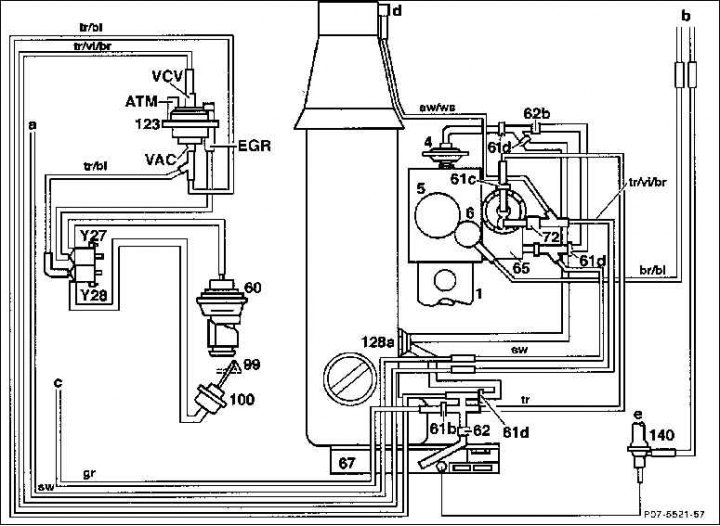
1. Fuel injector pump; 4. PLA - box; PLA = Pneumatic Idle Speed Increase; 5. ADA - box; ADA = atmospheric pressure dependent high pressure fuel pump rack limiter. Serves to correct for low air densities at high altitudes; 6. Stopper of the membrane mechanism of the vacuum regulator of ignition advance; 60. Exhaust gas recirculation system valve; 61b. Orange throttle; 61c. Choke diameter 0.5 mm, green color; 61d. Yellow connector; 62b. Filter; 62b. Ventilation filter with 0.13 mm diameter throttle 65. Vacuum control valve; 67. Vacuum pump; 72. Vibration damper; 99. Hydraulic valve; 100. Hydraulic valve of the membrane mechanism of the vacuum regulator of ignition advance; 128a. Thermostat (closed at 30°C); 140. Check valve for brake booster; Y27. Exhaust gas recirculation system changeover valve; Y28. Hydraulic valve changeover valve; a – Ventilation of the interior space of the car; b – Switching off with a key; c – Other consumers; e – To the brake booster
The start of the injection of the fuel pump injectors is checked, or, accordingly, adjustments are made if the engine produces too little power or a new fuel pump has been installed.
There are two different test and adjustment methods that can be used in a workshop depending on its equipment: the static method using a position sensor and the dynamic test method using a digital tester. The static method using a position sensor is described here. A position sensor is required to adjust the start of the fuel pump (position sensor).
After static adjustment, the pump start must be checked dynamically in a workshop, and therefore also in idle mode. For 2.2/2.5 liter engines, only a dynamic check is provided, or, respectively, adjustment of the pump start of fuel supply.
Examination
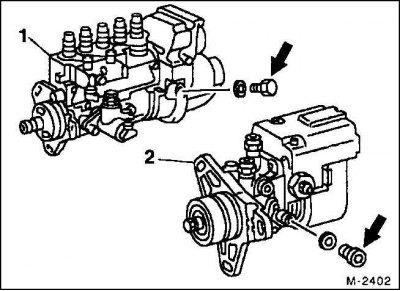
1 – In-line high pressure fuel pump
2 – High pressure fuel distribution pump
[Publication reprinted from this resource: www.mercedesman.ru]
1. Remove the screw plug (arrow) on the side of the high pressure fuel pump.
Caution: If oil comes out, remove it with a cloth.
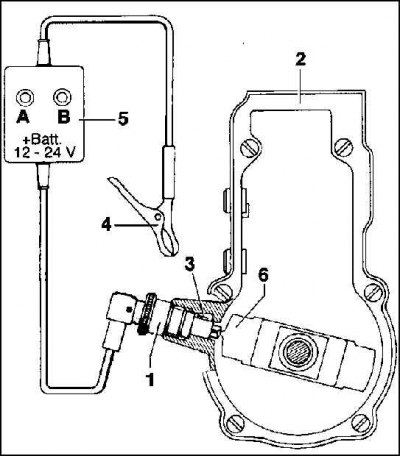
2. Install the position sensor (1) in the regulator housing so that the guide pin (3) of the sensor points upward. Tighten the union nut by hand.
3. Set the crankshaft to the position corresponding to the ignition timing of the first cylinder.
4. After this, turn the pulley further until the indicator light (A) flashes on the indicator sensor (5). Now continue to turn the pulley quite slowly until both lights (A) and (B) are lit.
In this case, both contacts of the position sensor (1), thanks to the pins of the weight (6) of the centrifugal adjustment mechanism, are located on the ground, due to which both lamps light up. This position of the regulator (2) of the fuel pump of the injectors indirectly corresponds to the start of fuel supply by the pump.
5. The pulley should now be at 14° + 0.5° after TDC, i.e. the original mark is above the 14° mark on the pulley.
Caution! Do not rotate the engine in the opposite direction. If only the light (B) lights up, repeat the test. In doing so, rotate the crankshaft approximately two revolutions and turn it especially slowly in the area where the light lights up.
Setting
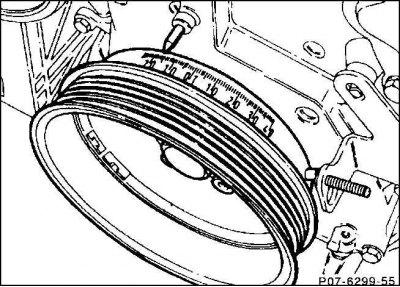
1. Set the crankshaft in the direction of engine rotation to 14° after TDC of the first cylinder. To do this, first set the crankshaft to the position corresponding to the ignition timing, and then turn it a little further.
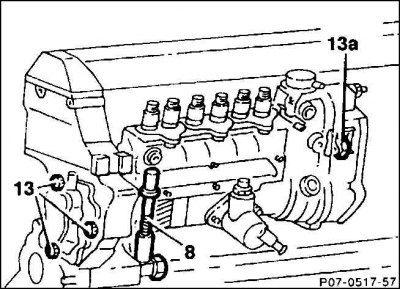
2. Loosen, without unscrewing, the bolts (13) on the high pressure fuel pump flange.
3. Loosen, without unscrewing, the bolts (13a) on the high-pressure fuel pump support bracket.
4. Turn the tension bolt with a socket wrench and thereby move the high-pressure fuel pump until both lamps (A) and (B) on the indicator light up. In doing so, turn the tension bolt to the right if the test showed that the pump delivery start was 14° after the TDC mark. If the pump delivery start should occur earlier, turn the tension bolt to the left.
Attention! If the possibility of movement is not ensured by means of the tension bolt, then it is necessary to remove and reposition the injector pump (auto repair shop work).
5. With a torque of 25 Nm (approximate value) tighten the injector pump mounting bolts to the flange and holder until secure.
6. Unscrew and remove the position sensor.
7. Screw in the threaded plug with the aluminium sealing ring to a torque of 30 Nm.
8. Check the gas system of rods and levers, adjust if necessary.
9. Check the engine oil level and adjust if possible.