



Checking the density of the electrolyte
In combination with voltage measurement, the actual density of the electrolyte allows us to draw a conclusion about the degree of discharge of the battery.
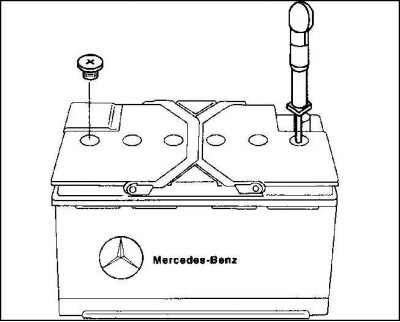
A battery densimeter with a pipette is used for testing. The higher the specific gravity (electrolyte density) the amount of electrolyte sucked in, the deeper the float (hydrometer) sinks. The density of the electrolyte can be read from the scale as specific gravity (g/ml) or degrees Baume (+° Be).
The following values must be achieved (at an electrolyte temperature of about +20°C).
| Battery discharge level | +° Ve | g/ml |
| Discharged | 16 | 1,15 |
| Half discharged | 24 | 1,22 |
| Well charged | 30 | 1,26 |
Check each individual element in turn, all elements of the cell should have the same electrolyte density (maximum difference 0.04 g/ml). Otherwise, the faulty battery may short-circuit.
Checking the battery under load
1. Connect the voltmeter to the battery terminals.
2. Note: If the battery voltage (without connecting consumers) less than 12 V, then it is discharged and needs to be recharged.
3. Start the engine and read the voltage.
4. During engine starting, the voltage of a charged battery should be no lower than 8 V (at an electrolyte temperature of about +20°C).
5. If the voltage drops immediately and different electrolyte densities were recorded in the cells, then the faulty battery may short-circuit.
The total voltage can be measured with a battery tester. Please refer to the manufacturer's recommendations for battery care.
Control values
| Battery capacity, Ah | Load current, A | Minimum voltage after 5-10 sec. at t 0-20°C |
| 62 | 190 | 10.0 V |
| 74 | 265 | 10.0 V |
| 100 | 300 | 10.0 V |
Attention! If during this measurement (lasting 10 seconds.) if the total voltage drops below 10 V, the battery is either discharged or faulty.