
Cars BMW Cars Volkswagen Cars Chevrolet Cars Land Rover Cars Lada Cars Honda Cars Peugeot
English Русский
Български
Беларускі
Український
Српски
Hrvatski
Română
Polski
Slovenský
Magyar
Bookmark News and articles Sitemap Feedback Site search
MercedesMan.ru


A-Class C-Class E-Class G-Class M-Class S-Class Others
W116 (1972-1980, petrol) W126 (1979-1991, petrol) W140 (1991-1998) W220 (1998-2005)
  • Main
  • S-Class
  • W220 (1998-2005)
  • General information
  • Maintenance
  • Checking the condition of the ribbed belts of the serpentine drive of auxiliary units

Checking the condition of the ribbed belts of the serpentine drive of auxiliary units (Mercedes-Benz S-Class W220)

0
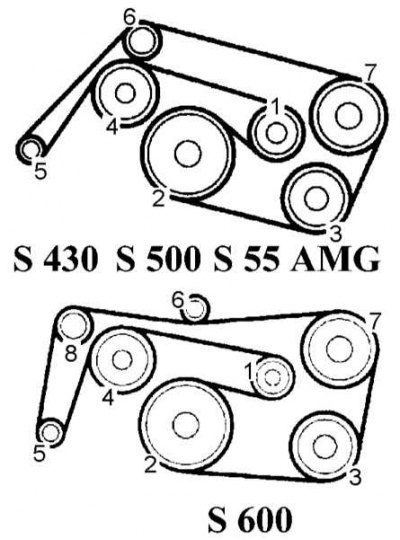
Scheme of serpentine belt routing for auxiliary units

Scheme of serpentine belt routing for auxiliary units
1 - Tension roller; 2 - Crankshaft; 3 - Air conditioner compressor; 4 - Water pump; 5 - Generator; 6 - Roller; 7 - Belt booster; 8 - Roller


Inspection


1. The ribbed belt tension is automatic. It is necessary to periodically check the condition of the belt, and if defects are found, replace the belt.

[Original article is on the portal MERCEDESMAN.ru]

2. The belt tension is carried out by an automatic tensioner and does not require checking.

3. Turn off the engine, set the transmission to neutral. Raise and place the car on stands.

4. Mark the belt with chalk in a clearly visible place.

5. Using the head, turn the engine by the crankshaft pulley in the direction of rotation, i.e. to the right, so that the chalk marking is visible. In this case, inspect the belt section by section.

6. With fingers (and using a flashlight if necessary) walk the entire length of the belt, feeling for cracks and delamination. Also check for abrasions and polished areas. The belt should be inspected from both sides, which means twisting it to check the condition of the reverse side. At the same time, check for rust, cracks and burrs on the pulleys. Shallow perpendicular cracks are allowed on the working surface of the belt. If these cracks do not extend beyond one rib and are not very deep, there is no need to replace the belt.
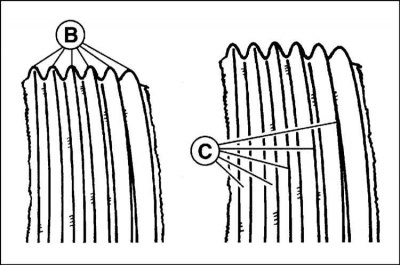


Wear of the edges of the ribbed belt
Wear of the edges of the ribbed belt


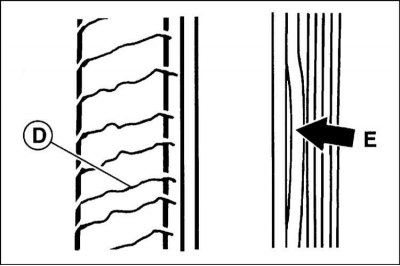
Transverse cracks D on the back side of the belt and delamination of the ribs E of the ribbed belt
Transverse cracks D on the back side of the belt and delamination of the ribs E of the ribbed belt


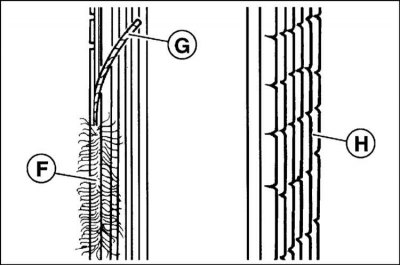
Fraying of the side ribs F, cracks H and delamination of the side ribs G
Fraying of the side ribs F, cracks H and delamination of the side ribs G


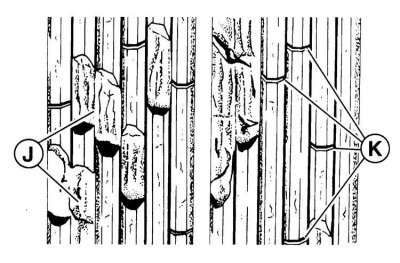
J rib detachment, K cracks

J rib detachment, K cracks


7. The belt tension is checked by pressing firmly with your thumb and determining the degree of its deflection. Measure the deflection with a ruler. If the distance between the pulley centers is from 180 to 280 mm, the deflection should be 6 mm. If the distance between the pulley centers is between 300 and 400 mm, the deflection should be 13 mm.

8. If one or more of the above damages are present, the V-belt must be replaced with a new one.
8. If one or more of the above damages are present, the V-belt must be replaced with a new one.


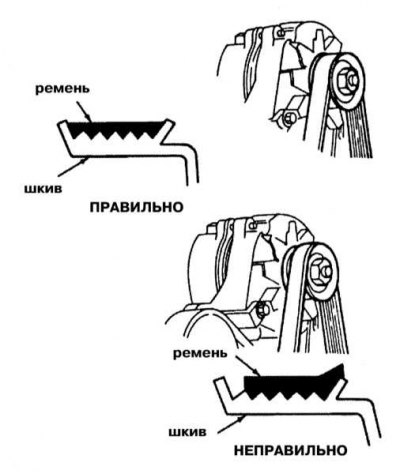
9. Place the belt correctly on the pulleys. Even a short period of operation with an incorrectly installed belt can cause damage to it.
This article is available at: russian, bulgarian, belarusian, ukrainian, serbian, croatian, romanian, polish, slovak, hungarian
The article has been verified: Khromov Roman Mikhailovich
Share with friends:
◀ Previous
S-Class W220 / Maintenance
Next ▶

Checking the condition and replacing engine compartment hoses, localizing leaks
Checking the fuel system
Checking the brake system
Changing engine oil and oil filter
Checking the condition of tires and their pressure. Designation of tires and wheel rims. Rotation and replacement of wheels
Checking the cooling system operation and frost resistance. Liquid replacement
Checking the condition of the exhaust system
Checking the Automatic Transmission Oil Level
Visual inspection of automatic transmission for leaks
Checking the condition of suspension and steering components
More similar articles for repairing other models

☛ V-belt — checking condition Mercedes W168 (1997-2004)
☛ Checking the condition of the ribbed belts of the serpentine drive of… Mercedes W203 (2000-2007)
☛ Checking the condition of the rear wheel drive shaft mudguards Mercedes W210 (1996-2002)
☛ Checking the condition of multi-rib belts for auxiliary drive units Mercedes W463 (1999-2019)
☛ Checking the condition of multi-rib belts for auxiliary drive units Mercedes W163 (1997-2005)
☛ Checking the drive belts Mercedes Vito 1 (1996-2003)
Link in different formats to this article
Comments and feedback from visitors
No comments yet


How much will 39 + 12 ?


W220 (1998-2005) 
  • General information
  • Introduction to guide
  • User manual
  • Maintenance
  • Power unit
  • Engine repair
  • Cooling and heating systems
  • Power and exhaust systems
  • Ignition and control system
  • Charge and launch systems
  • Transmission
  • Automatic gearbox
  • Drive shafts
  • Chassis
  • Brake system
  • Front suspension
  • Rear suspension
  • Steering
  • Body
  • Body elements
  • Electrical equipment
  • Equipment and devices
  • Electrical circuits
W140 (1991-1998) 
  • User manual
  • Controls and instruments
  • Driving and operation
  • Maintenance
  • Power unit
  • Petrol engine V6
  • Petrol engine V8
  • Petrol engine V12
  • Diesel engine OM603
  • Diesel engine OM606
  • Cooling system
  • Power supply and injection system
  • Control system HFM-SFI
  • Control system LH-SFI
  • Control systems ME-SFI
  • Diesel control system
  • Ignition system
  • Charge and launch system
  • Transmission
  • Mechanical gearbox 717.438
  • Mechanical gearbox 717.454
  • Automatic gearbox 722.5
  • Automatic gearbox 722.6
  • Clutch and drive shafts
  • Differential
  • Chassis
  • Brake system
  • Steering
  • Front suspension
  • Rear suspension
  • Body
  • Exterior (external elements)
  • Interior (internal elements)
  • Electrical equipment
  • Equipment and devices
  • Electrical circuits
W126 (1979-1991, petrol) 
  • Power unit
  • Engine repair
  • Ignition system
  • Lubrication system
  • Cooling system
  • Fuel system
  • Fuel injection system
  • Transmission
  • Clutch and cardan
  • Mechanical gearbox
  • Automatic gearbox
  • Chassis
  • Front suspension
  • Rear suspension
  • Steering
  • Brake system
  • Electrical equipment
  • Power devices
  • Electrical circuits
W116 (1972-1980, petrol) 
  • General information
  • Introduction to guide
  • Power unit
  • 8-cylinder V8 engine
  • 6-cylinder I6 engine
  • Cooling and lubrication system
  • Power system (carburetor)
  • Fuel injection system
  • Ignition system
  • Transmission
  • Clutch and cardan
  • Car gearbox
  • Chassis
  • Front suspension
  • Rear suspension
  • Steering
  • Brake system
  • Electrical equipment
  • Power devices
  • Electrical circuits
 
MercedesMan.ru © 2017–2026 · Mobile version · Read about Mercedes · Sitemap: EN BG BY UA RS HR RO PL SK HU · Feedback · Site search · Bookmark A-Class (W168) · C-Class (W201) · C-Class (W202) · C-Class (W203) · E-Class (W123) · E-Class (W124) · E-Class (W210) · G-Class (W463) · M-Class (W163) · S-Class (W116, petrol) · S-Class (W126, petrol) · S-Class (W140) · S-Class (W220) · Sprinter · Vito 1 · Vito 2 · Vario 814D ·
 
We only use cookies without which some of the site's features may not be available.