



Occupant Restraint Systems
Seat belts with seat belt tensioners and seat belt force limiting devices, airbags, and child restraint devices are independent passenger restraint systems whose protective functions are coordinated with each other.
Many countries have legal regulations governing the use of seat belts and child restraint devices. Regardless, all passengers are required to wear seat belts or child restraint devices.
There is a risk of injury!
Work on passenger restraint systems must be carried out exclusively at a maintenance station "Mercedes-Benz".
Inappropriately performed work may result in spontaneous activation or failure of passenger restraint systems.
Child restraint devices
There is a risk of injury!
To protect children in the event of an accident, children shorter than 150 cm and under 12 years of age require suitable restraints as seat belts cannot be fitted correctly in their case.
It is recommended that children sit in the back seats while the vehicle is moving, as they are provided with greater safety there.
Children should never sit on the laps of other passengers. In the event of an accident, they are not protected by a child restraint system and could be seriously injured, even killed, by being strapped into the same person or by the front passenger airbag.
Rearward-facing restraints must not be used on the front passenger seat, with the exception of a special child seat in combination with the automatic child seat recognition system.
Using a rear-facing restraint system without an automatic child seat sensing system near the airbag outlet could result in extremely serious or fatal injuries to the child.
If a forward-facing restraint device is used on the seat next to the driver, the seat should be moved to the rearmost position.
Use only restraint devices recommended by us.
Information on this issue can be obtained at any maintenance station "Mercedes-Benz".
To ensure the safety of passengers, always follow the manufacturer's installation instructions when installing a child restraint system.
Do not leave children unattended in the vehicle, even if they are secured with a child restraint system.
Automatic child seat recognition system
The automatic recognition system for the presence of a child seat on the front passenger seat requires a special child seat. Such a child seat can be purchased at any service station "Mercedes-Benz".
When using this special child seat on the front passenger seat, the front passenger airbag is deactivated. Indicator lamp
 on the center console remains lit continuously as long as this special child seat is installed on the front passenger seat.
There is a risk of injury!
If the indicator lamp comes on when a child seat with a child seat recognition system is installed
 does not light up, this means that the front passenger airbag is not turned off. In this case, install the child seat on the back seat. Have the automatic child seat recognition system checked at a service station "Mercedes-Benz".
To ensure the operation of the automatic child seat recognition system, a special child seat must be installed in the front passenger seat.
Do not place any pads under the child seat (for example, pillows).
Be sure to follow the manufacturer's installation instructions.
(Control lamp
 t- refer to Section Warning and indicator lamps, as well as multi-information display messages about registered faults).
Seat belts
Each seat is equipped with a seat belt.
The seat belt webbing is blocked when braking and decelerating the vehicle in all directions and when the webbing is pulled out with a jerk.
Automatic comfortable seat belt adjustment.
If the electronic key in the ignition switch is in position 1 or 2, the automatic comfort seat belt adjustment is activated.
The retraction force of the seat belt retractor is reduced, thereby increasing the comfort of the seat belt fit.
Note: Cleaning and care of seat belt webbing is discussed in Chapter Body.
There is a risk of injury!
Seat belts must be worn every time you ride.
Pregnant women should also not forego seat belt protection.
Each seat belt is intended for one passenger only.
It is prohibited to fasten any objects together with the passenger.
An incorrectly fastened seat belt may not provide the protection it was designed to provide in an accident, which could result in injury.
Sitting positions that prevent seat belts from fitting correctly increase risk factors and should therefore be avoided.
Do not pull the straps over sharp edges, the straps may break.
Airbags provide the intended protection only if occupants are wearing seat belts.
To protect themselves in the event of an accident, persons shorter than 150 cm require suitable restraint devices, as seat belts cannot be fitted correctly in their case. (Please refer to the Child Restraint Devices section).
Seat belts that are damaged or have been subjected to a high load during an accident should be replaced with new ones. Also check the belt fastenings.
Use only seat belts approved by us.
Do not modify the seat belts. This may adversely affect the effectiveness of the belts.
Fastening seat belts
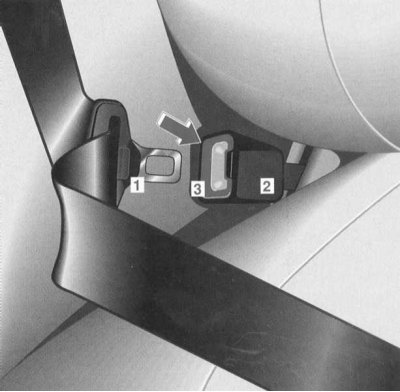
1 Belt tongue
2 Belt lock
3 Belt release key
Insert belt tongue "1" into belt buckle "2" until it locks into place.
The seat belt should, if possible, fit snugly in the pelvic area in front of the hip. If necessary, tighten the belt in the pelvic area. To do this, pull the belt up in front of the chest.
Make sure the belt fits snugly and runs across the middle of your shoulder.
The seat belt should not be twisted, should not pass across the neck or under the arm.
Set the backrests almost vertically. The back should be adjacent to the backrest.
Check that the belt fits correctly while driving and adjust if necessary.
When adjusting the seat position, the height of the seat belt is automatically adjusted to your height.
Unfastening seat belts
Press button "3" in belt buckle "2".
Move tongue "1" towards the belt exit.
Pyrotechnic seat belt tensioner with tension limiting device
The protective effect of the front and outer seat belts in the rear compartment is increased by a seat belt tensioner with a seat belt force limiter.
The seat belt tensioner with tension limiter is ready for operation when the electronic key in the ignition switch is turned to position 1 or 2.
(SRS Safety System Warning Light (Supplemental Restraint System) - refer to Section Warning and indicator lamps, as well as multi-information display messages about registered faults).
The seat belt tensioners with a force limiting device are designed so that they are activated in the event of a frontal collision or a rear-end collision.
Seat belt pretensioners are only activated in the event of a rear-end collision or impact with the vehicle.
Seat belt pretensioners are activated only in the event of a collision of precisely defined force. In doing so, they tighten the seat belts until they fit snugly against the body.
Seat belt force limiters reduce the loads placed on occupants during a crash.
Note: The front passenger seat belt pretensioner will only operate when the front passenger seat is occupied.
Do not place heavy objects on the front passenger seat, otherwise the seat belt pretensioner and front passenger seat-side air bag will deploy in an accident.
There is a risk of injury!
Seat belt pretensioners that have deployed in an accident should be replaced.
When removing seat belt tensioners, safety precautions must be followed.
These rules can be found at any maintenance station "Mercedes-Benz".
Airbags
Front airbags
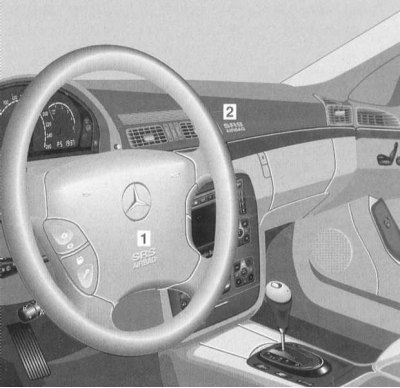
1 Driver's airbag
2 Front passenger airbag
The driver and front passenger airbags are designed to deploy in a frontal collision. The deployment occurs starting from a collision of a precisely defined force.
(SRS Safety System Warning Light (Supplemental Restraint System) - refer to Section Warning and indicator lamps, as well as multi-information display messages about registered faults).
Original material on the website [MercedesMAN.ru]
In the event of an accident without a strong impact from the front, the airbags do not deploy. In such accidents, the driver and passenger are protected as usual - by fastened seat belts.
Seat occupancy recognition system
The front passenger airbag will only deploy if the front passenger seat is occupied and the indicator lamp does not flash or come on
 on the middle console (Section Warning and indicator lamps, as well as multi-information display messages about registered faults).
Note: Do not place heavy objects on the front passenger seat, otherwise the front passenger airbag and front passenger side airbag with curtain shield airbag will deploy in an accident.
Side air bags (Sidebags), window air bags
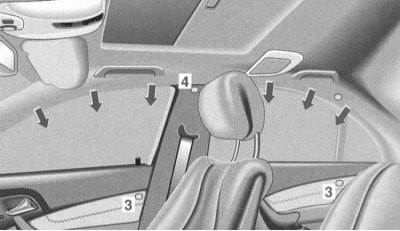
3 Side air bags (Sidebags)
4 Window airbags
The side airbags are designed so that they only deploy on the side of the collision.
The triggering occurs starting from a collision of a precisely defined force.
In the event of an accident without a strong impact from the side, the side airbags will not deploy.
The front passenger side airbag will only deploy if the front passenger seat is occupied.
The rear right side airbag is deployed if sensors in this area detect a side impact.
The driver's side rear side airbag will only deploy if the driver's side airbag has deployed.
Window Airbags: Window airbags provide additional protection against head and chest injuries.
They are located in the area of the A and C pillars (arrows) between the side windows and the head. They protect against penetrating objects.
The window airbags are designed so that in the event of a side impact they deploy on the side of the impact in addition to the side airbags.
Safety Notes
There is a risk of injury!
Improper or reckless behavior can result in injuries caused by airbag deployment, as airbags must inflate within milliseconds in the event of a crash.
Injuries are generally not serious, but in the immediate vicinity of the front airbag outlets, extremely serious injuries can occur, especially to small children.
Airbags provide the intended protection only if all occupants are wearing seat belts. (Fastening seat belts is described above.)
Airbags provide additional protection; however, to avoid injury when airbags deploy, the following must be taken into account:
- Choose a seating position as far away from the airbags as possible.
- Do not lean forward while driving. Do not lean against the doors from the inside.
- Always hold the steering wheel by the rim to ensure unimpeded inflation of the airbag.
- There must be no foreign objects on or between the airbags and the occupants.
- Do not hang hard objects, such as hangers, from the handles.
If there are children in the vehicle, it is mandatory to use child restraint systems (see above).
If the airbags deploy, do not touch hot parts. Airbags that deploy in an accident should be replaced with new ones.
The soft steering wheel cover, the front passenger airbag cover, the door trim and the soft headliner in the area of the window airbags must not be additionally covered or have signs or stickers attached to them, as otherwise the deployment of the airbags can no longer be guaranteed.
No modifications may be made to any component of the passenger restraint system, including the cabling.
When removing airbag assemblies, safety precautions must be followed.
These rules can be found at any maintenance station "Mercedes-Benz".
The service life of airbags is limited to 15 years.
Therefore, for safety reasons, no later than after 15 years, we strongly recommend that you replace the airbags at one of the service stations "Mercedes-Benz".
When selling a car, the owner is obliged to inform the buyer on this issue. This is done in the process of transferring the "Operating Manual".
When the airbags deploy, a small amount of smoke is released. This smoke is not hazardous to health and is not a sign of a fire in the car.
When inflated quickly, the fabric structure of the airbags may cause minor skin injuries.