
Cars BMW Cars Volkswagen Cars Chevrolet Cars Land Rover Cars Lada Cars Honda Cars Peugeot
English Русский
Български
Беларускі
Український
Српски
Hrvatski
Română
Polski
Slovenský
Magyar
Bookmark News and articles Sitemap Feedback Site search
MercedesMan.ru


A-Class C-Class E-Class G-Class M-Class S-Class Others
W116 (1972-1980, petrol) W126 (1979-1991, petrol) W140 (1991-1998) W220 (1998-2005)
  • Main
  • S-Class
  • W140 (1991-1998)
  • Power unit
  • Cooling system
  • Air Conditioning System — Information and Precautions

Air Conditioning System — Information and Precautions (Mercedes-Benz S-Class W140)

0
Contents: General information ↡ Precautionary measures ↡

General information


The air conditioning system consists of a condenser located in front of the radiator of the cooling system, an evaporator located near the heat exchanger of the heater, a compressor driven by a drive belt, a receiver/dryer, and various tubes connecting the above components. At the inlet of the evaporator, a damper is installed, which provides the pressure difference necessary for the operation of the system.

The fan supplies warm air from the passenger compartment to the evaporator (radiator analogue), where the heat from the air is transferred to the refrigerant. In this case, the refrigerant evaporates and exits the evaporator.
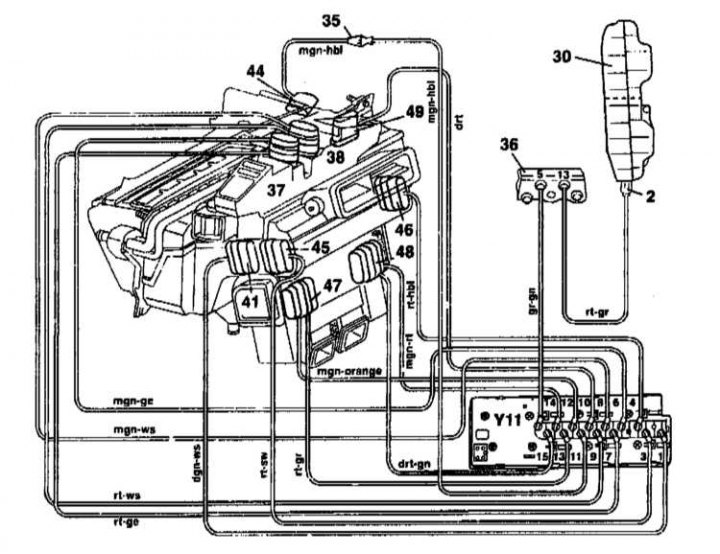
Front Automatic Air Conditioner Circuit Diagram

Front Automatic Air Conditioner Circuit Diagram
1 - Vacuum receiver; 35 - Divisor; 36 - Vacuum valve assembly; 37 - Vacuum element of the servo drive of the air duct flap of the left glass blowing nozzle; 38 - Vacuum element of the servo drive of the air duct flap of the left glass blowing nozzle; 41 - Vacuum element of the servo drive of the deflecting flap of the air duct of the central nozzle; 44 - Vacuum element of the main air damper servo drive; 45 - Vacuum element of the servo drive of the mixing flap of the air duct of the left central nozzle; 46 - Vacuum element of the servo drive of the mixing flap of the air duct of the right central nozzle; 47 - Vacuum element of the servo drive of the left foot air duct flap; 48 - Vacuum element of the right foot air duct flap servo drive; 49 - Vacuum element of the servo drive of the circulation mode switching flap; Y11 - Valve block bl - blue; dgn - dark green; drt - dark red; hbl - blue; ge - yellow; gr - gray; mgn - green; rt - red; orange - orange; sw - black; ws - white
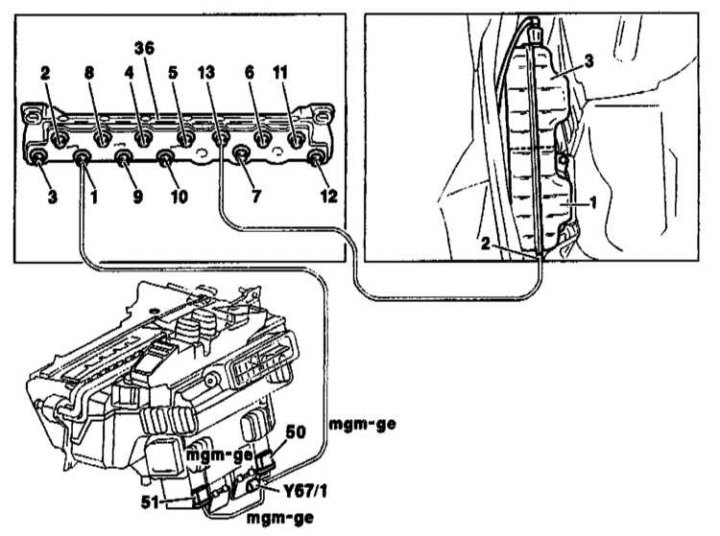


Rear Automatic Air Conditioner Circuit Diagram

Rear Automatic Air Conditioner Circuit Diagram
1 - Vacuum receiver; 36 - Vacuum valve assembly; 50 - Right rear footwell vacuum element; 51 - Left rear footwell vacuum element; Y67/1 - Rear air duct flap servo vacuum valve; bl - blue; dgn - dark green; drt - dark red; hbl - blue; ge - yellow; gr - gray; mgn - green; rt - red; orange - orange; sw - black; ws - white


On models equipped with automatic air conditioning, all distribution flaps are vacuum-operated. The vacuum from the receiver (30) and the vacuum valve assembly is fed to the valve block (Y11), which supplies it to the actuator of the corresponding flaps (37÷49) in accordance with the settings selected from the A/C control panel (see also Comfort Chapters User manual).

Precautionary measures


Warning! The system is under pressure! Do not attempt to disconnect any pipes related to the air conditioning system without first removing the working fluid from it.


Removing fluid from the system is a fairly complex operation that must be performed at a service station.

The system contains R134a refrigerant. Make sure the station has the equipment required for this type of refrigerant.


Wear safety glasses when disconnecting system tubes.

If your vehicle has an air conditioning system, take the following precautions when servicing any of its components:
  • The refrigerant R134a used today is much less aggressive than the previously used refrigerant type R12. However, it is very dangerous to health. Do not allow it to come into contact with your eyes or skin - you can get a burn. Although it is not toxic, its vapors can cause suffocation - do not remove it from the system in a closed room. Its vapors are heavier than air, so do not stand under the car when removing it from the system;
  • Do not allow refrigerant vapors to come into contact with an open flame. When it burns, it produces toxic gas. The gas, mixed with air in a certain proportion, can become explosive. Inhaling vapors through a lit cigarette can lead to tragic consequences;
  • Do not allow the refrigerant to enter the atmosphere. Unlike R12, the refrigerant type R134a does not cause destruction of the ozone layer, but leads to the greenhouse effect in the atmosphere;
  • The system uses seals made from a special material designed to work with a given type of refrigerant (for 134a - green). In order to avoid accidentally mixing different types of refrigerants, specific types of adapters are used to charge a specific type of refrigerant;
  • The system must be discharged at a Mercedes-Benz service station;
  • Before carrying out any work related to heating any vehicle components (welding, soldering, drying after painting), discharge the system. It is also necessary to discharge the system before servicing any of the air conditioning system components.
This article is available at: russian, bulgarian, belarusian, ukrainian, serbian, croatian, romanian, polish, slovak, hungarian
The article has been verified: Polyakov Zakhar Grigorievich
Share with friends:
◀ Previous
S-Class W140 / Cooling system
Next ▶

Fan Shroud and Fan Assembly — Installation Details
Ventilation, heating and air conditioning systems
Removal and installation the water pump
Removal and installation the cooling system radiator
Removal and installation the thermostat
Location of the main components of the automatic air conditioning system
More similar articles for repairing other models

☛ General information about the exhaust system Mercedes W168 (1997-2004)
☛ Charging system — general information and safety precautions Mercedes W203 (2000-2007)
☛ Air conditioning system — general information Mercedes W124 (1984-1995)
☛ Charging system — general information and safety precautions Mercedes W463 (1999-2019)
☛ Charging system — general information and safety precautions Mercedes W163 (1997-2005)
☛ Brake System Maintenance — General Information Mercedes Sprinter (1995-2000, diesel)
Link in different formats to this article
Comments and feedback from visitors
No comments yet


How much will 24 + 28 ?


W220 (1998-2005) 
  • General information
  • Introduction to guide
  • User manual
  • Maintenance
  • Power unit
  • Engine repair
  • Cooling and heating systems
  • Power and exhaust systems
  • Ignition and control system
  • Charge and launch systems
  • Transmission
  • Automatic gearbox
  • Drive shafts
  • Chassis
  • Brake system
  • Front suspension
  • Rear suspension
  • Steering
  • Body
  • Body elements
  • Electrical equipment
  • Equipment and devices
  • Electrical circuits
W140 (1991-1998) 
  • User manual
  • Controls and instruments
  • Driving and operation
  • Maintenance
  • Power unit
  • Petrol engine V6
  • Petrol engine V8
  • Petrol engine V12
  • Diesel engine OM603
  • Diesel engine OM606
  • Cooling system
  • Power supply and injection system
  • Control system HFM-SFI
  • Control system LH-SFI
  • Control systems ME-SFI
  • Diesel control system
  • Ignition system
  • Charge and launch system
  • Transmission
  • Mechanical gearbox 717.438
  • Mechanical gearbox 717.454
  • Automatic gearbox 722.5
  • Automatic gearbox 722.6
  • Clutch and drive shafts
  • Differential
  • Chassis
  • Brake system
  • Steering
  • Front suspension
  • Rear suspension
  • Body
  • Exterior (external elements)
  • Interior (internal elements)
  • Electrical equipment
  • Equipment and devices
  • Electrical circuits
W126 (1979-1991, petrol) 
  • Power unit
  • Engine repair
  • Ignition system
  • Lubrication system
  • Cooling system
  • Fuel system
  • Fuel injection system
  • Transmission
  • Clutch and cardan
  • Mechanical gearbox
  • Automatic gearbox
  • Chassis
  • Front suspension
  • Rear suspension
  • Steering
  • Brake system
  • Electrical equipment
  • Power devices
  • Electrical circuits
W116 (1972-1980, petrol) 
  • General information
  • Introduction to guide
  • Power unit
  • 8-cylinder V8 engine
  • 6-cylinder I6 engine
  • Cooling and lubrication system
  • Power system (carburetor)
  • Fuel injection system
  • Ignition system
  • Transmission
  • Clutch and cardan
  • Car gearbox
  • Chassis
  • Front suspension
  • Rear suspension
  • Steering
  • Brake system
  • Electrical equipment
  • Power devices
  • Electrical circuits
 
MercedesMan.ru © 2017–2026 · Mobile version · Read about Mercedes · Sitemap: EN BG BY UA RS HR RO PL SK HU · Feedback · Site search · Bookmark A-Class (W168) · C-Class (W201) · C-Class (W202) · C-Class (W203) · E-Class (W123) · E-Class (W124) · E-Class (W210) · G-Class (W463) · M-Class (W163) · S-Class (W116, petrol) · S-Class (W126, petrol) · S-Class (W140) · S-Class (W220) · Sprinter · Vito 1 · Vito 2 · Vario 814D ·
 
We only use cookies without which some of the site's features may not be available.