
Cars BMW Cars Volkswagen Cars Chevrolet Cars Land Rover Cars Lada Cars Honda Cars Peugeot
English Русский
Български
Беларускі
Український
Српски
Hrvatski
Română
Polski
Slovenský
Magyar
Bookmark News and articles Sitemap Feedback Site search
MercedesMan.ru


A-Class C-Class E-Class G-Class M-Class S-Class Others
W116 (1972-1980, petrol) W126 (1979-1991, petrol) W140 (1991-1998) W220 (1998-2005)
  • Main
  • S-Class
  • W140 (1991-1998)
  • Chassis
  • Steering
  • Wheel alignment angles, ground clearance

Wheel alignment angles, ground clearance (Mercedes-Benz S-Class W140)

0
Contents: General information ↡ Conditions for checking wheel…↡ Front wheel alignment ↡ Rear wheel adjustment ↡ Checking the vehicle body clearance ↡

General information


Wheel alignment angles have a significant impact on vehicle stability, tire wear and fuel consumption. The angle values are given in Specifications.

Camber is the tilt of the wheel in a vertical plane relative to the centerline of the car. It can be positive if the wheels are tilted outward or negative if the wheels are tilted inward. The camber angle mainly affects the uniformity of wear of the front tires. If the camber of one wheel is positive and the other is negative, the car will pull to one side when driving straight.

Toe-in is the lateral distance between the wheels. Positive toe-in means the front wheels are closer together than the rear wheels when measured at the wheel's midpoint height. Negative toe-in means the front wheels are further apart than the rear wheels.

The transverse caster angle is the angle between the caster axis of the steering knuckle and the vertical drawn through the wheel mounting point, looking in the longitudinal direction of the vehicle.

Due to the camber angles and the transverse tilt of the steering axis, the points of contact of the wheels with the road are located closer to the axis of the steering knuckle. This supports the so-called "rolling shoulder", the easier it is to control the car. Also, impacts from uneven surfaces are less transmitted to the steering.


Longitudinal tilt of the wheel turning axis. The axis around which the wheel turns is positioned in space so that its lower part is directed forward. This longitudinal tilt angle is called positive. With a positive angle, the self-return of the wheel to the middle position after turning is improved.

Conditions for checking wheel alignment angles


Checking the vehicle's installation angles requires an inspection pit or a special measuring lift. When taking measurements, the following conditions must be met:
  • The air pressure in the tires corresponds to the specified one;
  • The front wheels are set straight;
  • The car is not loaded, the fuel tank is full;
  • The car's suspension is very compressed;
  • The steering has been adjusted;
  • The clearances in the steering rod connections are within the permissible limits;
  • The gaps in the suspension joint are within the permissible limits;
  • The tread depth of the tires on the same axle is the same.

Front wheel alignment


Camber and longitudinal tilt of the wheel pivot axis
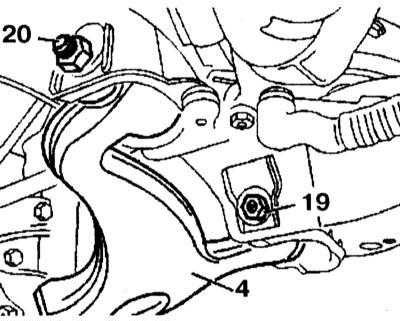


Adjustment of camber and longitudinal tilt of the front wheel pivot axis is performed using an…

Adjustment of camber and longitudinal tilt of the front wheel pivot axis is performed using an eccentric bolt


The camber adjustment is carried out by the front cam bolt (19), and the longitudinal angle of the wheel pivot axis is adjusted by the rear eccentric bolt (20) on the lower arm. The longitudinal angle of the wheel pivot axis is adjusted by means of the same bolt.

Convergence
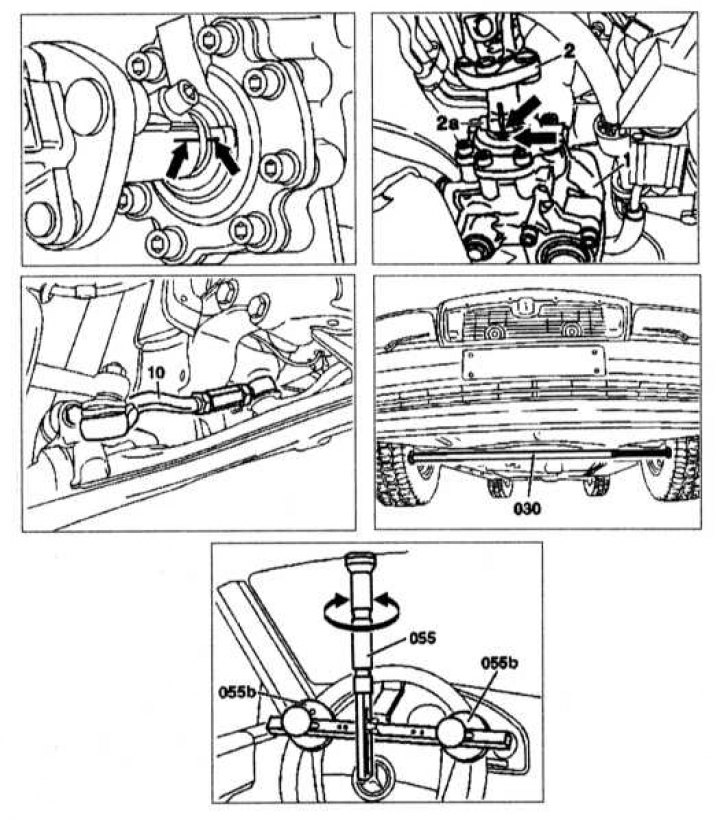


Checking and adjusting the front wheel alignment

Checking and adjusting the front wheel alignment


1. Set the wheels to the straight-ahead position using the device (055).

2. Check the central position of the steering gear and steering wheel (arrows).

3. Place a ruler (030) between the inner surfaces of the front wheels. Check the toe-in of the front wheels.

4. The toe-in is adjusted by rotating the steering rods (10). The nominal value of the front wheel toe-in is 0°35' ±10' (see Specifications).

Rear wheel adjustment


Collapse


The amount of camber of the rear wheels depends on the height of the ground clearance (clearance). The adjustment parameters are given in Specifications) to this Chapter.

Convergence
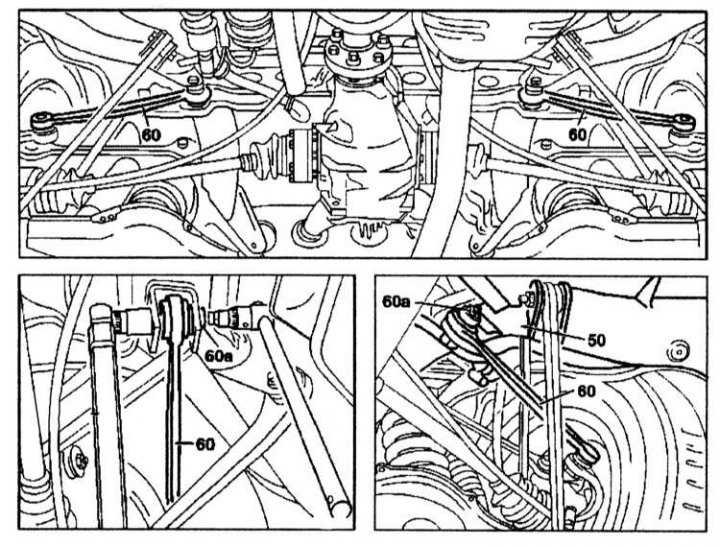


Rear wheel alignment adjustment

Rear wheel alignment adjustment


The toe-in of the rear wheels is adjusted using eccentric bolts (60a) on the left and right rods (60) on the rear suspension support (50).

Checking the vehicle body clearance
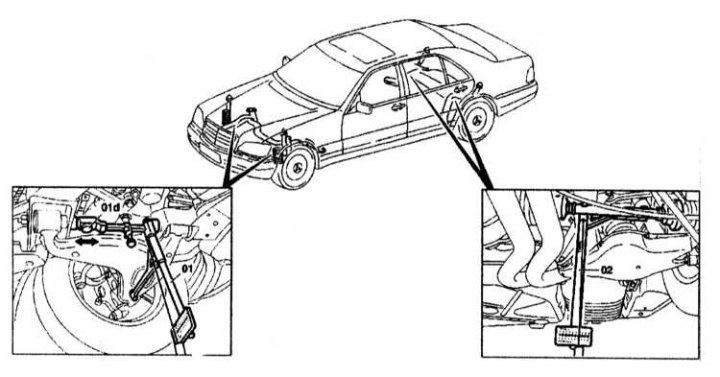


Checking the vehicle body clearance

Checking the vehicle body clearance


[Material borrowed from an online resource: MercedesMAN]

The front suspension clearance of the vehicle is checked using a measuring device (01) between the eccentric bolts of the lower arm.

The clearance of the rear suspension of the vehicle is checked using a device (02) attached to the drive shaft of the rear axle.
This article is available at: russian, bulgarian, belarusian, ukrainian, serbian, croatian, romanian, polish, slovak, hungarian
The article has been verified: Polyakov Zakhar Grigorievich
Share with friends:
◀ Previous
S-Class W140 / Steering
Next ▶

Safety precautions when repairing suspension and steering
Suspension and steering specifications
Removal and installation the steering gear
Removal and installation the steering pump (with engines 104, 119, 120 and 606)
Disassembling and assembling the power steering pump
Disassembly and assembly of the electronically adjustable steering column
Removal and installation the lower steering shaft
More similar articles for repairing other models

☛ Adjusting the position of the steering wheel Mercedes W168 (1997-2004)
☛ Conditions for checking wheel alignment angles Mercedes W203 (2000-2007)
☛ Checking and adjusting the front wheel alignment angles Mercedes W123 (1976-1985)
☛ Car Wheel Alignment Angles — General Information Mercedes W463 (1999-2019)
☛ Car Wheel Alignment Angles — General Information Mercedes W163 (1997-2005)
☛ Adjusting the front wheel alignment angles Mercedes Sprinter (1995-2000, diesel)
Link in different formats to this article
Comments and feedback from visitors
No comments yet


How much will 32 + 24 ?


W220 (1998-2005) 
  • General information
  • Introduction to guide
  • User manual
  • Maintenance
  • Power unit
  • Engine repair
  • Cooling and heating systems
  • Power and exhaust systems
  • Ignition and control system
  • Charge and launch systems
  • Transmission
  • Automatic gearbox
  • Drive shafts
  • Chassis
  • Brake system
  • Front suspension
  • Rear suspension
  • Steering
  • Body
  • Body elements
  • Electrical equipment
  • Equipment and devices
  • Electrical circuits
W140 (1991-1998) 
  • User manual
  • Controls and instruments
  • Driving and operation
  • Maintenance
  • Power unit
  • Petrol engine V6
  • Petrol engine V8
  • Petrol engine V12
  • Diesel engine OM603
  • Diesel engine OM606
  • Cooling system
  • Power supply and injection system
  • Control system HFM-SFI
  • Control system LH-SFI
  • Control systems ME-SFI
  • Diesel control system
  • Ignition system
  • Charge and launch system
  • Transmission
  • Mechanical gearbox 717.438
  • Mechanical gearbox 717.454
  • Automatic gearbox 722.5
  • Automatic gearbox 722.6
  • Clutch and drive shafts
  • Differential
  • Chassis
  • Brake system
  • Steering
  • Front suspension
  • Rear suspension
  • Body
  • Exterior (external elements)
  • Interior (internal elements)
  • Electrical equipment
  • Equipment and devices
  • Electrical circuits
W126 (1979-1991, petrol) 
  • Power unit
  • Engine repair
  • Ignition system
  • Lubrication system
  • Cooling system
  • Fuel system
  • Fuel injection system
  • Transmission
  • Clutch and cardan
  • Mechanical gearbox
  • Automatic gearbox
  • Chassis
  • Front suspension
  • Rear suspension
  • Steering
  • Brake system
  • Electrical equipment
  • Power devices
  • Electrical circuits
W116 (1972-1980, petrol) 
  • General information
  • Introduction to guide
  • Power unit
  • 8-cylinder V8 engine
  • 6-cylinder I6 engine
  • Cooling and lubrication system
  • Power system (carburetor)
  • Fuel injection system
  • Ignition system
  • Transmission
  • Clutch and cardan
  • Car gearbox
  • Chassis
  • Front suspension
  • Rear suspension
  • Steering
  • Brake system
  • Electrical equipment
  • Power devices
  • Electrical circuits
 
MercedesMan.ru © 2017–2026 · Mobile version · Read about Mercedes · Sitemap: EN BG BY UA RS HR RO PL SK HU · Feedback · Site search · Bookmark A-Class (W168) · C-Class (W201) · C-Class (W202) · C-Class (W203) · E-Class (W123) · E-Class (W124) · E-Class (W210) · G-Class (W463) · M-Class (W163) · S-Class (W116, petrol) · S-Class (W126, petrol) · S-Class (W140) · S-Class (W220) · Sprinter · Vito 1 · Vito 2 · Vario 814D ·
 
We only use cookies without which some of the site's features may not be available.