



Contents: Diesel engines ↡ Petrol engines ↡
Fuel tank, pump and fuel gauge. Petrol engine
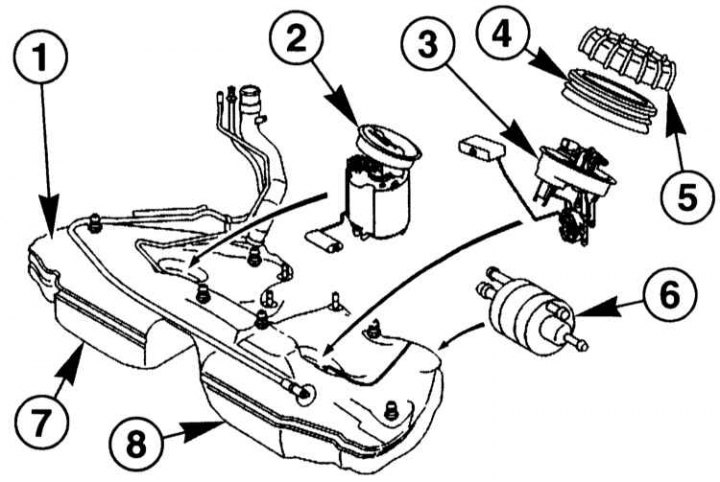
1 - Fuel tank; 2 - Fuel pump and fuel level sensor unit; 3 - Left fuel gauge; 4 - Profile sealing ring; 5 - Round nut; 6 - Fuel filter; 7 - Right camera; 8 - Left camera
Gasoline engine: The electric fuel pump together with the fuel level sensor is located in the right half of the fuel tank. They cannot be replaced separately. The second fuel level sensor is located in the left chamber of the fuel tank.
Diesel engine: Since the fuel is sucked in from a cam-driven fuel pump, only the sensors are located in the tank, each in its own chamber of the fuel tank.
Before removing the tank, it is necessary to empty it while the car is moving or pump the fuel out with a special pump into a container intended for this purpose. It is necessary to ensure good ventilation of the workplace. A radial fan with an electric motor located outside the air flow can be used for this purpose.
Warning! When removing the fuel pump, some fuel may leak out. Fuel vapors are toxic and flammable. Therefore, ensure that the work area is well ventilated. Avoid contact of fuel with skin. Wear gloves that are resistant to fuel. Do not use open flame!
Diesel engines
Removal
Note: This describes the removal of the fuel level sensor of a diesel engine. The removal of a gasoline engine is similar.
Caution: Do not connect an auxiliary power source to perform the following work, as the engine control unit may be damaged.
1. Disconnect the negative (-) battery cable with the ignition off. The cabin air filter box must be removed first.
Warning! Before disconnecting the cable, find out the radio receiver security code, if any, refer to Section Replacing the battery.
2. Empty the fuel tank. With a full tank, suck out about 20 liters of fuel from the right chamber.
3. Fold the seat cushions forward or remove them.
4. Fold back the floor covering.
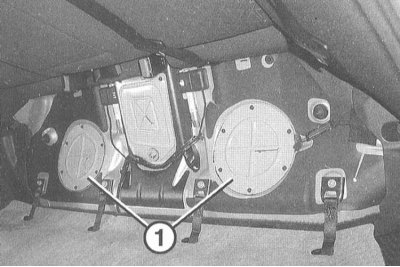
5. Unscrew both covers (1).
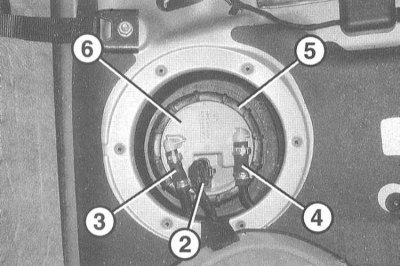
6. Disconnect the left (2) fuel level sensor connector.
7. Disconnect the fuel supply line (3) and fuel return line (4) at the left fuel gauge.
8. Unscrew the round nuts (5) using a cam wrench. If this tool is not available, unscrew the sensor using a gas wrench or a hardwood rod and light hammer blows.
Caution! Do not allow sparks to form, as this may cause a fire.
9. Remove the cover (6) with the profile sealing ring.
10. Pull out the right fuel level sensor a little.
11. Disconnect the right sensor connector.
12. If the sensor is being replaced, disconnect the connecting pipes on the right sensor.
Note: New stock sensors are equipped with couplings on the connecting pipes.
13. Carefully remove both sensors from the tank. Place a rag underneath and wipe off any leaking fuel.
Installation
1. Clean the mating surfaces on the tank and on the reserve sensors.
Caution! Do not allow dirt to enter the fuel tank.
2. Install a new gasket made of profile rubber on the left sensor, made to prevent it from getting into the fuel tank.
3. Pass the connecting pipes and plug through the fuel tank.
4. Remove the profile sealing ring from the left sensor and install it on the tank.
5. Connect the couplings or connecting pipes.
6. Connect the electrical wire of the right reserve sensor.
7. Install the right sensor with a new profile sealing ring.
8. Install the fuel level sensor cover so that the marks on the cover and the fuel tank match.
9. Tighten the round nuts to 85Nm.
10. Place the fuel supply and outlet hose on the left sensor and secure with clamps.
11. Connect the left fuel level sensor connector.
12. Check the fuel tank cap sealing cord and replace if necessary.
13. Install the lid and screw it onto the bottom.
14. Fold back the floor covering.
15. Fold back or install the seat cushion.
16. Connect the negative (-) cable to the battery with the ignition off. Reinstall the cabin air filter box. Enter the radio code and set the clock.
Petrol engines
Removal
Note: Only the difference from the diesel engine is described here.
1. Disconnect the seat cushion mounting clamps.
2. Use a cam wrench to loosen the round nut (5) of the fuel pump and the fuel level sensor (2). If the specified tool is not available, loosen the sensor using a gas wrench or a hardwood rod and light hammer blows.
Caution! Do not allow sparks to form, as this may cause a fire.
3. Disconnect the right fuel level sensor connector.
4. Disconnect the fuel supply hose from the fuel pump.
Note: The right sensor and fuel pump form a single unit.
5. Pull out the right fuel level sensor slightly.
6. Disconnect the fuel return hose from the right sensor.
7. Carefully remove the fuel pump with the right sensor from the fuel tank. Place a rag underneath and wipe off any leaking fuel.
Installation
1. Clean the mating surface of the fuel tank and fuel pump holder.
Caution! Do not allow dirt to enter the fuel pump.
2. Check the three fuel level sensor supports at the bottom of the tank, replace the fuel pump and fuel level sensor unit if necessary.
3. Place the fuel drain hose onto the right sensor.
4. Attach the fuel supply hose to the fuel pump.
5. Carefully insert the fuel pump with the sensor and new sealing ring and check their position. The mark on the cap should match the mark on the tank.
6. Install a new profile sealing ring.
7. Tighten the ring nut and secure it with a torque of 85 Nm.
8. Secure the rear seat cushion clamps.