



Contents: Petrol engines ↡ Diesel engines ↡ Safety precautions and rules for…↡ Safety precautions when removing the…↡
Control system component layout diagram. Models C240 and C320
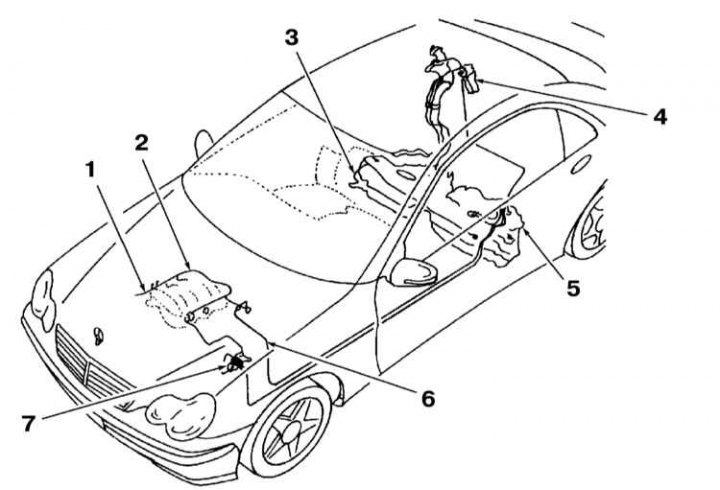
1 - Fuel pressure measurement connector; 2 - Fuel line; 3 - Fuel tank; 4 - Carbon adsorber; 5 - Fuel filter with built-in pressure regulator; 6 - Fuel supply line to the engine; 7 - Evaporative Blowoff Control Valve
Petrol engines
The fuel system consists of: installed in the rear of the vehicle (under the rear seat cushion) fuel tank with activated carbon canister, fuel lines, electric fuel pump, and electronic sequential injection system controlled by the control unit. The functional diagram of the control system and the location of the sensors are shown in the accompanying illustrations.
The fuel reserve is shown to the driver on the instrument panel. In a gasoline engine, gasoline vapors are collected in the adsorber and fed into the combustion chambers of the engine.
Driving style has a significant impact on fuel consumption. Below are some tips on how to use the gas pedal wisely.
- After starting the engine, move off immediately, even if it is in cold weather.
- If the vehicle is stopped for more than 40 seconds, turn off the engine.
- Always drive in the highest possible gear.
- When driving long distances, maintain a steady speed whenever possible. Avoid driving at high speeds. Drive carefully. Do not brake unnecessarily.
- Do not carry unnecessary loads on your vehicle. If the luggage rack is not in use, remove it from the roof.
- Check the air pressure in your tires. Do not allow the pressure to drop too much.
Diesel engines
The fuel system consists of: installed in the rear of the vehicle (under the rear seat cushion) fuel tank, fuel filter, injectors, fuel lines and hoses, fuel level sensor located inside the tank and the engine control unit.
Fuel is supplied by a special pump through a filter. The filter collects dirt and water contained in the fuel.
The engine is controlled by an electronic system similar to that of gasoline engines. The system controls the engine by analyzing information from a large number of sensors.
Diesel models do not have an accelerator cable. Instead, a pedal position sensor is installed on the pedal.
There is no fuel shut-off valve when the ignition is turned off. In order to shut off the engine when the ignition is turned off, the engine control unit sends a signal to the fuel injection pump control unit, which, in turn, stops the fuel supply to the injectors.
The fuel system is designed to prevent air "sucking" in when there is no fuel in the tank. The control unit constantly checks the fuel level in the tank, processing information coming from the fuel reserve sensor located in the tank. When the fuel reserve drops to a certain level, the control unit lights a warning lamp on the dashboard, after which it forcibly causes fuel supply misfires, thereby limiting the maximum speed. This continues until the fuel level in the tank exceeds the permissible mark.
The fuel system of diesel engines is very reliable. If clean fuel is used and regular maintenance is performed, it should function properly until the end of the vehicle's service life. After very high mileage, the internal components of the injectors may wear out and need to be repaired. Since the unit injectors have a complex design, it is recommended that repairs be carried out in a specialized workshop.
(Publication reprinted from this resource: «www.mercedesman.ru»)
Safety precautions and rules for maintaining cleanliness when working with the fuel system
Do not use open fire near the workplace, do not smoke or hold any very hot objects. There is a risk of accident! Keep a fire extinguisher at hand.
Ensure adequate ventilation of the work area. Fuel vapors are toxic.
The fuel system is under pressure. When opening the system, fuel may escape under pressure. Collect the fuel with a rag. Use safety glasses.
When working with diesel engine fuel system components, take special precautions. This applies especially to injectors. Keep in mind that the fuel pressure when leaving the injectors is about 1100 atmospheres. Do not allow any part of your body to come into contact with the fuel stream.
Hose connections are secured using band or clamp clamps. Clamp clamps must be replaced with band clamps or clamps of the latest design. A special device is available for installing band clamps, such as HAZET 796-5.
Clean connections and adjacent areas thoroughly before opening.
Place the removed parts on a clean lining and cover. Use polyethylene or paper for this. Do not use fibrous fabric!
Carefully cover open parts or install process plugs if the repair will take some time.
Install only clean parts. Remove spare parts from their packaging only immediately before installation. Do not use parts that have been stored unpackaged (for example, stored in a toolbox).
If possible, do not work with compressed air when the fuel system is open. If possible, do not move the vehicle while doing this.
Do not use silicone-containing sealants. Silicone elements that get into the engine do not burn out and damage the lambda probe.
Safety precautions when removing the fuel tank
Before removing the tank, drain the fuel from it or pump out the fuel using a pump specially designed for this purpose.
The fuel tank is removed from the underside of the vehicle. Before disconnecting the tank mounting clamps, place a jack and shims underneath the tank.
An empty tank is explosive and cannot be disposed of in this form. Before disposal, the tank must be cut into pieces. Make sure that no sparks are generated. To do this, hand the fuel tank over to a specialized company.
After installing the tank in place, start the engine and check the tightness of all connections.