



Steering
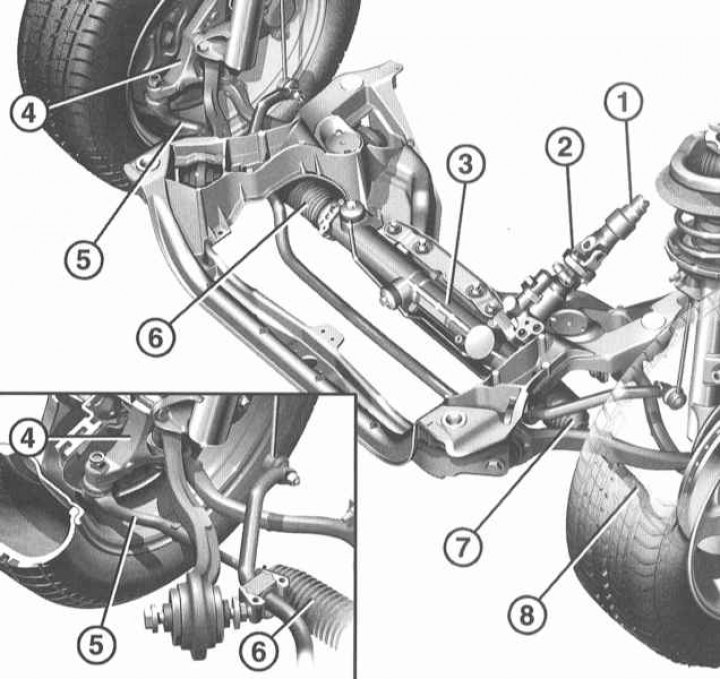
1 - Steering column; 2 - Cardan joint; 3 - Rack and pinion steering gear; 4 - Right steering knuckle; 5 - Right steering rod; 6 - Protective cover right; 7 - Left protective cover; 8 - Left steering rod
Rack and pinion steering mechanism
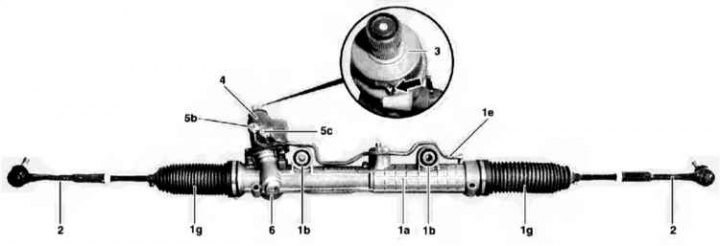
1a - Steering gear housing; 1b - Rubber support pads; 1e - Oil lines; 1g - Protective covers with fastening clamps; 2 - Steering rods; 3 - Cover with marking of the central position of the rack mechanism (arrow); 4 - Housing of the vane valve and control sleeve; 5b - Right pressure chamber connector; 5c - Left pressure chamber connector; 6 - Steering rack play compensator
Elements of the rack and pinion steering mechanism
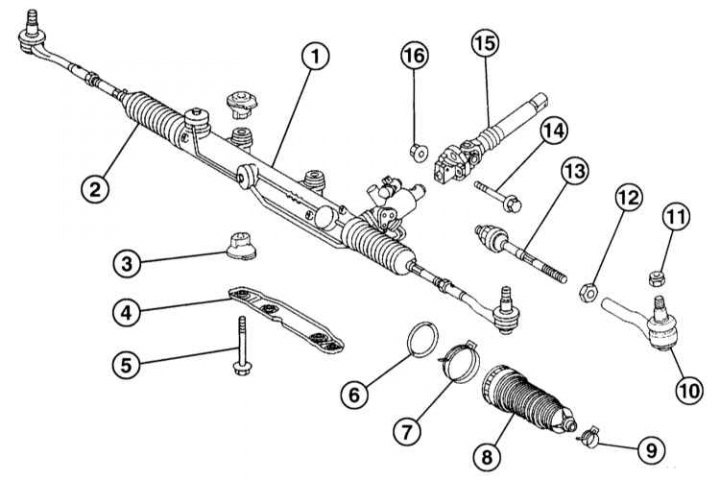
1 - Rack and pinion steering gear; 2 - Protective cover right; 3 - Lower support; 4 - Locking bar, for steering at the cross member; 5 - Bolt M12; 6 - Sealing ring*; 7 - Large clamp*; 8 - Protective cover left*; 9 - Small clamp*; 10 - Tie rod end; 11 - Nut, 55Nm, self-locking, be sure to replace with a new one; 12 - Nut M14; 13 - Steering rod; 14 - Bolt M8; 15 - Steering column; 16 - Nut M8
*) Protective cover repair kit
Steering rack play compensator
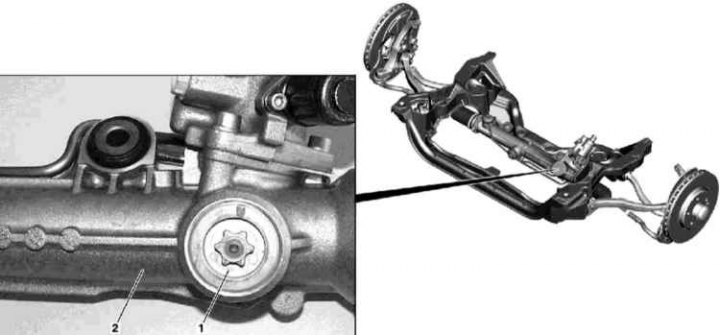
1 — Steering rack play compensator
2 — Steering gear housing
Hydraulic circuit and elements of the vehicle speed-sensitive steering system
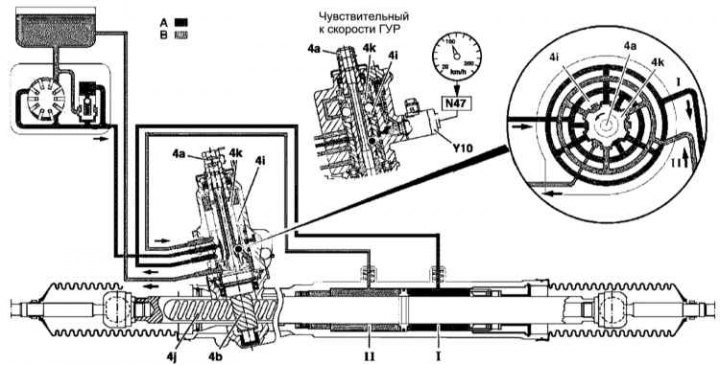
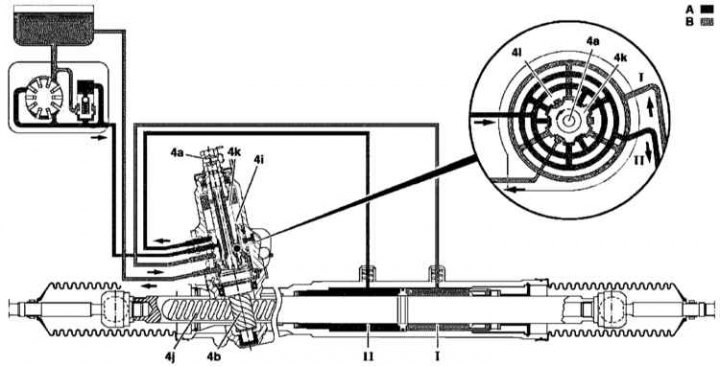
4a - Torsion bar; 4b - Drive gear; 4i - Control sleeve; 4j - Transfer rack; 4k - Vane shutter; A - Under pressure; B - No pressure; I - Right slave cylinder (left turn); II - Left slave cylinder (right turn); Y10 - SPS Solenoid Valve; N47 - Traction control and stabilization system control unit
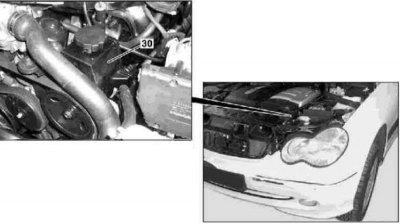
Location of power steering pump (30)
The steering consists of a steering wheel, a steering column, a rack-and-pinion steering gear, and steering rods. The steering column transmits the steering wheel movements to the steering gear. The rack-and-pinion steering gear moves to the right or left in accordance with the steering wheel rotation. The steering rods transmit the steering forces to the front wheels via the joints and the steering knuckle.
The rack and pinion transmission of the steering mechanism is made without backlash and does not require maintenance. As part of the maintenance, only inspection of the protective covers and dust caps of the steering rod ends is required.
The vehicle's steering system has a hydraulic booster, which reduces the force applied to the steering wheel. The booster coefficient increases with increasing speed. The hydraulic booster contains a hydraulic pump and a reservoir of working fluid. The hydraulic pump sucks fluid from the reservoir and delivers it under high pressure to the control valve in the steering mechanism. The control valve has a mechanical connection with the steering spindle and directs the fluid, depending on the turn of the steering wheel, to the corresponding cavity of the working cylinder in the steering mechanism housing. Here the fluid acts on the piston and thus maintains the control process. At the same time, the piston squeezes out the fluid from the opposite cavity of the working cylinder through the return pipeline into the fluid reservoir.
Speed Sensitive Power Steering (SPS) Operation
Electronic control of the SPS Y10 solenoid valve is carried out by the N47 control unit depending on the vehicle speed.
When the steering wheel is rotated, the pinion gear (4b) acts on the rack (4j). The rotating slider (4k) rotates around the control sleeve (4i) via the torsion bar (4a) and rests against the rack (4j), which changes the relative position of the control grooves. In this case, a flow of oil under pressure is supplied to the chamber of the right or left slave cylinder (I or II), causing an axial displacement of the rack (4j) in the corresponding direction. Oil from the unloaded slave cylinder is displaced and through the open return grooves in the control sleeve (4i) is directed back into the reservoir of the steering pump.
Security measures
Welding and straightening work on steering components is not permitted. Self-locking bolts and nuts, as well as bolts and nuts that are corroded, must be replaced with new ones.
Attention! The tightening torques of threaded connections must be maintained.
The driver's airbag is located in the steering wheel. The airbag is a collapsible air bag that fills with air during a frontal collision of the vehicle, thus protecting the driver's upper body and head. In the event of a frontal collision of sufficient force, the control unit sends a signal to the airbag fuse. The explosion produces gas that inflates the airbag for a few milliseconds. This time is enough to dampen the forward movement of the driver's upper body. Then, within a few seconds, the airbag collapses again, as the gases escape from the airbag through the existing openings.