



Note: This section describes models equipped with standard automatic interior heating - it does not cover models equipped with air conditioning; for more information, please contact paragraph 9.
Heater unit
Removal
1. Drain the cooling system as described in Chapter 1.
2. Remove the instrument panel as described in Chapter 11.
3. Loosen the cable clamp on the left side of the heater unit and remove the screw on the connector.
4. Disconnect the connector from the back of the heater fan motor switch (see fig. 8.4).
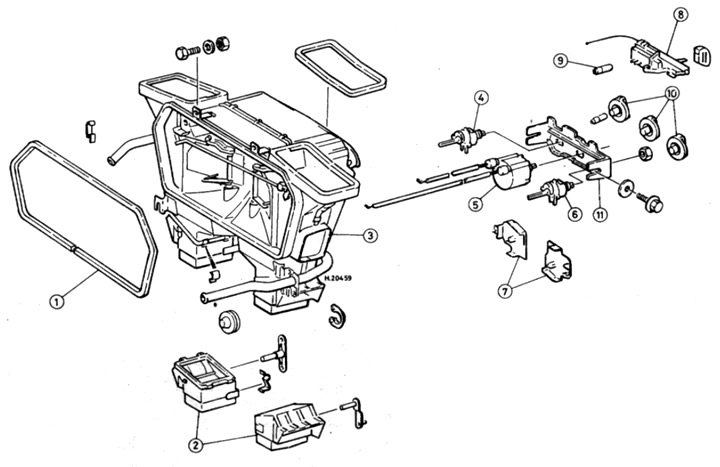
Fig. 8.4. Heater unit parts
1 Seal
2 Blowing nozzle
3 Heater
4 Vacuum switch
5 Air distributor
6 Vacuum switch
7 Lids
8 Heater fan switch
9 Lamp
10 Switch buttons
11 Switch bracket
5. Disconnect the vacuum lines and wire from the heater control unit light bulb.
6. Disconnect the heater radiator supply hose from the back of the cylinder head.
7. Place a container underneath the engine, under the detachable hose.
8. Disconnect the heater radiator return hose at the thermostat housing. Using compressed air from a foot pump, squeeze out the remaining coolant from the heater radiator by inserting the pump hose into the opening of the heater radiator return hose. The coolant will be forced out of the opening into a container.
9. Unscrew the two bolts and separate the return hose tube from the heater radiator flange (see fig. 8.9).
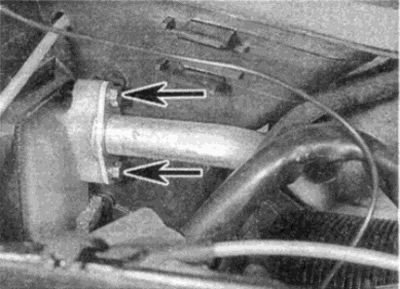
Fig. 8.9. Loosen the return flow tube bolts (see fig. 8.9).
10. Pull off the right air duct on the heater unit below the fluid return tube.
11. Remove the two bolts and separate the fluid supply pipe from the flange on the other side of the heater radiator.
12. Pull off the left air duct on the heater unit below the heater radiator supply pipe.
13. Remove the supply pipe holder from the engine compartment bulkhead on the right side.
14. Loosen the support bracket nut below the supply pipe holder.
15. Unscrew the nut of the right bracket under the return pipe.
16. Unscrew the two mounting nuts from the top of the heater unit.
17. Disconnect the control cable on the heater fan motor switch.
18. Disconnect the control cable on the main flap on the side of the heater unit.
19. Remove the heater unit from the support studs, lift it up and remove it from the vehicle.
Installation
20. Installation is carried out in the reverse order. When connecting the heater fan control cable, connect and secure the cable to the switch, then move the switch to the "MAX" fan position. Connect the end of the control cable to the main air damper lever, open the damper to the stop, then secure the cable sheath.
21. When finished, fill the cooling system as described in Chapter 1.
Heater radiator
Removal
22. Remove the heater unit as described earlier in this paragraph.
23. Loosen the screws on the heater inlet pipe.
24. Carefully unfasten all fasteners along the top surface on both sides and on the bottom surface of the heater unit.
25. Disconnect the lever mechanism from the left and right arms of the anti-fog device.
26. Press the lock on the left flap of the anti-fog channel while simultaneously pulling out the rod connector lever.
27. Remove the gaskets from the left and right connections of the anti-fog nozzle.
28. Push out the air mixing flap connecting levers on the left and right levers
29. Remove the ball heads of the connecting levers of the left and right air mixing flaps from the spherical recesses.
30. Separate the two halves of the heater unit and remove the air mixing flaps.
31. Loosen the screws securing the heater radiator frame. Remove the frame and take out the heater radiator.
Installation
32. Installation is carried out in reverse order.
Heater Fan Motor
Removal
33. Remove the intake manifold cover from the top of the air intake box as described in Chapter 12.
34. Disconnect the vacuum hose at the heater valve (see fig. 8.34).
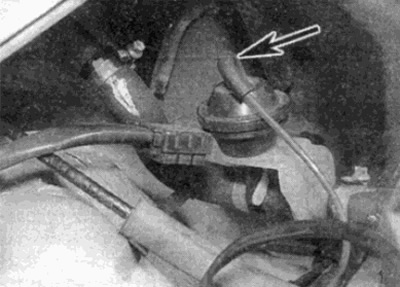
Fig. 8.34. Disconnect the vacuum hose (shown by arrow)
35. Unscrew the two screws on the heater electric fan cover (see fig. 8.35).
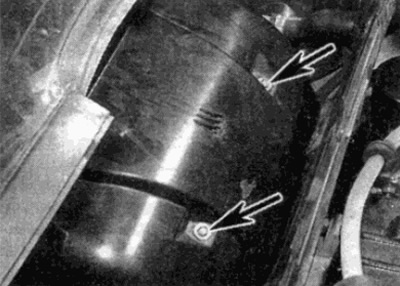
Fig. 8.35. Unscrew the screws of the heater electric fan cover (shown by arrows)
36. Lift the rubber sealing strip from the inner wall of the engine compartment bulkhead and unscrew the two bulkhead mounting screws on each side (see fig. 8.36).
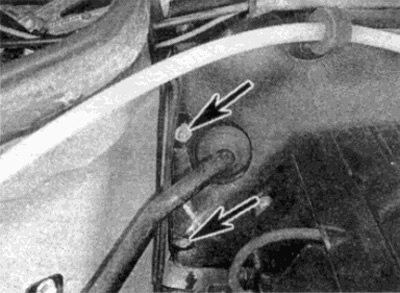
Fig. 8.36. Screws for fastening the internal bulkhead of the engine compartment (shown by arrows)
37. Move the partition wall up and forward, then remove the heater electric fan cover.
38. Loosen the cable clamps and disconnect the electric motor plug.
39. Loosen the heater electric fan mounting bolts and remove the electric motor away from the housing (see fig. 8.39).
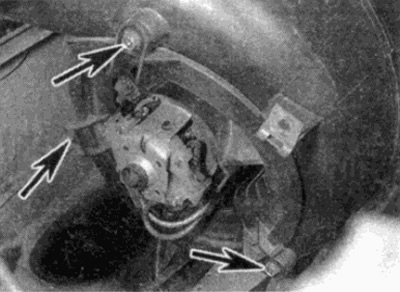
Fig. 8.39. Heater motor mounting bolts
Installation
40. Installation is carried out in reverse order. Heater valve
Heater valve
Removal
41. Remove the intake manifold cover from the top of the air intake box as described in Chapter 12.
42. Slowly loosen the expansion tank cap to relieve pressure in the cooling system
43. Disconnect the vacuum hose from the heater valve located next to the heater electric fan in the air intake box.
44. Disconnect the cooling hoses and remove the valve from the bracket.
Installation
45. Installation is carried out in the reverse order. However, note that the side of the valve, marked "water inlet" ("water inlet") should be facing the engine. When finished, top up the coolant.