



Connecting a multimeter to the engine control unit connectors using an auxiliary splitter
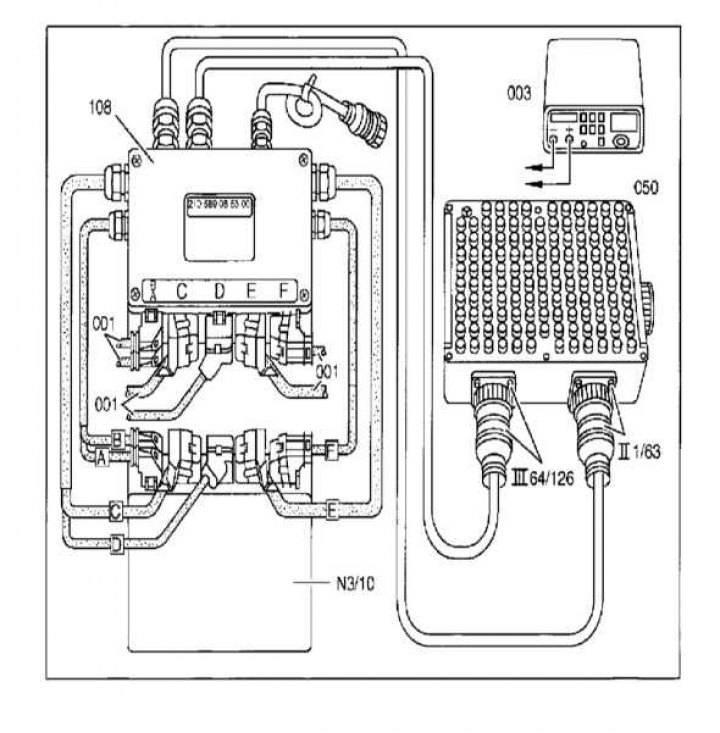
001 - ECM Connectors; 003 - Digital Multimeter; 050 - 126-pin splitter; 108 - Test cable; N3/10 - Engine Control Unit (ME-SFI); A-F - Connectors; II1/63 - Splitter connectors; III63/126 - Splitter connectors
When disconnecting the connectors on the ECM, the center connector (D) is installed last.
Important: The connector with the red marking is currently not required as the ECM does not have a corresponding function.
The OBD system includes several diagnostic devices that monitor individual parameters of the toxicity reduction systems and record detected failures in the on-board processor memory in the form of individual fault codes. The system also checks sensors and actuators, monitors vehicle maintenance cycles, and provides the ability to memorize even short-term failures during operation and clear the memory block.
All models described in this Manual are equipped with an on-board diagnostics system (OBD II). The main element of the system is the on-board processor, more often called the electronic control module (ECM) or the powertrain control module (PCM). The PCM is the brain of the engine management system. Initial data comes to the module from various information sensors and other electronic components (switches, relays, etc.). Based on the analysis of data received from the information sensors, and in accordance with the basic parameters stored in the processor memory, the PCM generates commands to operate various control relays and actuators, thereby adjusting the engine operating parameters and ensuring maximum efficiency with minimum fuel consumption. Reading of the OBD-II processor memory data is performed using a special scanner connected to the 16-pin diagnostic connector for reading the database (DLC), located in the car's interior.
Note: In principle, reading the fault codes stored in the self-diagnostic system memory is possible, on some models, using the "Check Engine" lamp or an auxiliary LED, as well as using the codes displayed on the automatic crankcase display.
Information about diagnostic devices
The proper functioning of the injection system components and the reduction of exhaust gas toxicity is checked using a universal digital meter (multimeter). Using a digital meter is preferable for several reasons. Firstly, it is quite difficult to measure the value of an analog meter (sometimes it's impossible), determine the result of the reading with an accuracy of up to hundredths and thousandths, while when examining circuits that include electronic components, such accuracy is of particular importance. The second, no less important, reason is the fact that the internal circuit of the digital multimeter has a fairly high impedance (the internal resistance of the device is 10 MOhm). Since the voltmeter is connected to the circuit being tested in parallel, the accuracy of the measurement is higher, the smaller the current that passes through the device itself. This factor is not significant when measuring relatively high voltage values (9÷12 V), but it becomes decisive when diagnosing elements that produce low-voltage signals, such as, for example, an l-probe, where we are talking about measuring fractions of a volt.
Parallel monitoring of signal parameters, resistances and voltages in all control circuits is possible using a splitter connected in series to the engine control unit connector. In this case, with the engine off, running or while the car is moving, the signal parameters are measured at the terminals of the splitter, from which a conclusion is made about possible defects.
Special diagnostic scanners or testers with a specific cartridge can be used to diagnose electronic systems of the engine, automatic transmission, ABS, SRS and others (if provided), a universal cable and connector. In addition, for this purpose, you can use an expensive specialized automotive diagnostic computer, specially designed for full diagnostics of most systems of modern cars (for example, ADC2000 from Launch HiTech). Also, for this purpose, you can use scanners and specialized diagnostic analyzers, for example FDS 2000, Bosch FSA 560 (www.bosch.de), KTS 500 (0 684 400 500) or a regular personal computer with a special adapter, cable (for example, set 1 687 001 439) and the installed OBD II browser program.
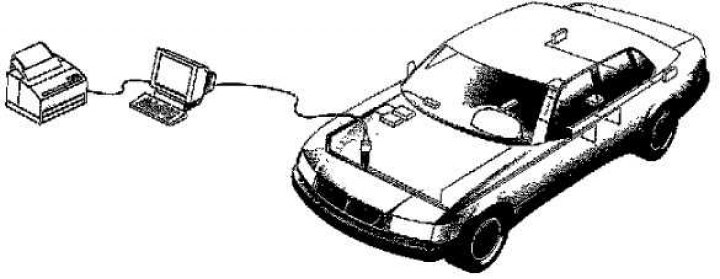
Some scanners, in addition to the usual diagnostic operations, allow, when connected to a personal computer, to print out the basic diagrams of electrical equipment stored in the control unit memory (if pledged), program the anti-theft system, observe signals in the car circuits in real time.
Diagnostics of electronic engine control systems, injection and ignition, automatic air conditioning and ABS/ASR/ETS/ESP
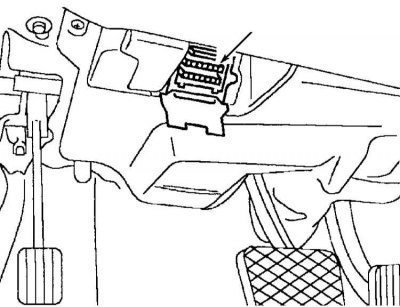
Location of 16-pin diagnostic connector, if installed
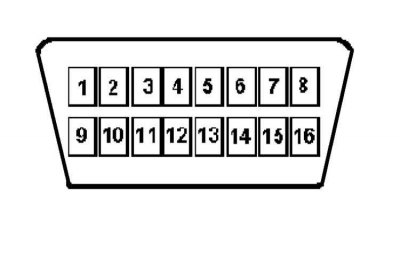
16-pin OBD II diagnostic connector (on USA models)
| Output No | Purpose |
| 1 | — |
| 2 | — |
| 3 | TNA signal (petrol); TD (diesel) |
| 4 | Connection to the body, cl. 31 |
| 5 | Housing - signal output, cl. 31 |
| 6 | CAN data bus high level (passenger compartment) |
| 7 | Engine Electronics (ME) |
| 8 | Nutrition, class 87 |
| 9 | Traction control system (ETS/ESP) |
| 10 | — |
| 11 | Transmission Control Unit (ETC) |
| 12 | Activity Module (AAM – All Activity Module) |
| 13 | Security systems |
| 14 | CAN data bus. Low level (passenger compartment) |
| 15 | IC dashboard |
| 16 | Plus battery via fuse. Live at any ignition switch position, terminal 30 |
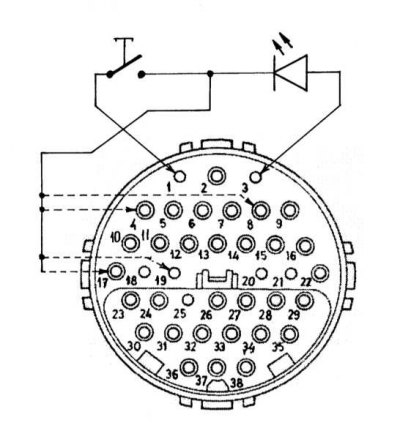
38-pin diagnostic connector for retrieving flashing codes (if installed)
Connect the wires according to the diagram. The wire shown as a broken line is connected to a specific terminal to diagnose a specific system (refer to the contact assignment list):
- to terminal 4 for injection system diagnostics;
- to pin 8 for diagnostics of the main unit;
- to terminal 17 for ignition system diagnostics;
- to pin 19 to check the diagnostic unit.
Pin assignment of the 38-pin diagnostic connector
| 1 | Mass, contour 31 (W12, W15, electronic grounding) | |
| 2 | Voltage, circuit 87 | |
| 3 | Voltage, circuit 30 | |
| 4 | EDS | Electronic injection system (diesel engines) |
| DFI | Fuel injection with electronic distribution (diesel engines) | |
| IFI | Sequential electronic fuel injection (diesel models) | |
| HFM-SFI | Sequential multipoint injection/ignition system HFM (engines 104) | |
| LH-SFI | Sequential distributed injection system LH (engines 104, 119, 120 [right]) | |
| ME-SFI | Sequential distributed injection system ME (engines 119, 120 [right]) | |
| 5 | LH-SFI | Sequential distributed injection system LH (engines 120 [left]) |
| ME-SFI | Sequential distributed injection system ME (engines 120 [left]) | |
| 6 | ABS | Anti-lock brake system |
| ETS | Electronic traction control system | |
| ASR | Adjusting slip during acceleration | |
| ESP | Electronic stabilization program | |
| 7 | EA | Electronic acceleration |
| CC/ISC | Speed control/idle speed stabilization system. | |
| 8 | VM | Basic module. |
| BAS | Emergency brake assist. | |
| 9 | ASD | Automatic differential lock. |
| 10 | ETS | Electronic transmission control. |
| 11 | ADS | Adaptive damping system. |
| 12 | SPS | Speed-sensitive power steering system. |
| 13 | TNA signal (petrol models), LH-SFI engines. | |
| TN signal (petrol models), HFM (ME)-SFI engines. | ||
| 14 | Signal, duty cycle information, engines 119, 120 LH-SFI (right). | |
| 15 | Signal, duty cycle information, 120 LH-SFI engines (left). | |
| IC | Instrument cluster. | |
| 16 | A/C | Air conditioning system. |
| 17 | DI | Ignition system with distributor, engines 104, 119 and 120 (right) |
| TD signal (time division) (diesel models) | ||
| TN signal, LH-SFI engines. | ||
| 18 | DI | Ignition system with distributor, LH-SFI engines. |
| 19 | DM | Diagnostic module. |
| 20 | PSE | Pneumatic equipment. |
| 21 | CF | Comfort. |
| 23 | ATA | Anti-theft alarm. |
| 24-27 | Not used. | |
| 28 | PTS | Parktronic system. |
| 29 | Not used. | |
| 30 | AB | Airbags/belt tensioners ETR (SRS) |
| 31 | RCL | Remote control of a single lock. |
| 32-33 | Not used. | |
| 34 | CNS | Communication and navigation system. |
| 35-38 | Not used |
Reading and clearing flashing codes
Reading of codes is performed using a simple circuit consisting of a push-button switch and a LED. Depending on the type of diagnostic connector and the system being diagnosed, the connection is performed as shown in the illustrations.
1. Connect the circuit according to the illustration.
2. Turn on the ignition.
3. Press and hold the switch button for 2-4 seconds and release it. After 2 seconds, the LED will display a code, the value of which is equal to the number of flashes. The flash duration is 0.5 seconds, the interval is 1 second. Identify the code by decoding. To read the next code, press the button again. To erase this code, press the button and hold it for 6-8 seconds. In addition, on some models, erasing codes in the memory is possible by disconnecting the negative terminal of the battery.
4. Turn off the ignition and disconnect the circuit for testing.
Diagnostics of the electronic system of automatic air conditioning (A/C)
Material taken from a web resource [MERCEDESMAN.ru]
Diagnostic codes can be read from the display of the KV control unit in addition to a special scanner. Malfunction codes are saved even when the battery is disconnected.
Reading codes
- Turn on the ignition;
- Move the temperature selection knobs to the HI left and LO right positions;
- Within 20 seconds after moving the handles, simultaneously press and hold the REST and EC buttons for 5 seconds;
- The LED of the RECIRCULATION key will start flashing and OFF will appear on the display;
- Press the right AUTO button for more than 1 sec. If there are no faults in the memory, E will appear on the left side of the display, and FF on the right. Otherwise, Ebl will be displayed on the left side, and the fault code on the right side (please refer to the list of KV codes below);
- To display the next fault code, press the AUTO button;
- To erase codes after they have been fully read, press the right and left AUTO buttons for more than 2 seconds. The left side of the display shows d, the right side shows FF;
- Pressing the right AUTO button restores erased codes (compare with the codes recorded earlier);
- After deleting the codes, E is displayed on the left side of the display, and FF on the right side;
- Set the temperature selection knob to the normal position;
- Turn off the ignition.