



Orthopedic seat (FDS) (since 09.2002, codes 433 and 434)
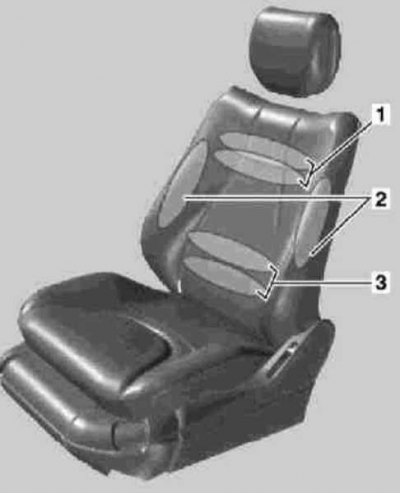
1-Air cushion in the shoulder area (double}
2 - Side airbag
3 - Air cushion to support the upper and lower lumbar regions
Orthopedic seat (MCS)
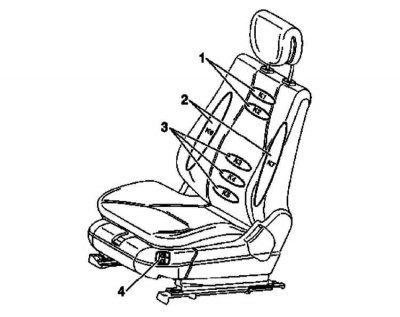
1 - Two air bags in the shoulder area
2 - Two air cushions on the sides
3 - Three air cushions for lumbar support
4 - Switches
Heated seats
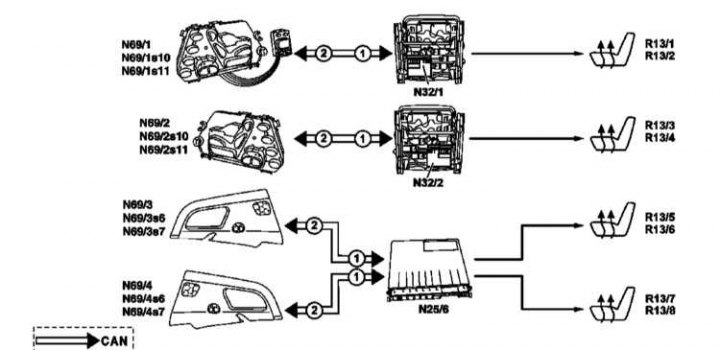
1 - Seat heating control via CAN; 2 - Activation of LEDs in the door control unit N69/3s7 via CAN; N₂5/6 - Rear seat control unit N69/4; N32/1 - Left front seat adjustment control unit with memory N69/4s6; N32/2 - Right front seat adjustment control unit with memory N69/4s7; N69/1 - Left front door control unit R13/1; N69/ls10 - Switch for modes 1 and 2 heating R13/2 or only mode 1 seat heating; N69/ls11 - Seat ventilation switch or ' R13/3 mode 2 seat heating R13/4; N69/2 - Right front door control unit; N69/2s10 - Seat heating in modes ' and 2 or only in R13/5 mode 1 R13/6; N69/2sl 1 - Seat ventilation or seat heating mode 2 R13/7 R13/8; N69/3 - Left rear door control unit; N69/3S6 - Seat heating in modes 1 and 2 or only in mode 1; N69/3s - Seat ventilation or seat heating mode 2; N69/4 - Right rear door control unit; N69/4s6 - Seat heating in modes 1 and 2 or only in mode 1; N69/4s7 - Seat ventilation or we will solve 2 seat heating; R13/1 - Heated cushion of the left front seat; R13/2 - Heated left front seat back cushion; R13/3 - Heated cushion of the right front seat; R13/4 - Heated right front seat back cushion; R13/5 - Left rear seat heated cushion; R13/6 - Heated cushion of the backrest of the left rear seat; R13/7 - Heated cushion of the right rear seat; R13/8 - Heated cushion of the backrest of the right rear seat
Note: The description is for the driver's seat and fully applies to the front passenger seat as well.
Dynamic (orthopedic) the seats (FDS) feature a multi-contour design with adjustable backrest with memory function (MMKL) and dynamic lateral support. The multi-contour design of the backrest is provided by three groups of air cushions, providing upper and lower shoulder, side and upper and lower lumbar support. The shape of the surface and the firmness of the backrest are adjusted manually using the Group of the corresponding switches of the driver's (S109) or front passenger (S108) seat and the "dynamic lumbar support" function.
Dynamic cross stop (front seats)
Function requirements:
- Contour 15 R On;
- Circuit 15 On:
- Adequacy of voltage level (without any up or down changes);
- No signal from overheating sensor,
- No air leaks from the cushions.
The "dynamic lateral stop" function is activated/deactivated via the FDS pushbutton and monitored by the seat adjustment control module (N32/19). Activation of the function is confirmed by the control LED integrated in the FDS button. After activation of the function, the seat control module ensures the required inflation of the side bolster cushions on the outside of the bend during cornering. The required information on the current lateral acceleration is received from the skid control module (N47) and transmitted by the central gateway control module (N93) from the CAN-C bus in the engine compartment to the CAN-B bus in the passenger compartment. If the FDS data flow is interrupted for more than 2 seconds, the function is automatically deactivated.
The degree and speed of inflation of the air bags are regulated at the second control level of the instrument panel (A1).
Sports mode (state 1)
The pressure in the side strut cushions builds up faster and to a higher value.
Comfort mode (state 2)
The pressure is pumped more slowly and to a lower value. The modules involved in the control of dynamic seat adjustments include:
- Driver Seat Control Module (N32/19);
- Front Passenger Seat Control Module (N32/22);
- Central Gateway Control Module (N93);
- Anti-skid control module (N47).
Stop activation priorities
- Priority 1. Lumbar support;
- Priority 2. Shoulder Rest (except for individual rear seats);
- Priority 3: Crosscut stop;
- Priority 4: Dynamic Lumbar Support and Dynamic Lateral Supports (for front seats only).
When multiple control switches are used simultaneously, only the highest priority function is activated.
Disconnection criteria
Automatic deactivation of all functions occurs when the supply voltage level fluctuates. Overheating of the valves and air leaks can cause the individual function to be deactivated.
Background functions
The lumbar support cushion group operates in paired overlapping in a wave-like sequence. Since only one cushion is activated in each case, the adjacent cushions are considered inactive, i.e. empty. The background functions listed below provide the appropriate conditions for maintaining the correct functioning of the cushions.
Mode for releasing air from inactive airbags (additional equipment function)
By maintaining constant pressure in the active cushion (resident period) air from adjacent inactive cushions is released.
Background pressure drop
When air is released from an active cushion, the residual air from adjacent inactive cushions is also released at the moment the pressures are equalized.
[Material taken from a web resource: mercedesman]
Pressure relief limit
When the destination point is reached at the end of the lumbar support wave, the active cushion is emptied by a command from the switch, but not for more than 1 minute.
Management functions
Control of the inflation of the individual cushions of the thrust areas in each case is carried out by the control module of the corresponding seat (N32/19 and N32/22) and unnoticeably for the user, while maintaining manual adjustments.
Additional adjustments are made, for example, in the event of pressure fluctuations associated with changes in the position of the occupant, leaks in the air pump devices, temperature changes caused by activation/deactivation of seat heating elements and heat flows from the air conditioning system/the occupant's body, etc.
Sharp pressure surges caused by changes in the sitting position are dampened quickly and unnoticeably. Control parameters can be programmed during diagnostics.