



Contents: Fuel pump ↡ Fuel filter ↡ Pressure regulator ↡ Nozzles ↡ Electronic control device ↡ Fuel pump control ↡ Intake Manifold Pressure Sensor ↡ Impulse switch ↡ Temperature sensor ↡ Cold start injector ↡ Additional air supply valve ↡ Checking the pressure in the fuel…↡ Checking the pressure regulator ↡ Checking the injectors ↡
Fuel pump
The fuel pump delivers fuel from the fuel tank to the injectors and the starting injector and simultaneously maintains pressure in the fuel system. The pump is of the rotary type and is driven by an electric motor. An eccentrically located rotor rotates in a cylindrical housing. Semicircular grooves are located along the circumference of the rotor, in which metal rollers are installed. When the rotor rotates, the rollers are pressed against the cylindrical surface of the housing and act as a seal. The principle of operation of the pump is that when the rotor rotates, the rollers form a larger volume in the inlet valve area, and a smaller volume in the outlet valve area. A pressure limiting and fuel drain valve is installed on the outlet pipe of the pump, which prevents the pressure in the system from dropping when the engine is turned off. On the other hand, the valve limits the pressure within 3...4 atm. The ventilation system in the valve prevents air from entering the fuel system. The fuel pump is located next to the fuel tank (see fig. 133). The pump performance at a voltage of 12 V and a rotation speed of 2500 rpm and a pressure of 2 atm is 120 l/hour.
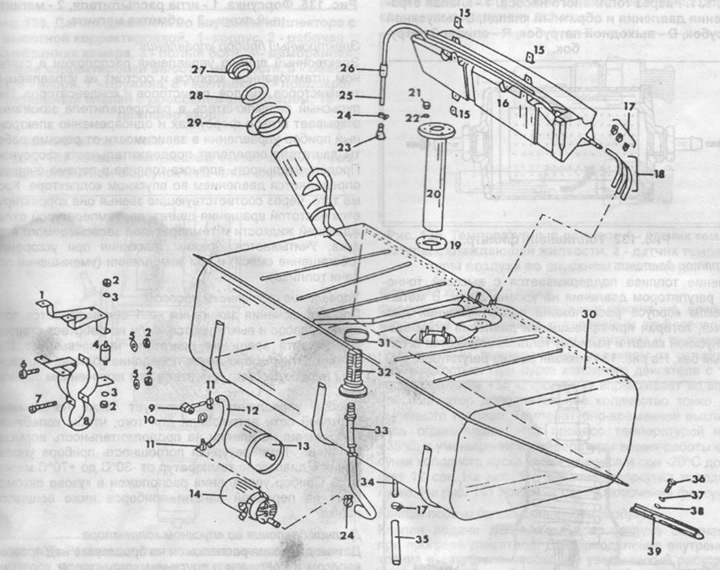
Fig. 133. Fuel tank parts.
1 - bracket,
2 - nut,
3 - spring washer,
4 - buffer,
5 - washer,
6 - cylindrical head screw,
7 - cylindrical head screw,
8 - clamp,
9 - corner fitting,
10 - sealing ring,
11 - clamp,
12 - fuel hose,
13 - fuel filter,
14 - fuel pump,
15 - clamp nut,
16 - distribution tank,
17 - clamp,
18 - fuel hose,
19 - gasket,
20 - pipe,
21 - nut,
22 - washer,
23 - rubber cuff,
24 - clamp,
25 - ventilation tube,
26 - rubber tube,
27 - fuel tank cap,
28 - gasket,
29 - rubber nozzle,
30 - fuel tank,
31 - sealing ring,
32 - hollow bolt with filter,
33 - suction hose,
34 - fuel outlet,
35 - fuel hose,
36 - bolt,
37 - spring washer,
38 - washer,
39 - reinforcing bar.
Fuel filter
The fuel filter is located in a metal housing. There are connecting pipes on both sides of the housing. The filter element is replaced after 40,000 km of run. When installing, observe the direction of fuel flow (arrows in Fig. 132).
Article obtained from this portal [MercedesMAN]
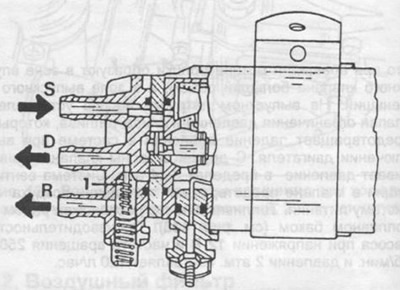
Fig. 131. Sectional view of the fuel pump.
1 - pressure limiting valve and check valve,
S - outlet pipe,
D - outlet pipe,
R - drain pipe.
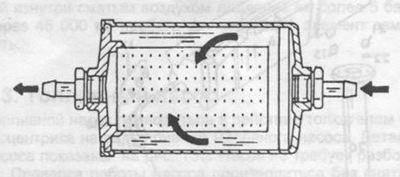
Fig. 132. Fuel filter.
Pressure regulator
Fuel pressure is maintained with high precision by a pressure regulator at a level of 2 atm. A spring-loaded diaphragm is located in the metal housing. When the pressure is exceeded, it opens the bypass channel and excess fuel is drained into the fuel tank. Fig. 134 shows a section of the regulator.
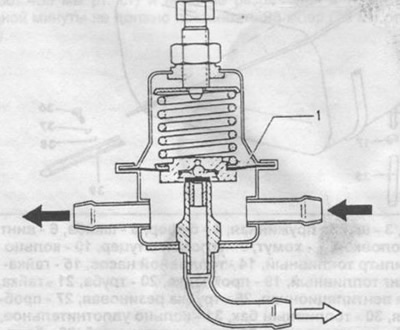
Fig. 134. Pressure regulator.
1 - diaphragm.
Nozzles
Electromagnetic injectors are used for dosing and atomizing fuel. The injector consists of an injector body and a spring-loaded metering needle with a magnetic anchor. When the electromagnet is turned on, the needle moves away from the seat by 0.1... 6 mm, and the fuel enters through a calibrated ring target. When the winding is de-energized, the needle drops onto the seat under the action of the spring. The front end of the needle is beveled for atomizing fuel. Fig. 135 shows a section of the injector with the described parts.
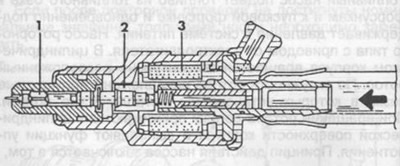
Fig. 135. Nozzle.
1 - spray needle,
2 - magnetic anchor,
3 - magnet winding.
Electronic control device
The electronic control device is located in a stamped steel housing and consists of controlled transistors, diodes, resistors and capacitors. The pulse switch in the ignition distributor opens the needles in the injectors and at the same time the electronic control device, depending on the engine operating mode, determines the duration of the injectors. The duration of fuel injection is primarily determined by the pressure in the intake manifold. In addition, through the corresponding links, it is adjusted by the engine speed, coolant temperature and intake air temperature. The driving mode during acceleration is taken into account (enrichment of the mixture) and when slowing down (reducing fuel supply).
Fuel pump control
After the ignition is turned on, the fuel pump is turned on for 1 second and turned off if the starter does not work or the engine speed does not exceed 100 rpm. This prevents fuel from entering the cylinders of a non-running engine when the ignition is on.
The control unit also corrects the voltage of the vehicle's on-board network so that voltage fluctuations do not affect the duration of fuel injection. The temperature error of the control unit in the temperature range from -30°C to +70°C is less than ±2%. The control unit is located in the vehicle body on the front instrument panel below the glove compartment.
Intake Manifold Pressure Sensor
The pressure sensor is located on the mudguard above the right wheel and is connected to the intake manifold by a short hose. The sensor housing contains two membrane chambers connected to each other, one chamber is working, the other communicates with the atmosphere through a hollow bolt. When the chambers move, the anchor moves relative to the winding, changing its inductance. The change in inductance as a function of the pressure in the intake pipe is transmitted to the control device.
The anchor is constantly pressed against the membrane chambers by a spring. The sensor fitting contains a throttle damper, which reduces vibrations in the system due to pressure pulsation in the intake manifold. The throttle is installed in a large cross-section safety valve. When the throttles are opened sharply, the valve ensures rapid response of the sensor to pressure changes. Fig. 136 shows a section of the sensor.
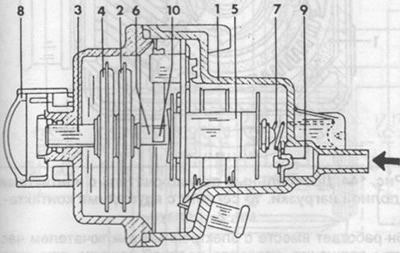
Fig. 136. Intake manifold pressure sensor with altitude correction.
1 - body,
2 - working membrane chamber,
3 - hollow bolt,
4 - membrane chamber for terrain altitude correction,
5 - winding,
6 - anchor,
7 - spring,
8 - plug,
9 - safety valve with throttle-damper,
10 - armature damper.
Impulse switch
Fig. 137 shows a pulse switch that controls the opening of the injectors and the start of injection.
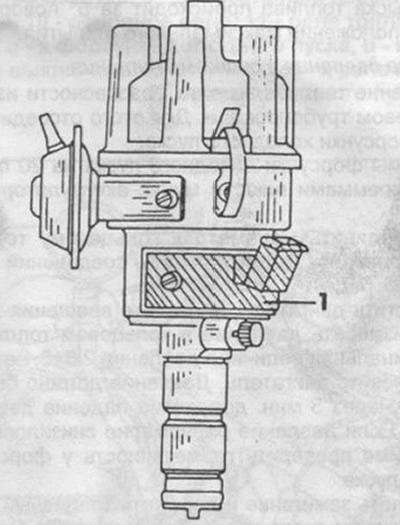
Fig. 137. Ignition distributor with remote impulse switch (1).
A remote pulse switch is located in the lower part of the ignition distributor housing. Two contact switches located at an angle of 180° are actuated by an eccentric on the ignition distributor shaft. Each switch controls the operation of a group of injectors. Fig. 138 shows a section (top view) ignition distributor with built-in impulse switch.
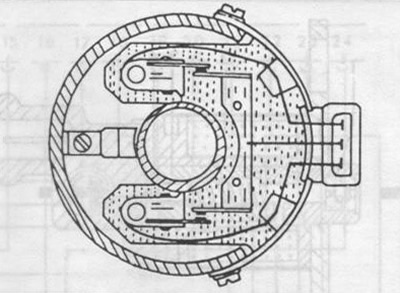
Fig. 138. Movable contact switches.
Temperature sensor
The temperature sensor operates as a resistance, the value of which changes depending on the temperature, and is located in a protective housing with good thermal conductivity. The housing is made in the form of a bolt with a hexagonal head. The sensors measure the temperature of the coolant and air in the intake manifold, and through the control device regulate the fuel supply depending on these parameters. Fig. 139 shows the temperature sensors.
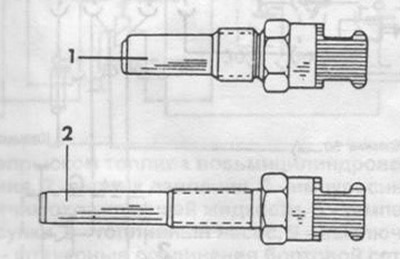
Fig. 139. Temperature sensors.
1 - coolant temperature sensor,
2 - intake manifold air temperature sensor.
Cold start injector
The cold start injector is located on the intake manifold and is connected to the fuel line. The injector is controlled by the ignition switch and a temperature-time switch washed with coolant. When starting a cold engine with a temperature below +35°C, the injector injects an additional amount of finely atomized fuel into the intake manifold. The temperature-time switch limits this process to a temperature below +35°C; as the temperature decreases, the operating time of the cold start injector increases and at -20°C reaches 12 sec. Fig. 140 shows the cold start injector. Fig. 141 shows the injector connection diagram.
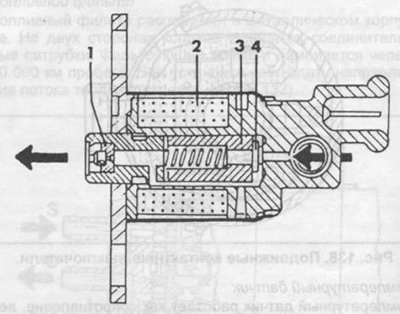
Fig. 140. Cold start injector.
1 - nozzle with thread,
2 - magnet winding,
3 - anchor,
4 - gasket.
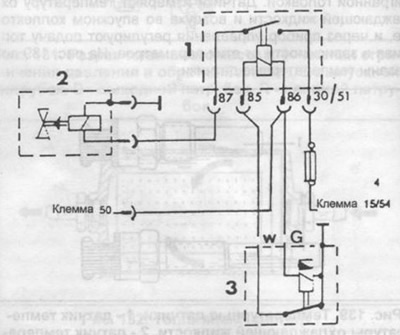
Fig. 141. Cold start injector connection diagram.
1 - relay,
2 - cold start nozzle,
3 - temperature-time switch.
Additional air supply valve
The additional air supply valve is switched on when the engine warms up. Increased fuel consumption is required to overcome internal friction in the engine. The required additional air passes through the filter in the engine compartment, through the control valve bypassing the throttle. The thermal element, washed by the coolant, changes the flow area of the valve and, accordingly, the amount of air depending on the temperature. The valve is fully open below -20°C and fully closes at +65°C. Fig. 143 shows a section of the additional air supply valve.
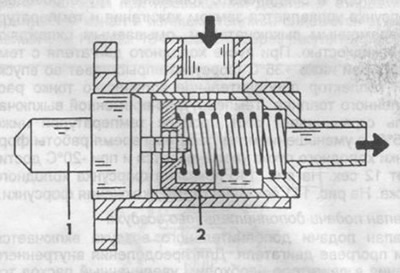
Fig. 143. Additional air supply valve.
1 - thermoelement,
2 - valve.
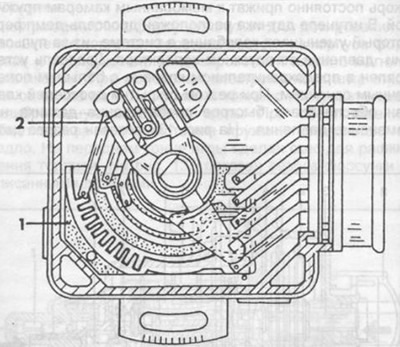
Fig. 144. Throttle switch with full load contacts.
1 - segment with circular contacts,
2 - slider.
It works together with the electronic speed switch, controlling the fuel supply in variable driving mode. The switch lengthens the pulse duration and increases the injection duration in order to compensate for the inertia of the pressure sensor. Ground contacts slide on a segment with several circular contacts, which vary the injection pulse as needed. Ground contacts are connected to a slider, with the help of which only during acceleration the mixture is enriched. The slider provides the mixture composition for the full load mode via double ground contacts at fully open throttle. With this control method, a sharp increase in fuel injection occurs 5° of throttle rotation before the maximum opening position.
Checking the pressure in the fuel system
For safety reasons, the fuel pressure is measured in the ring line. To do this, disconnect the plug from the cold start injector.
The terminals of the cold start injector are connected to the positive and negative terminals of the battery for 20 seconds.
Attach the pressure gauge to the ring fuel line. Check the tightness of the fuel line connections.
Start the engine at idle speed and measure the pressure in the ring fuel line. The nominal pressure value is 2.0+0.1 atm.
Stop the engine. The pressure should be about 1.7 atm. After 5 minutes, a pressure drop to 1.5 atm is permissible. If the pressure has dropped evenly to 0, then it is necessary to check the tightness of the cold start injector
Turn on the ignition and pinch the fuel hose on the cold start injector (see fig. 146). Maintaining fuel pressure is a sign of a leaky injector, and it must be replaced.
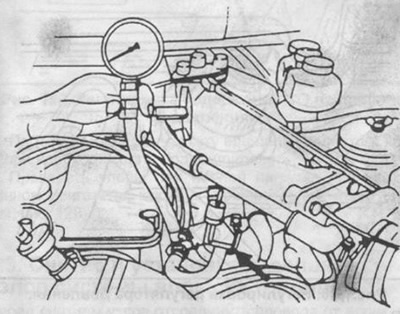
Fig. 146. Checking the cold start injector.
Checking the pressure regulator
Turn on the ignition and after turning off the fuel pump, pinch the fuel drain hose from the regulator. Maintaining fuel pressure is a sign of a leak in the pressure regulator and it must be replaced.
Check the ball valve on the fuel pump outlet fitting.
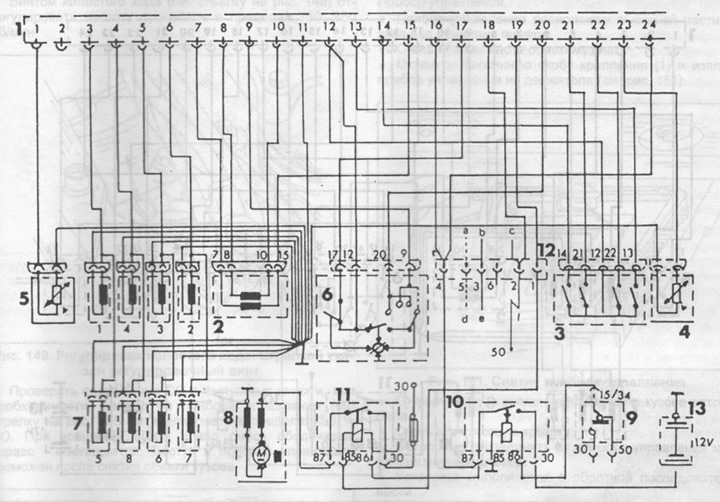
Fig. 142. Wiring diagram of the electronic fuel injection control device of an eight-cylinder engine (350 SE/450 SE).
1 - control device contact strip,
2 - pressure sensor,
3 - pulse switch in the ignition distributor,
4 - coolant temperature sensor,
5 - air temperature sensor,
6 - throttle switch,
7 - nozzles,
8 - fuel pump,
9 - ignition switch,
10 - main relay,
11 - fuel pump relay,
12 - plug connections of the vehicle's on-board network,
a - to the cold start nozzle,
b - to the thermal-time switch terminal W,
c - to the thermal-time switch terminal G,
d - to the cold start relay terminal 87,
e - to the cold start relay terminal 85,
f - to the cold start relay terminal 86,
13 - battery.
Turn on the ignition and after turning off the fuel pump, pinch the fuel supply hose to the damper. If the pressure persists, it is a sign that the fuel pump needs to be replaced.
Checking the injectors
Remove the injectors with the ring fuel line. Release the fastening and remove the control unit under the glove compartment. Remove the fuel pump relay (arrow in Fig. 147) and short-circuit tips 1 and 3. The fuel pump is connected to tip 1. Turn on the ignition and the fuel pump will start working with the engine off.
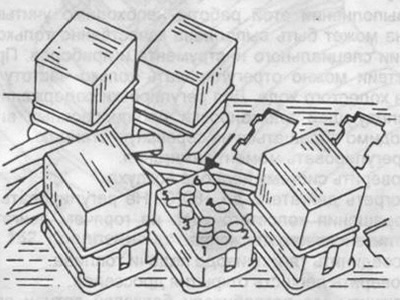
Fig. 147. Checking the injectors.
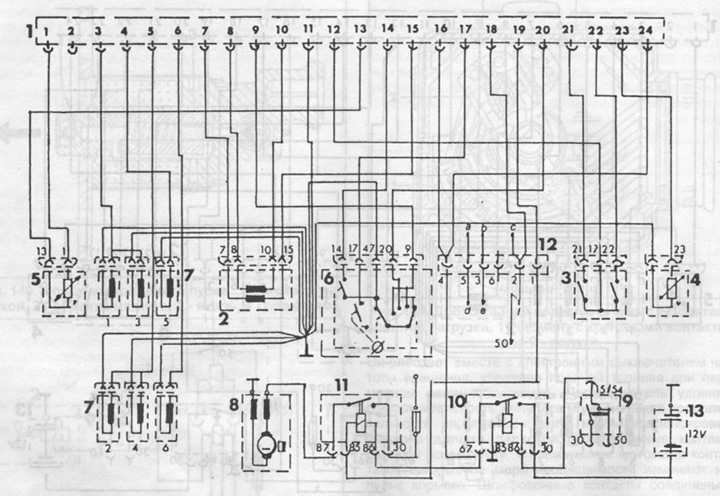
Fig. 145. Wiring diagram of the electronic fuel injection control device for the M110 (280 SE) engine.
1 - control device contact strip,
2 - pressure sensor,
3 - pulse switch in the ignition distributor,
4 - coolant temperature sensor,
5 - air temperature sensor,
6 - throttle switch,
7 - nozzle,
8 - fuel pump,
9 - ignition switch,
10 - main relay,
11 - fuel pump relay,
12 - plug connection of the vehicle's on-board network,
a - to the cold start nozzle,
b - to the thermal-time switch terminal W,
c - to the thermal-time switch terminal G,
d - to the cold start relay terminal 87,
e - to the cold start relay terminal 85,
f - to the cold start relay terminal 86,
13 - battery.
Start the engine at idle speed and adjust the fuel pressure to 2.0+0.1 atm using the screw on the pressure regulator (Fig. 148). If no change in pressure is noted after turning the adjusting screw, the pressure regulator must be replaced. Before removing the pressure gauge, as already indicated, the fuel pressure must be released.
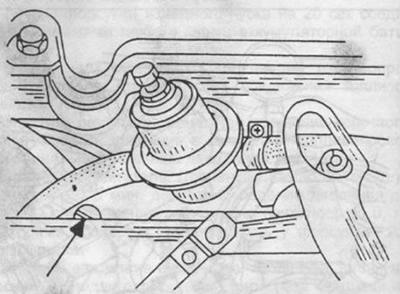
Fig. 148. Adjusting the pressure regulator.