



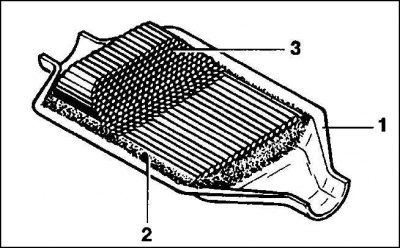
The catalyst body (1) and the tubular connections are made of high-quality steel. The noble metal layer applied to the catalyst promotes additional oxidation of the exhaust gases. The shock-sensitive monolith (3) is fixed with a metal cloth (2).
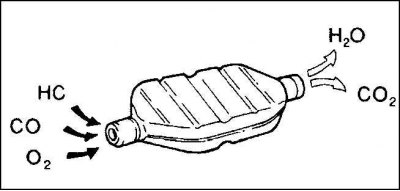
The diesel engine uses a so-called oxidation catalyst. This catalyst oxidizes carbon monoxide (CO) and hydrocarbons (HC) to water (H2O) and carbon dioxide (CO₂), which are harmless to the environment.
When recirculating exhaust gases, some of them are drawn back into the combustion chamber. This reduces the combustion temperature, which leads to less nitrogen oxide (NOx) formation.