



Contents: Maintenance-free battery control ↡ Charging standard and…↡ Charging a maintenance-free battery ↡
Control of standard and maintenance-free batteries
1. If the car has a low annual mileage, it is enough to check the density of the electrolyte every three months to determine the state of charge of the battery. Check the density with a hydrometer and compare the results with the following table. Keep in mind that the density values determined by the hydrometer are correct at an electrolyte temperature of 15°C; for every 10°C below 15°C, subtract 0.007. For every 10°C above 15°C, add 0.007.
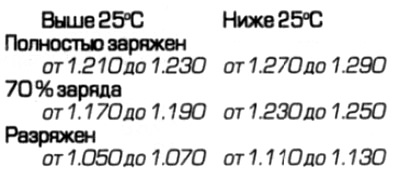
2. If the battery condition is suspect, first check the specific gravity of the electrolyte in each section. A difference of 0.040 or more between any sections indicates loss of electrolyte or destruction of the internal plates.
3. If the difference in specific gravity is 0.040 or more, the battery should be replaced. If the difference between sections is within the normal range but the battery is discharged, it should be charged as specified below in this paragraph.
Maintenance-free battery control
4. If the car has a maintenance-free battery, checking the density of the electrolyte in the sections is impossible. The battery condition in this case can only be checked using a voltmeter or battery condition indicator.
5. Some models are equipped with a maintenance-free battery with a built-in charge indicator. The indicator is located on top of the battery case, and the charge of the latter can be determined by the color of the indicator. If the indicator is green, the battery is well charged. If the indicator darkens, in some cases to black, this means that the battery needs charging (described in this paragraph below). If the indicator turns solid yellow, it means the electrolyte level is below the acceptable limit and the battery needs to be replaced. Do not attempt to charge, top up or jump start another battery when the battery indicator is yellow.
6. When testing the battery using a voltmeter, connect the voltmeter to the battery terminals and compare the result with the voltage values stated in the "Technical data" section under the heading "State of charge". The test results will only be accurate if the battery has not been charged for the previous six hours. If this is not the case, turn on the headlights for 30 seconds, then wait four to five minutes, after which you can test the battery. All electrical consumers must be switched off, in particular, check that the interior and trunk doors are properly closed.
7. If the voltage shown by the voltmeter is below 12.2 V, then the battery is discharged; a voltage between 12.2 and 12.4 V indicates a partially discharged state.
8. To charge the battery, remove it from the vehicle (paragraph 3) and charge as described below in this paragraph.
Charging standard and low-maintenance batteries
Note: The steps below should be considered as a general guide only, please refer to the manufacturer's instructions before charging (usually included with the battery) and follow its recommendations, even if they differ from those described in this book.
9. Charge the battery with a current of 3.5-4 amperes until the density of the electrolyte stops increasing within four hours.
10. Alternatively, you can leave the battery on a continuous charge with a current of 1.5 amperes all night - this is completely safe for the battery.
11. Too fast, forced charging, allowing the battery capacity to be restored in 1-2 hours, is not recommended, as it can cause serious damage to the battery plates due to overheating.
12. When charging the battery, ensure that the electrolyte temperature never exceeds 40°C.
Charging a maintenance-free battery
Note: The steps below should be considered as a general guide only: please refer to the manufacturer's instructions before charging (usually included with the battery) and follow its recommendations, even if they differ from those described in this book.
13. This type of battery takes significantly longer to fully charge than a standard type battery. The actual time depends on the level of discharge and can be up to three days.
14. A constant voltage charger is required for charging. Once connected, it should be set to a voltage of 13.9 to 14.9 volts with a charging current of up to 25 amps. This will bring the battery to working condition within three hours, bringing its output voltage to 12.5 volts, but this is only a partially charged state. A full charge, as noted above, may take considerably longer.
15. If the battery needs to be charged from a completely discharged state (from voltage at terminals below 12.2 V), it is recommended to entrust this work to a battery specialist, since in this case the charge occurs at a high current and the battery requires constant monitoring.